Pre-Reading
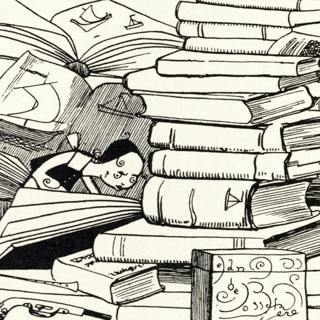
In this episode of High Theory, Milan Terlunen talks to Kim about Pre-Reading. There are many books we will never read and films we will never watch, but it turns out we know quite a bit about them in advance. A concept developed in his work on the plot twist, pre-reading names the epistemic practices by which we approach a text before we read it (if we ever do). The pre-reading environment is shared, social knowledge that shapes our expectations long before we open the cover or hit play. This podcast episode forms part of the pre-reading environment for Milan’s article, "What We Can(’t) Know Before We Read: Towards a Theory of the Pre-Reading Environment" (Book History 27, no. 2 (2024): 346-374). The article proposes the Pre-Reading Environment as a new object of study for understanding how texts relate to communal knowledge. While easily overlooked by scholars, equipped with fuller knowledge derived from their own reading, Pre-Reading Environments are among the most widespread epistemic objects in book history. Turning to two literary texts, Agatha Christie’s The Murder of Roger Ackroyd (1926) and Hanya Yanagihara’s A Little Life (2015), the article examines how their respective Pre-Reading Environments, in newspapers and on Twitter, strategically concealed key plot points that might pre-emptively spoil the experience of potential readers. The transcript of this episode lives here as a WordDoc and here as a PDF. Milan Terlunen is a scholar of literature, with a focus on narrative and the history of reading practices. He works as a Researcher in Digital Humanities at the University of Sussex. While a PhD student at Columbia University he co-created and hosted two podcasts – How To Read and In Sacred Spaces – and co-founded the Humanities Podcast Network in 2021, where he met Kim and Saronik. He is also an editor of the Palgrave Handbook of Humanities Podcasting, a huge project that he ran along with Kim, Saronik, and Beth Kramer. A book about podcasting would not be complete without its own podcast. Keep your ears peeled for Podcasting the Humanities later this year. The image for this episode is an illustration from Jean de Bosschère’s Weird Islands (1921), titled “Read Books on Practical Navigation.” It is a line drawing showing a reader swamped by piles of books. The image was found for High Theory by Lili Epstein on the Public Domain Image Archive. Learn more about your ad choices. Visit megaphone.fm/adchoices Support our show by becoming a premium member! https://newbooksnetwork.supportingcast.fm/critical-theory

Episoder(2208)

Mark Pennington, "Foucault and Liberal Political Economy: Power, Knowledge, and Freedom" (Oxford UP, 2025)

Mark Pennington, "Foucault and Liberal Political Economy: Power, Knowledge, and Freedom" (Oxford UP, 2025)

Foucault and Liberal Political Economy: Power, Knowledge, and Freedom by Mark Pennington This highly original and innovative book is the first to comprehensively engage the ideas of the French social...

30 Mar 58min

Ainehi Edoro, "Forest Imaginaries: How African Novels Think" (Columbia UP, 2026)

Ainehi Edoro, "Forest Imaginaries: How African Novels Think" (Columbia UP, 2026)

Forests in fiction are often understood simply as settings, symbols, or remnants of a premodern past. Yet many African novelists have turned to the forest to experiment with worldbuilding and to imagi...

30 Mar 1h 2min

Emmanuel Ofuasia, "Ìwà: the Process-Relational Dimension to African Metaphysics" (Springer, 2024)

Emmanuel Ofuasia, "Ìwà: the Process-Relational Dimension to African Metaphysics" (Springer, 2024)

Correction: In the interview, the host mistakenly mentioned that Prof. Ofuasia is teaching the University of Pretoria. In reality, Prof Ofuasia is currently a decoloniality research associate at the U...

29 Mar 1h 31min

Thomas Hegghammer and Diego Gambetta eds., "Fight, Flight, Mimic: Identity Mimicry in Conflict" (Oxford UP, 2024)

Thomas Hegghammer and Diego Gambetta eds., "Fight, Flight, Mimic: Identity Mimicry in Conflict" (Oxford UP, 2024)

Time spent and words spent—what does each signal? Deceptive mimicry—the manipulation of individual or group identity—includes passing off as a different individual, as a member of a group to which on...

28 Mar 1h 5min

The Criminal Record Complex: Risk, Race, and the Struggle for Work in America

The Criminal Record Complex: Risk, Race, and the Struggle for Work in America

Most employers in the United States routinely conduct criminal background checks on job applicants, weeding out those with criminal convictions—and thus denying opportunities to those who need them m...

26 Mar 54min

Hsuan L Hsu, "Olfactory Worldmaking" (U Minnesota Press, 2026)

Hsuan L Hsu, "Olfactory Worldmaking" (U Minnesota Press, 2026)

Smell is a vital, if underappreciated, medium through which we inhabit and imagine the world. In Olfactory Worldmaking (University of Minnesota Press, 2026), Dr. Hsuan L. Hsu traces how olfactory expe...

24 Mar 26min
Prolepsis

Prolepsis

In this episode of High Theory, Gloria Fisk talks to Kim about Prolepsis. Defined by Gerard Genette in the 1970s, prolepsis is a flash forward, the opposite of analepsis, a flash back. Initially the p...

23 Mar 16min

Populært innen Vitenskap

fastlegen
rekommandert
jss
tingenes-tilstand
liberal-halvtime
sinnsyn
rss-rekommandert
forskningno
tomprat-med-gunnar-tjomlid
rss-nysgjerrige-norge
villmarksliv
dekodet-2
fjellsportpodden
rss-paradigmepodden
smart-forklart
kvinnehelsepodden
tidlose-historier
nevropodden
utenrikshospitalet
rss-lundqvist-podden