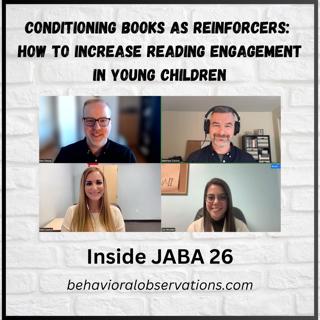

Conditioning Books as Reinforcers: How to Increase Reading Engagement in Young Children: Inside JABA 26

Conditioning Books as Reinforcers: How to Increase Reading Engagement in Young Children: Inside JABA 26

Episode Summary

In this episode, I'm joined by Dr. Daniel Fienup, Dr. Kate Loomis, and Lilian Morales to discuss their recent paper in JABA, Turning the Page: Increasing children's preference for looking at and engaging with books.

In this episode, we explore how books can function as powerful reinforcers for young children, especially in early learning and ABA contexts. We discuss how to identify when books are actually reinforcing, how to condition books as reinforcers if they're not already, and practical strategies for incorporating them into teaching and behavior support.

Key Topics Covered 1. What Makes Something a Reinforcer?
  • Reinforcers are defined by their effect on behavior—not by intention

  • A book is only a reinforcer if it increases the likelihood of a behavior

  • Preference ≠ reinforcement (must test it)

2. Are Books Naturally Reinforcing?
  • For some children: yes (especially those with strong interest in stories, visuals, or routines)

  • For others: books may be neutral or even aversive

  • Depends on learning history and prior pairing

3. Conditioning Books as Reinforcers
  • Pair books with already-established reinforcers (e.g., attention, snacks, praise)

  • Make reading interactive and engaging (voices, movement, pointing, questions)

  • Start with short durations and build up tolerance/enjoyment

  • Follow the child's lead (let them turn pages, choose books, etc.)

4. Embedding Books into Teaching
  • Use books as part of discrete trial or natural environment teaching

  • Reinforce responses with brief access to a favorite book

  • Incorporate targets into reading (labeling, WH questions, listener responding)

  • Use repeated readings to build fluency and predictability

5. Expanding Reinforcer Repertoires
  • Why it matters: reduces reliance on edibles or screens

  • Books are portable, social, and developmentally beneficial

  • Helps build early literacy and joint attention skills

6. Common Mistakes
  • Assuming all kids like books

  • Using books too long as a reinforcer (loses value)

  • Not rotating or updating book options

  • Ignoring signs of disengagement

7. Practical Tips
  • Keep a small "high-value" book rotation

  • Use novelty strategically

  • Observe what aspects the child enjoys (pictures, repetition, sensory elements)

  • Track what actually increases responding

Takeaways
  • Books can absolutely function as reinforcers—but only if conditioned or preferred

  • Pairing and engagement are key to building their value

  • Using books as reinforcers supports both behavior change and language development

Resources

Episoder(332)

Supporting Health and Wellness in Developmental Disabilities: Session 330: Brandon May, Maggie Pavone, and Kate Heersink

Supporting Health and Wellness in Developmental Disabilities: Session 330: Brandon May, Maggie Pavone, and Kate Heersink

In this episode, I'm joined by Drs. Brandon May and Maggie Pavone, and Kate Heersink to talk about how we can better support healthier lifestyles for individuals with developmental disabilities. We st...

25 Apr 1h 13min

Train Smarter, Not Harder: Heart Rate Zones, VO2 Max, and Better Fitness: Session 329 with Nick Green

Train Smarter, Not Harder: Heart Rate Zones, VO2 Max, and Better Fitness: Session 329 with Nick Green

In Session 329, I'm joined once again by Dr. Nick Green, Ph.D., BCBA-D, who's been doing some really interesting work at the intersection of fitness and behavior science. In this episode, Nick walks u...

8 Apr 1h 1min

Comportamiento, espacio y algoritmos: Análisis de la conducta recargado, BOP en Español 17 con Alejandro León

Comportamiento, espacio y algoritmos: Análisis de la conducta recargado, BOP en Español 17 con Alejandro León

Comportamiento, espacio y algoritmos: Análisis de la conducta recargado En este episodio de Espacio y Comportamiento, Miguel Avila conversa con Alejandro León sobre una dimensión del comportamiento qu...

20 Mar 1h 9min

The 2025 Verbal Behavior Conference Panel Discussion: Session 326

The 2025 Verbal Behavior Conference Panel Discussion: Session 326

Thanks for joining me for Session 326 of The Behavioral Observations Podcast. This episode was recorded live at the 2025 Verbal Behavior Conference, where I had the honor of moderating the annual pane...

11 Mar 59min

Developing Rapport and Sustaining Motivation in Autism Treatment: Session 325 with Alice Shillingsburg

Developing Rapport and Sustaining Motivation in Autism Treatment: Session 325 with Alice Shillingsburg

In this episode, I talk with Dr. Alice Shillingsburg about her work on rapport building and pairing procedures in applied behavior analysis for children with autism. We explore how building therapeuti...

23 Feb 1h 5min

Resilience Is a Skill — Raising Capable Kids in a Fragile World: Session 324 with Paulie Gavoni and Steve Ward

Resilience Is a Skill — Raising Capable Kids in a Fragile World: Session 324 with Paulie Gavoni and Steve Ward

In Session 324, Dr. Paulie Gavoni and Steve Ward join me to discuss what resilience actually looks like from a behavior science perspective — and why many well-intentioned adult responses can unintent...

13 Feb 1h 21min

Building Clinical Excellence in Autism Services: How Apollo Trains and Supports RBTs and BCBAs - Session 322

Building Clinical Excellence in Autism Services: How Apollo Trains and Supports RBTs and BCBAs - Session 322

In this episode of the Behavioral Observations Podcast, I'm joined by Kim Dean, founder of Apollo Behavior, and Kristen Vaughn, Vice President of Clinical Operations, to talk about what it really take...

30 Jan 1h 1min

Populært innen Vitenskap

fastlegen
tingenes-tilstand
jss
liberal-halvtime
forskningno
rekommandert
sinnsyn
tomprat-med-gunnar-tjomlid
rss-paradigmepodden
villmarksliv
rss-overskuddsliv
tidlose-historier
fjellsportpodden
nevropodden
rss-inn-til-kjernen-med-sunniva-rose
nordnorsk-historie
dekodet-2
kvinnehelsepodden
rss-nysgjerrige-norge
diagnose