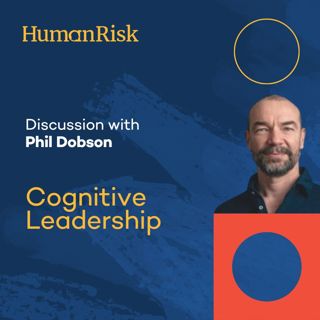
Phil Dobson on Cognitive Leadership

Phil Dobson on Cognitive Leadership

We tend to assume that if we’re working hard, we’re working well. But what if that isn’t true?

Episode Summary
My guest on this episode is Phil Dobson, author of The Brain Book and founder of Brain Workshops, about what he calls 'cognitive leadership': using neuroscience and psychology to help people sustain performance, think more clearly, and navigate uncertainty. Phil explains how a broken ankle led him from music and sales into hypnotherapy, neuroscience, and leadership development, and why he believes most of us are never properly taught how our brains actually work.

In a wide-ranging discussion, we explore the difference between productivity and effectiveness, why attention may be our most valuable asset, and how modern working life often undermines flow, creativity, and good decision-making. We also discuss stress, workload, digital distraction, the limits of measurement, and what organisations get wrong when they try to manage people as if more time always equals more value.

Discover how leaders can create better conditions for thinking, resilience, creativity, and change; and why understanding the human brain matters far beyond the workplace.

Episode Summaruy
  • why most of us are taught far too little about how our brains work
  • Phil’s unusual route from musician to hypnotherapist to neuroscience-based leadership adviser
  • the difference between being productive and being effective
  • why self-employment sharpened Phil’s focus on impact rather than activity
  • how experimentation, iteration, and reflection shape better ways of working
  • the distinction between fun and fulfilment
  • flow states and why modern life makes them harder to access
  • the growing importance of attention in a world of distraction
  • why stress management has to include workload management, not just breathing techniques
  • how rest, breaks, and so-called “unproductive” time often drive insight and creativity
  • why measuring people too narrowly can damage performance
  • how understanding the brain helps leaders navigate change and uncertainty
  • why improving human decision-making matters not just for performance, but for reducing costly mistakes
AI-Generated Timestamped Summary
00:00 — Introduction: busyness vs effectiveness
02:00 — Phil’s journey into cognitive leadership
07:00 — Productivity vs effectiveness (and the 80/20 shift)
12:00 — Experimentation, habits, and fulfilment
17:00 — Flow, focus, and attention under pressure
22:00 — Attention as a critical (and under threat) asset
27:00 — Why knowing isn’t the same as doing
31:00 — Rethinking productivity: energy, creativity, and insight
36:00 — The neuroscience of better thinking (default mode network)
40:00 — Measurement, management, and leadership challenges
45:00 — Human performance beyond the workplace
50:00 — Human error, decision-making, and risk
55:00 — Evolving work: shorter weeks and smarter working
58:00 — Leading change with a brain-based approach
01:03:00 — Final reflections and closing

Relevant Links
Phil's website - https://phildobson.com/

Brain Workshops - https://brainworkshops.co.uk/

Phil on LinkedIn - https://www.linkedin.com/in/brainworkshops/

The Brain Book - https://www.amazon.com/Brain-Book-Smarter-Concise-Advice/dp/1910649732

Denne episoden er hentet fra en åpen RSS-feed og er ikke publisert av Podme. Den kan derfor inneholde annonser.

Episoder(368)

Will Tarrant on Service: Closing the gap between brand promise and reality

Will Tarrant on Service: Closing the gap between brand promise and reality

What makes great service? It’s one of those things we instantly recognise when we experience it, but struggle to define. And while organisations spend huge amounts of time trying to design seamless cu...

8 Mai 1h

Dr Carissa Véliz on Prophecy

Dr Carissa Véliz on Prophecy

What if prediction isn’t about knowing the future, but controlling it?  On this episode, I'm joined by a leading thinker on digital ethics, privacy and technology to explore the idea of prophecy.Episo...

25 Apr 1h 2min

Dr C Thi Nguyen on How to stop playing someone else's game

Dr C Thi Nguyen on How to stop playing someone else's game

We like to think we choose what matters. But what if the goals we’re chasing… aren’t actually ours?Episode Summary My guest on this episode is Dr. C. Thi Nguyen, philosopher and author of The Score: H...

12 Apr 1h 8min

Professor Mark Stoyle on The Western Rising of 1549

Professor Mark Stoyle on The Western Rising of 1549

What lessons does a religious protest that led to an uprising  in 1549 have to do with human risk?At first glance, not very much. It’s easy to see it as a distant historical event — something about re...

22 Mar 1h 4min

Jeffrey Ludlow on What A Sign Is...

Jeffrey Ludlow on What A Sign Is...

What exactly is a sign?  At first glance, that might sound like a strange question. Signs are everywhere: telling us where to go, what to do, what not to do, and sometimes what might happen if we igno...

14 Mar 1h 4min

Marc Ross on The Art of The Negroni

Marc Ross on The Art of The Negroni

What Can a Cocktail Teach Us About Curiosity and Creativity? At first glance, documenting Negronis around the world might sound like a frivolous hobby. But could a simple cocktail become a vehicle for...

7 Mar 45min

Tom & Sue Hardin On Wired On Wall Street

Tom & Sue Hardin On Wired On Wall Street

What’s the difference between a mistake… and a bad decision? My guest knows this only too well. Tom Hardin has been on the show several times before. As Tipper X, he wore a wire for the FBI and helped...

28 Feb 1h 15min

Populært innen Vitenskap

fastlegen
tingenes-tilstand
jss
forskningno
rss-zahid-ali-hjelper-deg
rekommandert
rss-paradigmepodden
sinnsyn
liberal-halvtime
vett-og-vitenskap-med-gaute-einevoll
rss-overskuddsliv
kvinnehelsepodden
nordnorsk-historie
tidlose-historier
villmarksliv
grunnstoffene
rss-inn-til-kjernen-med-sunniva-rose
nevropodden
noen-har-snakket-sammen
fjellsportpodden