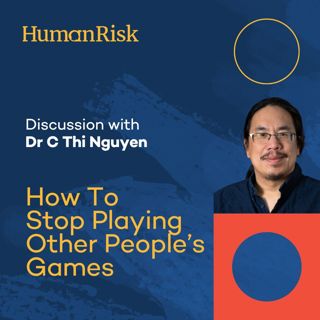
Dr C Thi Nguyen on How to stop playing someone else's game

Dr C Thi Nguyen on How to stop playing someone else's game

We like to think we choose what matters. But what if the goals we’re chasing… aren’t actually ours?

Episode Summary
My guest on this episode is Dr. C. Thi Nguyen, philosopher and author of The Score: How to Stop Playing Somebody Else’s Game, a book about how metrics, scoring systems, and “games” shape our behaviour—often without us realising it. Thi explains how his work on games led him to a deeper question: why do scoring systems make games feel meaningful, but make real life feel distorted? The answer lies in how metrics redefine success—quietly shifting us from what we care about to what we can measure.

In a wide-ranging discussion, we explore the idea of “value capture”, why institutions rely on simplified proxies, and how the very features that make metrics useful also make them dangerous. We also discuss expertise, transparency, gamification, and why removing metrics altogether doesn’t solve the problem. This is a conversation about control: who sets the rules, who keeps score, and what happens when we stop questioning the game we’re playing.

Guest Bio
Dr. C. Thi Nguyen is a philosopher whose work explores how games, metrics, and social systems shape human behaviour and values. A professor of philosophy at the University of Utah, his research sits at the intersection of ethics, decision-making, and the philosophy of agency, with a particular focus on how the structures around us influence what we care about and how we act.

Alongside his academic work, Thi is also a keen gamer, rock climber, and cook; interests that inform his thinking about play, challenge, and the richness of human experience beyond what can be easily measured.

AI-Generated Timestamped Summary
00:00 – Introduction: games, metrics, and meaning
03:00 – How Thi came to study games and philosophy
07:00 – What games are (and why they matter)
10:00 – Achievement vs striving play
13:00 – Cheating and misunderstanding the point of games
16:00 – Games, struggle, and meaningful activity
18:00 – Cooking, recipes, and rules
22:00 – Metrics as simplified rule systems
25:00 – Value capture and how metrics reshape goals
29:00 – Why institutions rely on measurement
32:00 – Quantification and loss of context
36:00 – Rules, algorithms, and expertise
40:00 – Standardisation and the cost of consistency
43:00 – Transparency, trust, and unintended consequences
47:00 – Metrics and the loss of expert judgment
50:00 – Ungrading and the limits of removing metrics
54:00 – Designing better scoring systems
58:00 – Gamification and why it misses the point
01:02:00 – Choosing your own game
01:06:00 – Final reflections and closing

Relevant Links

Thi’s personal website – https://objectionable.net/
His faculty page - https://profiles.faculty.utah.edu/u6021584
The Score: How to Stop Playing Someone Else’s Game - https://www.penguin.co.uk/books/457380/the-score-by-nguyen-c-thi/9780241653975
Thi on Bluesky – https://bsky.app/profile/add-hawk.bsky.social

Denne episoden er hentet fra en åpen RSS-feed og er ikke publisert av Podme. Den kan derfor inneholde annonser.

Episoder(368)

Will Tarrant on Service: Closing the gap between brand promise and reality

Will Tarrant on Service: Closing the gap between brand promise and reality

What makes great service? It’s one of those things we instantly recognise when we experience it, but struggle to define. And while organisations spend huge amounts of time trying to design seamless cu...

8 Mai 1h

Dr Carissa Véliz on Prophecy

Dr Carissa Véliz on Prophecy

What if prediction isn’t about knowing the future, but controlling it?  On this episode, I'm joined by a leading thinker on digital ethics, privacy and technology to explore the idea of prophecy.Episo...

25 Apr 1h 2min

Phil Dobson on Cognitive Leadership

Phil Dobson on Cognitive Leadership

We tend to assume that if we’re working hard, we’re working well. But what if that isn’t true?Episode SummaryMy guest on this episode is Phil Dobson, author of The Brain Book and founder of Brain Work...

4 Apr 1h 9min

Professor Mark Stoyle on The Western Rising of 1549

Professor Mark Stoyle on The Western Rising of 1549

What lessons does a religious protest that led to an uprising  in 1549 have to do with human risk?At first glance, not very much. It’s easy to see it as a distant historical event — something about re...

22 Mar 1h 4min

Jeffrey Ludlow on What A Sign Is...

Jeffrey Ludlow on What A Sign Is...

What exactly is a sign?  At first glance, that might sound like a strange question. Signs are everywhere: telling us where to go, what to do, what not to do, and sometimes what might happen if we igno...

14 Mar 1h 4min

Marc Ross on The Art of The Negroni

Marc Ross on The Art of The Negroni

What Can a Cocktail Teach Us About Curiosity and Creativity? At first glance, documenting Negronis around the world might sound like a frivolous hobby. But could a simple cocktail become a vehicle for...

7 Mar 45min

Tom & Sue Hardin On Wired On Wall Street

Tom & Sue Hardin On Wired On Wall Street

What’s the difference between a mistake… and a bad decision? My guest knows this only too well. Tom Hardin has been on the show several times before. As Tipper X, he wore a wire for the FBI and helped...

28 Feb 1h 15min

Populært innen Vitenskap

fastlegen
tingenes-tilstand
jss
forskningno
rss-zahid-ali-hjelper-deg
rekommandert
rss-paradigmepodden
sinnsyn
liberal-halvtime
vett-og-vitenskap-med-gaute-einevoll
rss-overskuddsliv
kvinnehelsepodden
nordnorsk-historie
tidlose-historier
villmarksliv
grunnstoffene
rss-inn-til-kjernen-med-sunniva-rose
nevropodden
noen-har-snakket-sammen
fjellsportpodden