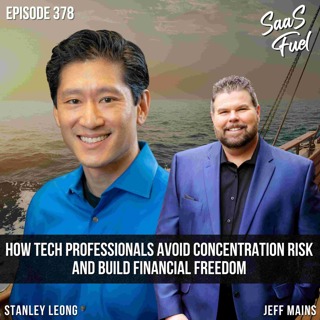
How Tech Professionals Can Avoid Concentration Risk and Build Financial Freedom | Stanley Leong | 378
SaaS Fuel9 Apr

How Tech Professionals Can Avoid Concentration Risk and Build Financial Freedom | Stanley Leong | 378

In this episode, Jeff Mains sits down with Stanley Leong — former IBM/Agilent engineer turned bestselling author and private wealth advisor — to explore what it truly means to engineer your finances. Stanley brings his analytical, systems-driven engineering background to personal wealth building, and the result is a refreshingly practical framework for tech founders and high-income professionals who are great at running businesses but often treat their personal finances as an afterthought.

Stanley shares how getting laid off the day after buying his first house sent him on an unexpected 20-year journey into financial planning. He explains why concentration risk (too much wealth in one stock or one company) is the #1 mistake he sees among tech professionals, why investment management is really risk management, and how the key question every investor should ask first is "What if I'm wrong?" The conversation also dives deep into underutilized tax strategies — including the Mega Backdoor Roth and the HSA as a stealth retirement account — and wraps with a powerful discussion on aligning money with purpose and preparing emotionally for life after a liquidity event.

Key Takeaways

4:10 — From Chips to Cashflow: Stanley's Origin Story Stanley was laid off the day after buying his first house. Frustrated by conflicting advice and no clear answers, he pivoted from engineering to financial planning — and discovered he could serve others facing the same confusion.

7:24 — What "Engineering Your Finances" Actually Means Stanley applies the same systematic, process-oriented thinking he used as an engineer to personal finance. His "Wealth Focus Model" structures client meetings around specific, scheduled topics — goal tracking, protection planning, taxes, and investment strategy.

9:02 — Concentration Risk: The #1 Mistake Tech Founders Make Too much net worth tied up in a single stock, employer equity, or your own company is the most common and dangerous financial mistake. Tech founders are especially vulnerable — success can quietly become massive exposure.

15:19 — How to Think About When to Diversify Start with your goal (e.g., retire at 60), work backward to determine how much you need to set aside in diversified investments, and then let the rest work harder in higher-risk/higher-reward vehicles. This keeps you on track even if the concentrated bet doesn't pay off.

17:10 — Investment Management Is Really Risk Management Most people think investing is about making money. Stanley reframes it: the job is to manage risk first, then optimize returns. That mindset shift is what separates investors from gamblers.

18:10 — The Investor's First Question: "What If I'm Wrong?" Before committing capital to anything, ask what happens if the investment doesn't go your way — and whether you can live with that outcome. Gamblers ask "How much can I make?" Investors ask "What's the downside?"

20:34 — Tax Diversification: Build Three Buckets Prepare for an uncertain tax future by spreading wealth across three types of accounts: pre-tax (traditional 401k), after-tax Roth (tax-free growth and withdrawals), and taxable brokerage. Having optionality across tax buckets is just as important as investment diversification.

22:44 — The Mega Backdoor Roth: A Largely Unknown Strategy High earners who can't contribute directly to a Roth IRA can use a little-known third 401k contribution type — after-tax contributions — to funnel an additional $20–40K/year into a Roth position. The key: don't forget to actually convert the after-tax contributions to Roth.

27:45 — The HSA: The Most Tax-Efficient Account Nobody Maxes Out The Health Savings Account beats every other tax-advantaged vehicle: pre-tax contributions, tax-deferred growth, and tax-free withdrawals. The strategy: don't use it for current healthcare costs — let it grow, save your receipts, and reimburse yourself decades later tax-free.

32:44 — The Retirement Tax Window Many Miss Many high earners experience a brief "tax valley" in early retirement — income drops before RMDs and Social Security kick in. Use that window to convert pre-tax retirement accounts to Roth at a very low (sometimes 0%) rate before required minimum distributions force higher taxes.

36:19 — Money Without Purpose Has No Value Stanley's first question to every new client: "What is the purpose of this money?" Clear goals — not just "retire someday," but where, with whom, doing what — make risk evaluation real and decisions intentional.

39:10 — Life After a Liquidity Event: The Emotional Preparation The financial transition is only part of the story. Founders who retire or exit without a clear vision for what comes next often struggle. Start forming that post-exit identity before the event — read, talk to others, explore — so you're moving toward something, not just away from work.

42:17 — Financial Independence ≠ Retirement The better framing is "financial independence" — the freedom to work on your own terms. One of Stanley's clients realized he loved his job the moment he knew he didn't have to be there anymore. The ability to walk away is sometimes more valuable than walking away.

Tweetable Quotes"You should want to pay more capital gains tax than anyone you know — because that means you've made more money than anyone you know." — Stanley Leong"Investment management sounds cooler, but we're really risk managers. The focus on risk is what defines an investor versus a gambler." — Stanley Leong"A gambler's first question is 'How much money am I going to make?' A good investor's first question is always 'What if I'm wrong?'" — Stanley Leong"Money without purpose has no value." — Stanley Leong"Success can quietly turn into massive exposure. Diversification isn't about fear — it's about freedom." — Stanley Leong"Don't be afraid to pay capital gains tax. It means you made money. The more you pay, the more you made." — Stanley Leong"Financial independence doesn't mean you stop. It means you're still living your life — just maybe in a different way." — Stanley Leong"Start forming your post-retirement vision while you're still working — it's a lot easier to dream when you're not already in it." — Stanley LeongSaaS Leadership Lessons

1. Engineer Your Systems, Not Just Your Product The same discipline you apply to software architecture belongs in your financial life. Build repeatable, scheduled processes around your wealth — don't wing it. A systematic approach to finances compounds over time just like good code.

2. Concentration Is a Silent Risk As founders, your identity and your net worth are often tied to one thing: your company. That's a risk management problem, not a success story. The most dangerous financial position isn't losing — it's winning so much in one place that you forget you're exposed.

3. Reframe Risk Before You Reach for Returns Before you invest in anything — a new product line, a strategic hire, a side bet — ask "What if I'm wrong?" Not just "What's the upside?" Embedding this question into your leadership culture protects the company as much as the balance sheet.

4. Build Optionality Into Everything — Including Taxes High-growth founders often optimize for today's tax savings and ignore tomorrow's flexibility. Diversifying across tax buckets (pre-tax, Roth, taxable) gives you options in an unpredictable future. The same principle applies to your cap table, your customer base, and your revenue streams.

5. Purpose Drives Better Decisions at Every Stage Vague goals produce vague results. Whether you're managing a P&L or a portfolio, specificity creates accountability. "Retire at 60 to travel Europe with my family" is a strategy. "Someday retire" is a wish. Build toward something concrete.

6. Financial Independence Is a Better Goal Than Exit The most underrated outcome of building a great company isn't the exit — it's the freedom to choose. Many founders discover they love the work once they no longer have to do it. Design your financial life so you work because you want to, not because you have to.

Guest Resources

Stan@engineeringyourfinancesbook.com

www.engineeringyourfinancesbook.com

Episode Sponsor

The Futureproof Series - https://www.youtube.com/playlist?list=PLfkXKUPZ5xuOqMPR7_gzGybncTtavyR1N

The Captain's Keys

Small Fish, Big Pond – https://smallfishbigpond.com/ Use the promo code ‘SaaSFuel’

Champion Leadership Group – https://championleadership.com/

SaaS Fuel Resources

Website - https://championleadership.com/

Jeff Mains on LinkedIn -

Episoder(385)

Overcoming Fear in Sales and Entrepreneurship: How to Build Confidence and Take Action | Jim Effner | 384

Overcoming Fear in Sales and Entrepreneurship: How to Build Confidence and Take Action | Jim Effner | 384

Jeff Mains sits down with Jim Effner, founder of P2P Group and a 36-year veteran of Northwestern Mutual, where he grew a firm from 63 to 127 financial advisors and nearly 400 total staff before sellin...

30 Apr 44min

The Future of Legacy: How AI Can Preserve Your Story Forever | Brian Will | 383

The Future of Legacy: How AI Can Preserve Your Story Forever | Brian Will | 383

Brian Will — Wall Street Journal bestselling author, serial entrepreneur, and founder/CEO of Living Forever AI — joins host Jeff Mains for a wide-ranging conversation on entrepreneurship, scaling, sal...

28 Apr 43min

How to Use AI Effectively: Smarter Ways to Work and Scale Your Business | Steve Wunker | 382

How to Use AI Effectively: Smarter Ways to Work and Scale Your Business | Steve Wunker | 382

What if AI isn't just a tool to plug into your business — but a reason to redesign the entire thing? In this episode, Jeff Mains sits down with Steven Wunker, managing director of New Markets Advisors...

23 Apr 48min

New Competitive Moats in AI: Why Trust and Relationships Matter More Than Ever | Nikki Barua | 381

New Competitive Moats in AI: Why Trust and Relationships Matter More Than Ever | Nikki Barua | 381

Nikki Barua — immigrant, serial entrepreneur, and CEO of Flip Work — joins Jeff Mains for a conversation on what it truly takes to build something outsized in the AI age. Drawing on two decades of exp...

21 Apr 45min

Ship, Learn, Repeat: The Real Growth Strategy for Startup Founders | Mike Collins | 380

Ship, Learn, Repeat: The Real Growth Strategy for Startup Founders | Mike Collins | 380

Mike Collins is a serial entrepreneur turned venture capitalist who has spent his career at the intersection of technology, innovation, and investing. Starting at a VC firm right out of college in 198...

16 Apr 52min

How to Turn Customers into Brand Advocates and Drive Word-of-Mouth Growth | Ken Rapp | 379

How to Turn Customers into Brand Advocates and Drive Word-of-Mouth Growth | Ken Rapp | 379

Most SaaS founders obsess over acquisition — but what happens after the sale is where loyalty is either built or silently lost. In this episode, Jeff Mains sits down with Ken Rapp, CEO and co-founder ...

14 Apr 46min

AI and Emotional Intelligence: Finding the Balance in Modern Research | James Warren | 377

AI and Emotional Intelligence: Finding the Balance in Modern Research | James Warren | 377

What if the most valuable data in your company isn't in a dashboard — it's buried in stories no one is asking for?In this episode, Jeff Mains sits down with James Warren, founder and CEO of Share More...

7 Apr 52min

Populært innen Business og økonomi

stopp-verden
lydartikler-fra-aftenposten
dine-penger-pengeradet
e24-podden
rss-penger-polser-og-politikk
rss-borsmorgen-okonominyhetene
rss-pa-konto
pengesnakk
pengepodden-2
utbytte
finansredaksjonen
morgenkaffen-med-finansavisen
liberal-halvtime
livet-pa-veien-med-jan-erik-larssen
tid-er-penger-en-podcast-med-peter-warren
stormkast-med-valebrokk-stordalen
rss-sunn-okonomi
rss-skravla-gar
rss-markedspuls-2
lederpodden