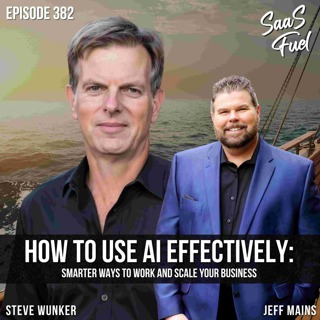
How to Use AI Effectively: Smarter Ways to Work and Scale Your Business | Steve Wunker | 382

How to Use AI Effectively: Smarter Ways to Work and Scale Your Business | Steve Wunker | 382

What if AI isn't just a tool to plug into your business — but a reason to redesign the entire thing? In this episode, Jeff Mains sits down with Steven Wunker, managing director of New Markets Advisors and bestselling author of AI and the Octopus Organization: Building the Super Intelligent Firm. Steven has been working in AI since 2012 and has advised dozens of Fortune 500 companies on how to unlock real growth through transformation — not just optimization.

Steven challenges the "AI magic dust" approach most companies default to — sprinkling AI on top of existing workflows for marginal gains — and makes the case for something far more powerful: using AI to take over entire classes of tasks, redistribute decision-making to the front lines, and redesign how organizations actually work.

Whether you're a SaaS founder thinking about your product roadmap or a leader rethinking your org structure, this episode will challenge you to think way bigger.

Key Takeaways

4:13 — AI is the biggest shift of our lifetimes — bigger than smartphones Steve has been in AI since 2012 and helped launch one of the first smartphones in 1999. He says this is still bigger — not just in breadth of adoption, but in depth: changing strategies, org structures, and roles within companies.

7:14 — Stop using AI as "magic dust" Sprinkling AI on top of existing workflows only yields marginal gains. The real transformation happens when AI takes over entire tasks that humans won't do (too tedious), shouldn't do (not the best use of their skills), or can't do (too high volume). That's when organizations must fundamentally rethink how work gets done.

9:55 — The Octopus Organization: distributed intelligence in action The octopus has nine brains — one central brain and one in each arm. Each arm can sense, think, and act independently while remaining contextually aware of the whole. That biological model is the blueprint for how AI-powered organizations should be structured: parallel execution, distributed decision-making, and strategic focus at the center.

11:25 — Why authority hasn't truly been devolved — and how AI finally changes that For 40 years, leaders have talked about flattening orgs and devolving decision-making. It hasn't happened for two reasons: humans resist giving up authority, and front-line workers have lacked the contextual awareness to make good autonomous decisions. AI solves the second problem — and also gives leaders visibility to veto in near real-time rather than always having to pre-approve.

16:48 — Map the "work chart," not the org chart Microsoft calls it the "work chart" — how work actually flows through the organization, cross-functionally, in reality. That's what needs to be mapped and redesigned. Layering AI onto the org chart misses the point entirely. Change happens workflow by workflow, tranche by tranche.

26:29 — Three questions every leader must answer right now

  1. How does the competitive landscape change? (Include DIY and AI-native startups)
  2. What makes you special in an AI world?
  3. How do you get work done — what behaviors, culture, and structure do you need?

32:19 — Everyone in management is now a change manager It doesn't matter how technical your role is — if you have people reporting to you, you must become a change manager. That skill can no longer be confined to a C-suite priesthood. Psychological safety for AI adoption and rethinking how good work is incentivized are critical.

32:58 — The LUCK framework for strategic serendipity Derived from workforce survey research, four patterns that separate successful AI adopters:

  • L — Leverage help (stay connected, workflows are increasingly cross-functional)
  • U — Unexpected connections (be open to signals outside the average case)
  • C — Control chaos (build systems to absorb the disruption coming)
  • K — Know what's missing (AI is only as good as its data; humans must fill the gaps)

34:57 — Don't chase glamorous AI use cases first IBM's Watson failed spectacularly by targeting cancer diagnoses — the world's best oncologists didn't need it. The win? Recording doctor-patient conversations so doctors can actually practice medicine instead of typing. Low risk, high utility, high return. Start there.

38:05 — The most valuable AI use cases are unglamorous Things humans won't do: take notes after every meeting and distribute them. Things humans shouldn't do: type during patient consultations. Things humans can't do: transcribe and summarize 40 simultaneous three-person breakout groups and track individual commitments. AI can do all of this — none of it is flashy, all of it is high-value.

28:10 — Build in AI optionality from the start Upwork re-engineered their stack with an AI optionality layer — flexible to swap between small LLMs, large LLMs, agents, or other AI systems. You can't predict where AI goes. Build optionality in. Don't make bespoke bets you can't unwind.

Tweetable Quotes"AI has this ability to take over certain tasks entirely — things humans wouldn't do, shouldn't do, or simply can't do at scale. That's when it gets truly transformative." — Steven Wunker"We've been talking about devolving authority and de-siloing organizations since 'In Search of Excellence' in the 1980s. It just hasn't happened. AI finally changes the equation." — Steven Wunker"The octopus is 300 million years old — 70 million years older than the dinosaurs — and it has survived because it is so darn adaptable. We need to be like that." — Steven Wunker"AI magic dust — sprinkling it on top of what you're currently doing — will get you marginal improvements. That's nice. But it won't fundamentally change how organizations work." — Steven Wunker"Don't be Adobe in the face of Figma. That has already played out. It would be very easy for that to play out again in innumerable SaaS markets unless we think transformatively." — Steven Wunker"Every person in any management position is now a change manager. It doesn't matter how specialized your technical skill is." — Steven Wunker"Features are only as good as their adoption." — Steven Wunker"AI is only as good as the data that's in it — so it's the role of the human to think about what's NOT in that AI system that needs to complete the picture." — Steven WunkerSaaS Leadership Lessons

1. Redesign the work, don't just automate it. The companies that win with AI aren't the ones that add AI features — they're the ones that fundamentally rethink how work flows through the organization. Map your "work chart" (how work actually happens cross-functionally) and redesign it workflow by workflow. Layering AI on your existing org chart is the surest path to becoming the next Kmart.

2. Your installed base is an asset — but only if you act transformatively. Existing SaaS companies have something AI startups don't: data, customer relationships, and deep domain context. That is an enormous advantage — but only if you think transformatively. AI-native disruptors are watching your market. Your data moat only protects you if you use it to reimagine what you build, not just improve what you have.

3. Prioritize low-risk, high-utility AI use cases first. Resist the temptation to prove what AI can do with your most complex, high-stakes problem. Start where the utility is obvious and the risk is low. Prove value there. Build trust with customers and your team. Then expand. IBM's Watson at MD Anderson is a $62M cautionary tale. The doctor who gets to practice medicine instead of typing is the win.

4. Build optionality into your AI architecture. You cannot predict where AI capabilities are heading. Large models, small models, agents, new paradigms — the landscape is shifting too fast to make permanent bets. Build your product and internal systems with an optionality layer that stays flexible. Businesses that hard-code their AI assumptions will face expensive rebuilds. Those who build for adaptability will compound their advantage.

5. Transform your go-to-market alongside your product. AI transformation isn't just a product problem — it's a sales, marketing, and customer success problem. The companies that win aren't just selling software; they're selling a changed way of getting something done. That means customer success becomes more important, not less. Sales cycles involve more change management. Proving economic value requires new evidence. Think Workfront, not the feature-obsessed competitor it acquired.

6. Make change management everyone's job. The old model — change management as a C-suite discipline — is dead. In an AI-first organization, every manager at every level must develop the skills to lead people through uncertainty, redesign workflows, and create psychological safety for new ways of working. If you're building or leading a SaaS company, start developing these muscles now — in your leaders, your managers, and yourself.

Guest Resources

swunker@newmarketsadvisors.com

Book: AI and the Octopus Organization: Building the Super Intelligent Firm — Available on Amazon in all formats (print, ebook, audio)

Book Website:

Denne episoden er hentet fra en åpen RSS-feed og er ikke publisert av Podme. Den kan derfor inneholde annonser.

Episoder(415)

414 | How to Sell in the Age of AI: A Founder's Guide | Bob Kocis

414 | How to Sell in the Age of AI: A Founder's Guide | Bob Kocis

Jeff Mains sits down with Bob Kocis, former President & COO of Aptean and former CRO of Continuum Managed Services, and author of The President's Club Mindset: Inside the Winning Strategies of Tech's ...

13 Aug 48min

413 | How to Enter Flow State for Peak Performance | Steven Puri

413 | How to Enter Flow State for Peak Performance | Steven Puri

Steven Puri has produced Academy Award-winning visual effects on films like Independence Day, Braveheart, and Se7en, climbed the executive ladder at DreamWorks and 20th Century Fox, and built three te...

11 Aug 52min

412 | Are AI Agents Ruining Customer Experience? | Vanitha Swaminathan

412 | Are AI Agents Ruining Customer Experience? | Vanitha Swaminathan

Vanitha is a marketing professor at the University of Pittsburgh, Director of their Center for Branding, and author of Hyper Digital Marketing: Six Pillars of Strategic Brand Marketing in an AI-Powere...

6 Aug 44min

411 | Physical Mail: Your Best Sales Weapon in 2026 | Neal Goyal

411 | Physical Mail: Your Best Sales Weapon in 2026 | Neal Goyal

In a world where 21,883 software companies are all chasing the same narrow pool of buyers, automation isn't a competitive edge — it's the noise. Neal Goyal, who has closed $41M in software revenue wit...

5 Aug 45min

410 | 5 SaaS Onboarding Mistakes Killing Your Growth | Claire Heginbotham

410 | 5 SaaS Onboarding Mistakes Killing Your Growth | Claire Heginbotham

Claire has spent nearly a decade writing emails, fixing onboarding flows, and tightening messaging for enterprise AI security, LiDAR tech, and competitive SaaS products — where a bad first impression ...

30 Jul 48min

409 | Can AI Replace Your Accountant? | Sai Dhanak

409 | Can AI Replace Your Accountant? | Sai Dhanak

In this episode, Sai breaks down why he deliberately chose a services business over pure SaaS, how a human-in-the-loop model creates a defensible moat in a world increasingly disrupted by Claude and C...

28 Jul 48min

408 | 95% of AI Projects Fail: Here's the Fix | Ben Tasker

408 | 95% of AI Projects Fail: Here's the Fix | Ben Tasker

Ben Tasker joins Jeff Mains to break down the real reason most AI rollouts fail: it's almost never the technology. From his time as Dean of AI at Southern New Hampshire University to building life-sav...

23 Jul 47min

407 | The SaaSpocalypse: Why Startups Fail in 2026 | Brian Herr

407 | The SaaSpocalypse: Why Startups Fail in 2026 | Brian Herr

The SaaS world is in the middle of a brutal reckoning. Products that looked innovative 18 months ago are quietly becoming redundant — not because markets disappeared, but because the floor rose. In th...

21 Jul 51min

Populært innen Business og økonomi

stopp-verden
lydartikler-fra-aftenposten
dine-penger-pengeradet
rss-penger-polser-og-politikk
e24-podden
rss-borsmorgen-okonominyhetene
rss-skravla-gar
lederpodden
rss-pa-konto
utbytte
pengepodden-2
livet-pa-veien-med-jan-erik-larssen
morgenkaffen-med-finansavisen
finansredaksjonen
tid-er-penger-en-podcast-med-peter-warren
liberal-halvtime
rss-markedspuls-2
pengesnakk
rss-politisk-preik
okonomiamatorene