428 | Intellectual Property for Founders: Trademarks, Patents, Copyright, and Trade Secrets | James Gourley

428 | Intellectual Property for Founders: Trademarks, Patents, Copyright, and Trade Secrets | James Gourley

Jeff Mains sits down with James Gourley, a patent attorney and IP litigator who has spent 20 years on both sides of intellectual property disputes — from filing patents and trademarks to defending companies against infringement claims. This episode is a practical, plain-English guide to the IP fundamentals every SaaS and tech founder needs to get right before the scary letter arrives. They cover trademark due diligence, the "work made for hire" trap with contractors, the unsettled legal frontier of AI-generated code, how trade secrets actually work, why software patents are getting slightly easier to obtain, and what a well-structured IP portfolio does for your valuation at exit. James's core message: IP protection is a rounding error in cost compared to what it saves you on the back end — and the regret is always about what you didn't do early enough.

Key Takeaways

0:00 — A trade secret is anything that gives your company a competitive advantage that you've taken reasonable measures to keep secret.

1:46 — Most founders don't find out whether they actually own their company name until the worst possible moment — right before a raise or mid-acquisition.

4:22 — The first thing founders should do when naming a company is check whether anyone else is already using a similar name for something similar.

6:36 — Before you build and ship, run a freedom-to-operate search to see if someone already holds a patent you might be infringing.

9:29 — To get a patent through the USPTO, your invention must be both novel and non-obvious over everything that came before.

11:19 — Patent examiners are time-constrained and often miss prior art, so invalid patents do get issued — but they can be invalidated in court.

16:18 — If you hire a contractor and the contract has no IP assignment clause, the contractor owns the work by default — not you.

18:46 — As the law stands today, AI-generated code and content cannot be copyrighted — nobody owns it.

21:12 — Trade secrets require you to take reasonable measures like restricting access on a need-to-know basis, not just calling something "secret."

25:14 — Filing a trademark gives you presumptive nationwide rights as of the filing date, and it's incredibly cheap relative to other business costs.

27:14 — Software patents may be getting slightly easier to obtain after a decade of difficulty, thanks to new USPTO examiner guidance.

29:51 — When filing a software patent, think through future roadmap variations and alternative implementations — not just what you're shipping today.

32:35 — Don't take matters into your own hands when someone copies you — get legal counsel to calibrate how aggressive you should be.

34:15 — Never throw an infringement letter in the trash — an attorney can quickly tell you whether the plaintiff is serious or a paper tiger.

36:02 — Fake, AI-generated law firms are sending cease-and-desist letters as shakedown scams — always verify the sender is real.

38:21 — In the next 30 days, start with trademark registration — it's the cheapest, highest-leverage IP move you can make early.

Tweetable Quotes"If you have AI create what would otherwise be a copyrightable work, nobody owns the copyright." — James Gourley, 18:46"You gotta have a good contract if you want to own the IP." — James Gourley, 18:22"It's never too early to start looking at protecting the trademark." — James Gourley, 39:04"The regret is usually not that I spent money on lawyers to protect the IP. It's that we tried to save a little bit of money and it's costing us a lot on the back end." — James Gourley, 39:14"IP isn't paperwork you get around to later. It's the ground your company is actually standing on." — Jeff Mains, 41:51"If you can be aggressive in response, sometimes it makes them go away." — James Gourley, 13:48SaaS Leadership Lessons

1. Trademark diligence is free — skipping it is not. Before you name your company or product, run a basic search. The standard isn't exact match — it's "likelihood of confusion." A name that's spelled slightly differently or uses a shared key term can still trigger a dispute years later when both companies grow into overlapping markets. The cost of a trademark search is zero; the cost of rebranding mid-acquisition is enormous.

2. No assignment clause, no ownership. The "work made for hire" doctrine covers employees by default — but contractors, agencies, and freelance developers own what they create unless your contract explicitly says otherwise. The wedding photographer example says it all: you hired them, you paid them, but without a transfer clause, they own the photos. Every contractor agreement your company signs should include an IP assignment provision. One clause changes everything.

3. AI-generated IP is legally unownable — plan accordingly. If AI writes your code or generates your logo, you likely can't copyright it. The current legal landscape says AI-created works have no copyright owner — period. For hybrid human/AI codebases, you'd need to disclaim the AI-generated portions in a copyright registration. This is a bleeding-edge issue that will be litigated for years. Until then, founders building on AI-assisted code should understand they may have no legal recourse if that code is copied.

4. Trade secrets demand least-privilege access, not just labels. Calling something a "trade secret" doesn't make it one. You have to show a judge you took reasonable measures — and that means limiting access to people who genuinely need it. A CRM that every employee can open weakens your claim. Restrict permissions, use document management tools, and document your access controls. If someone walks out with the data, you need to prove you tried to protect it.

5. Patent for the roadmap, not just the release. Software evolves faster than the patent process. If you file on what you're shipping today but your product migrates six months later, your patent may no longer cover what you actually built. When filing a software patent, describe not just your current implementation but alternative approaches and future variations you can foresee. The patent is only as valuable as its ability to still cover what you're doing two years from now.

6. Never ignore legal letters — and never respond emotionally. The two worst responses to an infringement letter are throwing it in the trash or firing back in anger. A 20-minute call with an experienced IP attorney can tell you whether the plaintiff has a history of filing suit or is just a copyright troll sending shakedown letters. The same attorney can tell you whether your own case is strong enough to be aggressive or whether you should approach gently. Calibrate before you act.

Guest Resources

gourley@caglaw.com

www.caglaw.com

https://www.linkedin.com/in/jamesgourley/

Episode Sponsor

The Futureproof Series - https://www.youtube.com/playlist?list=PLfkXKUPZ5xuOqMPR7_gzGybncTtavyR1N

The Captain's Keys

Small Fish, Big Pond – https://smallfishbigpond.com/ Use the promo code ‘SaaSFuel’

Champion Leadership Group – https://championleadership.com/

https://jeffmains.com/books/

SaaS Fuel Resources

Website - https://championleadership.com/

Jeff Mains on LinkedIn - https://www.linkedin.com/in/jeffkmains/

Twitter - https://twitter.com/jeffkmains

Facebook - https://www.facebook.com/thesaasguy/

Instagram - https://instagram.com/jeffkmains

Denne episoden er hentet fra en åpen RSS-feed og er ikke publisert av Podme. Den kan derfor inneholde annonser.

Episoder(433)

432 | How Cross-Functional Alignment Prevents Costly Project Failures | Deborah Kaminetzky

432 | How Cross-Functional Alignment Prevents Costly Project Failures | Deborah Kaminetzky

A software implementation can be delivered on time and on budget, then fail the moment people refuse to use it.In this episode, Jeff Mains talks with Deborah Kaminetzky, founder of De Facto Project Ma...

15 Okt 47min

431 | The Hidden Work Behind Cross-Border Supply Chains | Daman Grewal

431 | The Hidden Work Behind Cross-Border Supply Chains | Daman Grewal

Daman Grewal grew a logistics company from $1 million to $24 million in four years, working across dispatch, safety, accounts receivable, and sales before he fully recognized the skills he was buildin...

13 Okt 53min
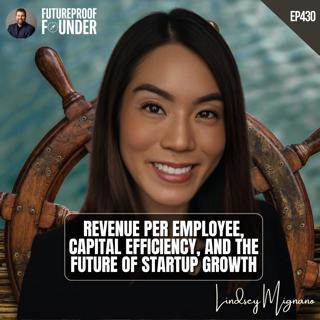
430 | Revenue Per Employee, Capital Efficiency, and the Future of Startup Growth | Lindsey Mignano

430 | Revenue Per Employee, Capital Efficiency, and the Future of Startup Growth | Lindsey Mignano

Are you raising venture capital because your business needs it—or because getting funded feels like proof you’ve made it?In this episode of Futureproof Founder, Jeff Mains sits down with Lindsey Migna...

8 Okt 54min

429 | AI, Education, and the Decline of Independent Thinking | Jonathan Schaeffer

429 | AI, Education, and the Decline of Independent Thinking | Jonathan Schaeffer

Are you using AI to make better decisions—or letting a confident answer do your thinking for you?In this episode of Futureproof Founder, Jeff Mains sits down with AI researcher and entrepreneur Jonath...

6 Okt 57min
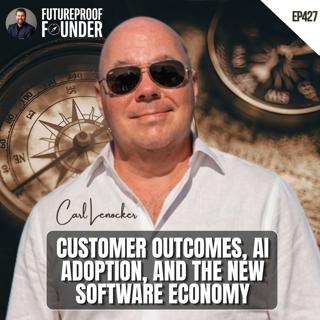
427 | Customer Outcomes, AI Adoption, and the New Software Economy | Carl Lenocker

427 | Customer Outcomes, AI Adoption, and the New Software Economy | Carl Lenocker

Jeff Mains sits down with Carl Lenocker, a 30-year enterprise software veteran who started in Silicon Valley in the '80s, survived the dot-com bust, and now consults founders on what actually creates ...

29 Sep 45min

426 | How Founders Can Turn AI Whiplash Into Strategic Focus | David Fung

426 | How Founders Can Turn AI Whiplash Into Strategic Focus | David Fung

David Fung spent 15 years at Salesforce as a Senior Director before walking away from unvested RSUs to launch Coachful Coaching. He now coaches CTOs and tech leaders on the pattern he calls "AI whipla...

24 Sep 46min

425 | Product-Market Fit Starts with Understanding the User | Erin Rollenhagen

425 | Product-Market Fit Starts with Understanding the User | Erin Rollenhagen

Erin Rollenhagen learned the most expensive lesson in product development the hard way: she spent years building software without ever talking to a single end user—and people took early retirement to ...

22 Sep 46min

Populært innen Business og økonomi

stopp-verden
dine-penger-pengeradet
e24-podden
rss-penger-polser-og-politikk
rss-borsmorgen-okonominyhetene
rss-skravla-gar
rss-pa-konto
pengepodden-2
livet-pa-veien-med-jan-erik-larssen
tid-er-penger-en-podcast-med-peter-warren
utbytte
lederpodden
finansredaksjonen
stormkast-med-valebrokk-stordalen
rss-markedspuls-2
morgenkaffen-med-finansavisen
pengesnakk
rss-orjasater
okonomiamatorene
liberal-halvtime