Illuminating cave art

Illuminating cave art

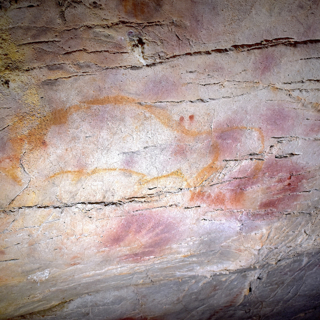
Deep in our past, in the dark depths of caves, our ancestors did something strange and beautiful. Working by firelight, some doodled little designs. Others made hand stencils. Some saw a bulge of rock, or a crack in the wall, and thought to turn it into a horse or a bison. Why did they make this art? What did it mean to them? Who were these artists? These questions are old—very old—but thanks to new methods and new interpretive frameworks, archaeologists are beginning to see them in a new light.

My guest today is Dr. Izzy Wisher. Izzy is an archaeologist at Aarhus University in Denmark, specializing in Paleolithic art.

Here, Izzy and I talk about why we in the present are so drawn to cave art. We lay out the basic timeline, geography, and categories of Paleolithic art. We consider the difference between figurative and non-figurative art, and why it might be that non-figurative art came first. We discuss hand stencils. We talk about an ongoing shift in archaeology known as the "sensory turn." We dig into some of Izzy's work on the role of pareidolia, palimpsests, and children in cave art. And we touch on an ongoing project she is involved in trying to understand the earliest symbolic marks that our species made—and what they could have been used for. Along the way we touch on the site known as El Castillo, Werner Herzog, hunting magic, why hand stencils are so often missing fingers, graffiti, tectiforms and flutings, why depictions of humans are actually quite rare in cave art, stages in children's art production, the use of virtual reality as a research method, and the idea of archaeology as world-building.

I think you'll enjoy this one friends. Who among us—after all—doesn't feel drawn to these caves, to these most enigmatic of human creations? Without further ado, here's my conversation with Dr. Izzy Wisher.

Notes

3:00 – For more on El Castillo cave, see here and here.

9:00 – Werner Herzog's film—Cave of Forgotten Dreams—is being briefly re-released in April 2026.

12:00 – For some of Dr. Wisher's popular writing on cave art, see here and here.

16:30 – One example of a recent rock art finding in Sulawesi.

20:30 – Our earlier episode with Dr. Eleanor Scerri and Dr. Manuel Will, in which we discuss the mostly retired idea of a "cognitive revolution" in Europe in the Upper Paleolithic.

22:00 – For more on the recently discovered rock art panel in Colombia, see this news story and this recent academic study.

25:00 – The relative rarity of humans in Paleolithic art has provoked much discussion, both among scholars and the public.

27:00 – On the idea that Venus figurines might be self-representations—made from the perspective of the artist viewing her own body—see here.

29:00 – For a recent treatment of the "missing fingers" in hand stencils, with some overview of different hypotheses, see here. For more on the idea that such stencils could constitute a system of hand-signs, see here.

34:00 – A popular article by Dr. Wisher about one example of portable art—a deer-tooth necklace with engraved designs.

36:00 ­– For a discussion of the earliest non-figurative art, see here. For one account of the transition from non-figurative to figurative art, including discussion of hand stencils, see here.

42:00 – A paper in which Dr. Wisher and a colleague discuss the "sensory turn" in archaeology and how her work contributes to it.

51:00 – Dr. Wisher's studies on pareidolia are here and here.

59:00 – For Dr. Wisher's study of palimpsests in cave art, see here.

1:07:00 – For an influential early study on cave marking by children, see here. For Dr. Wisher's recent study of children's art in the caves, see here. A book by Dr. John Matthews on the development of drawing in children.

1:14:00 – The website of the eSYMB project is here. An important early publication by this group is here. A recent overview of the project and its context by Dr. Wisher and colleagues.

1:18:00 – A recent paper arguing that certain systems of marks represented a "phenological calendar." Another recent paper providing evidence that certain Paleolithic marks constituted a system of conventional signs.

1:22:00 – The paper arguing that archaeology is "world-building."

Recommendations

Kindred, by Rebecca Wragg Sykes (former guest!)

Homo sapiens rediscovered, by Paul Pettitt

Many Minds is a project of the Diverse Intelligences Summer Institute, which is made possible by a generous grant from the John Templeton Foundation to Indiana University. The show is hosted and produced by Kensy Cooperrider, with help from Assistant Producer Urte Laukaityte and with creative support from DISI Directors Erica Cartmill and Jacob Foster. Our artwork is by Ben Oldroyd.

Subscribe to Many Minds on Apple, Stitcher, Spotify, Pocket Casts, Google Play, or wherever you listen to podcasts. You can also now subscribe to the Many Minds newsletter here!

We welcome your comments, questions, and suggestions. Feel free to email us at: manymindspodcast@gmail.com.

For updates about the show, visit our website or follow us on Bluesky (@manymindspod.bsky.social).

Denne episoden er hentet fra en åpen RSS-feed og er ikke publisert av Podme. Den kan derfor inneholde annonser.

Episoder(162)

Babies, dogs, and the riddles of word learning

Babies, dogs, and the riddles of word learning

It's kind of astonishing, really, that kids ever learn words. Each one poses a little riddle. Does this sound string refer to a person? A category of things? Or maybe some other feature of the bloomin...

22 Mai 1h 18min

The inner life of the hand

The inner life of the hand

Newton saw in the human hand proof of the divine; Darwin saw a key to our species' success. Many others, too, have described the hand in hyperbolic terms, as a paragon of design, a cornerstone of huma...

7 Mai 1h 10min

From the archive: The cuttlefish and its coat of many colors

From the archive: The cuttlefish and its coat of many colors

Hi friends! We're skipping a beat to take care of some spring housekeeping tasks. We will be back in May! In the meanwhile, enjoy this listener favorite from our archives! ----- [originally aired Apri...

22 Apr 1h 33min

What can AI teach us about the mind?

What can AI teach us about the mind?

Everyone is talking about AI these days. Often these conversations are about how AI might upend education, or work, or social life, or maybe civilization itself. But among cognitive scientists and psy...

26 Mar 1h 21min

Mutualisms all the way down

Mutualisms all the way down

No one is an island. We all depend on each other in critical, often tangled ways. And when I say "we" and "each other" I don't just mean humans. Yes, we humans rely on other humans. But we also rely o...

11 Mar 1h 8min

Seven metaphors for AI

Seven metaphors for AI

If you wanted a petri dish for understanding metaphors—how they emerge and evolve and jostle with each other—it would be hard to do better than the world of AI. We talk about AI systems variously as c...

26 Feb 55min

Origins of the kiss

Origins of the kiss

Humans do some pretty weird things. Some of us will sit in searingly hot rooms or jump into icy ponds. Others risk their lives trying to climb to new heights or dive to new depths. And every once in a...

12 Feb 1h 1min

Populært innen Fakta

fastlegen
dine-penger-pengeradet
relasjonspodden-med-dora-thorhallsdottir-kjersti-idem
rss-bisarr-historie
foreldreradet
treningspodden
jakt-og-fiskepodden
rss-strid-de-norske-borgerkrigene
mikkels-paskenotter
rss-sunn-okonomi
sinnsyn
dopet
rss-kunsten-a-leve
rss-kull
hverdagspsyken
fryktlos
rss-sarbar-med-lotte-erik
hagespiren-podcast
lederskap-nhhs-podkast-om-ledelse
level-up-med-anniken-binz