The Chosen Anomaly Conundrum

The Chosen Anomaly Conundrum

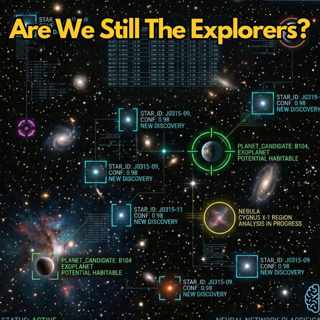
Space exploration has always depended on scarcity. There is never enough time, bandwidth, human attention, or instrument capacity to examine everything. That was manageable when the stream of possible discoveries was still small enough for scientists to review by hand. But that era is ending. Telescopes now generate oceans of data. Rovers see more terrain than teams on Earth can parse in real time. Future missions will only widen that gap.


AI looks like the obvious answer. It can scan signals, rank targets, flag strange patterns, and decide what deserves a closer look before the moment passes. Without that help, science teams risk drowning in their own data and missing discoveries simply because no human got to them in time. In that sense, AI does not just make exploration faster. It makes modern exploration possible.


But once AI becomes the system that filters what humans notice first, exploration starts to change in a subtler way. The universe we study is no longer just the universe our instruments capture. It is the universe that survives a machine’s first pass. That may be a huge advantage when the model catches weak patterns no person would have spotted. It may also mean the frontier gradually bends toward what machine systems are best at recognizing, while the truly strange, noisy, low-confidence anomalies get pushed aside because they look too messy to trust.


The conundrum:


If AI becomes the first judge of what in space deserves human attention, then the tradeoff is no longer just efficiency. It is about what kind of exploration we are willing to become.


One path says we should embrace that filter. Discovery at scale now depends on machine triage, and refusing it would mean letting extraordinary signals die unseen in overwhelming data. In that view, AI expands human curiosity by helping us notice more of the universe than we ever could alone.|


The other path says the cost is deeper than it appears. Some of the most important discoveries in history looked ambiguous, inconvenient, or easy to dismiss at first. If AI becomes the layer that decides what gets surfaced, then humanity may get better at finding the patterns it already knows how to value while getting worse at noticing the anomalies that force it to rethink reality.


So as exploration moves deeper into a universe too large for human attention alone, what should matter more: using AI to ensure we miss less, or protecting room for the kinds of strange signals that a machine might be least prepared to recognize?

Denne episoden er hentet fra en åpen RSS-feed og er ikke publisert av Podme. Den kan derfor inneholde annonser.

Episoder(870)

Is Grok Bot the Best AI Work Assistant?

Is Grok Bot the Best AI Work Assistant?

The episode opened with a hands-on comparison of Grokbot, Codex and Claude. Gareth found Grokbot strong for delegation, organization and everyday work, but weaker on difficult problem solving. The dis...

20 Aug 1h 3min

Do We Need to Rethink What Work Is?

Do We Need to Rethink What Work Is?

The episode opened with Apple Vision Pro being used to map a house while running Ethernet cable, letting a worker see marked locations through floors and walls. That led to a wider discussion about di...

19 Aug 1h

Are Custom GPTs Reaching the End?

Are Custom GPTs Reaching the End?

The episode opened with a practical example of how quickly AI coding agents are moving beyond software. Someone used Claude to write a Mac driver for an old Windows-only HP printer, leading to a wider...

18 Aug 50min

Are AI Harnesses the New AI Wrappers?

Are AI Harnesses the New AI Wrappers?

The episode opened with the reported Stripe acquisition of OpenRouter at a $7 billion valuation and questions about how OpenRouter’s business model supports that price. The conversation expanded into ...

17 Aug 58min

The Pool of One Conundrum

The Pool of One Conundrum

Insurance has always worked by not knowing. You paid into a pool with people you would never meet, and nobody could say which of you would be the one who burned, crashed, or got sick. Everyone paid fo...

15 Aug 23min

Can AI Solve the Energy Problem It Is Creating?

Can AI Solve the Energy Problem It Is Creating?

The episode opened with the growing power demands behind AI. The hosts discussed Nvidia, Google and Microsoft’s work on 800-volt DC power for data centers, which could reduce energy lost converting el...

14 Aug 58min

Is Grok 4.6 Changing the Economics of AI Agents?

Is Grok 4.6 Changing the Economics of AI Agents?

The episode opened with Grok 4.6, which reportedly moved close to Claude Opus 5 and GPT-5.6 Sol on Artificial Analysis benchmarks while offering lower costs and stronger efficiency on long-running age...

14 Aug 1h 5min

Is the Claude to Codex Exodus Real?

Is the Claude to Codex Exodus Real?

The episode returned to Anthropic’s new AI watermarking system with much more detail about how it will work. Anthropic says new Claude models will add machine-readable marks to generated content as pa...

12 Aug 55min

Populært innen Teknologi

lydartikler-fra-aftenposten
teknisk-sett
tomprat-med-gunnar-tjomlid
smart-forklart
elektropodden
rss-ki-praten
fornybaren
shifter
rss-ai-forklart
teknologi-og-mennesker
rss-bouvet-bobler
rss-alt-som-gar-pa-strom
rss-kunstig-intelligens-med-elisabeth-maren-og-morten
nasjonal-sikkerhetsmyndighet-nsm
rss-fisketimen
rss-alt-vi-kan
rss-polypod
digital-forretningsforstaelse
energi-og-klima
rss-nkom-innsikt