The 1:61,320 Ratio: Deconstructing Time Dilation, Tidal Solitons, and the Near-Extremal Black Hole of Interstellar

The 1:61,320 Ratio: Deconstructing Time Dilation, Tidal Solitons, and the Near-Extremal Black Hole of Interstellar

The $1:61,320$ Ratio: Deconstructing Time Dilation, Tidal Solitons, and the Near-Black Hole of InterstellarDescription

The 2014 motion picture Interstellar, directed by Christopher Nolan with lead scientific consultation from Nobel Laureate Kip Thorne, presents a unique case study in the intersection of narrative fiction and high-fidelity astrophysical simulation. The sequence depicting Miller's Planet—a water-covered terrestrial world orbiting the supermassive black hole Gargantua—serves as the film's primary crucible for exploring gravitational time dilation and orbital dynamics in curved spacetime.

The narrative premise defines the relativistic cost of exploration: one hour on the planetary surface equates to seven Earth-years, implying a massive time dilation factor of approximately 61,320:1. This episode provides an exhaustive deconstruction of the physics required to sustain such a scenario, synthesizing general relativistic geometry, orbital mechanics, and fluid dynamics.

Key topics we explore:
  • The Near-Extremal Kerr Solution: Initial critiques were grounded in the physics of non-rotating (Schwarzschild) black holes, where stable orbits cannot produce such extreme time dilation (maximum factor is ~1.22). We explain how the film’s premise is validated by specifying **Gargantua** as a **supermassive Kerr black hole** ($10^8 M_\odot$) with a necessary **near-extremal dimensionless spin parameter ($a_*$) of $1 - 1.3 \times 10^{-14}$**. This nearly maximal rotation fundamentally alters the structure of spacetime, allowing the Innermost Stable Circular Orbit (ISCO) to approach the event horizon.
  • Frame Dragging and Orbital Stability: The planet's stability is maintained because it orbits just slightly outside the event horizon, a position Thorne describes as "a pinch from the event horizon". This stable orbit is made possible by the centrifugal force imparted by **frame dragging** (or the "space whirl"). The rotation of space itself carries the planet along, stabilizing its position against the immense gravitational pull.
  • Tidal Survival and Density Requirements: We analyze the "Roche Limit Violation" critique and explain the pivotal counter-intuitive result: the tidal forces exerted at the event horizon are inversely proportional to the square of the black hole’s mass ($a_{tidal} \propto 1/M^2$). The supermassive nature of Gargantua ($10^8 M_\odot$) makes the tidal gradient across a planetary body gentler compared to a stellar-mass black hole. For Miller's Planet to survive tidal stretching, the calculation indicates it must possess a high density of approximately **10,000 kg/m³**.
  • Visualizing Spacetime Geometry: We examine the advanced visualization methodology developed for the film. The Double Negative (DNEG) visual effects team created the **Double Negative Gravitational Renderer (DNGR)**. This bespoke ray-tracing software solved the geodesic equations for photons in the Kerr metric, allowing for the accurate simulation of phenomena like gravitational lensing, the **Einstein Ring**, and the relativistic Doppler beaming observed in the black hole's accretion disk.

Denne episoden er hentet fra en åpen RSS-feed og er ikke publisert av Podme. Den kan derfor inneholde annonser.

Episoder(38)

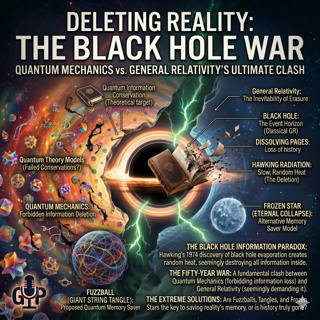
Deleting Reality: The Black Hole War

Deleting Reality: The Black Hole War

If you burn a book, the information survives in the ash. If you throw a book into a black hole, it should be gone forever. Stephen Hawking proved that black holes slowly evaporate into random heat, th...

11 Jun 27min
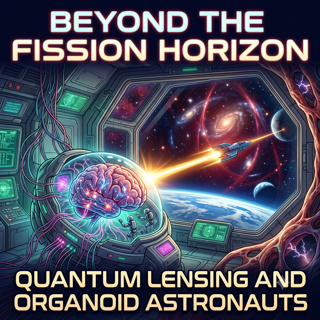
Beyond the Fission Horizon: Quantum Lensing and Organoid Astronauts

Beyond the Fission Horizon: Quantum Lensing and Organoid Astronauts

Humanity’s old-school dreams of space exploration are dead—and what’s replacing them is terrifyingly brilliant. In this episode, we pull back the curtain on the violent collision between cutting-edge ...

9 Jun 46min
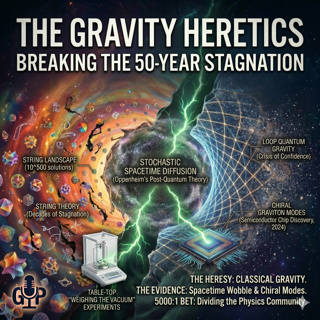
The Gravity Heretics: Breaking the 50-Year Stagnation

The Gravity Heretics: Breaking the 50-Year Stagnation

For half a century, the "Quantization Dogma" has ruled physics: the belief that gravity, like all other forces, must be quantum. But after decades of silence from String Theory and Loop Quantum Gravit...

4 Jun 29min

The Quantum Schism: Strings, Loops, and the Battle for the Soul of Physics

The Quantum Schism: Strings, Loops, and the Battle for the Soul of Physics

For over a century, the unification of General Relativity and Quantum Mechanics has remained the "elusive dream" of physics—an open wound at the heart of our understanding of reality. In this deep-div...

28 Mai 41min

 The Big Bounce: Gravity Without Infinity

The Big Bounce: Gravity Without Infinity

Is the Big Bang truly the beginning, or just a moment in an eternal cosmic cycle? This episode investigates Loop Quantum Cosmology (LQC), the application of Loop Quantum Gravity that challenges the co...

21 Mai 36min

Strings Attached: Solving the Quantum Gravity Puzzle

Strings Attached: Solving the Quantum Gravity Puzzle

Modern physics is built on two pillars that refuse to stand together: Quantum Mechanics and General Relativity. This podcast breaks down how String Theory attempts to bridge this gap through a "top-do...

14 Mai 25min

Igniting the Future: From Grid-Scale Fusion to Antimatter Starships

Igniting the Future: From Grid-Scale Fusion to Antimatter Starships

In this episode, we explore the unprecedented leap of high-energy physics from theoretical laboratories into scalable engineering and commercial realities. We dive deep into the 2026 commercial fusion...

12 Mai 39min

Gravity’s Ghost: The Hunt for the True "God Particle"

Gravity’s Ghost: The Hunt for the True "God Particle"

"Big news! We are bringing "Quantum Gravity Wars" home to this feed. Moving forward, we’re introducing a brand-new weekly segment: Thursday Deep Dives. These special episodes will go beyond our usual ...

7 Mai 36min

Populært innen Vitenskap

fastlegen
tingenes-tilstand
forskningno
vett-og-vitenskap-med-gaute-einevoll
liberal-halvtime
rekommandert
sinnsyn
rss-paradigmepodden
jss
fjellsportpodden
villmarksliv
dekodet-2
hva-er-greia-med
rss-inn-til-kjernen-med-sunniva-rose
tomprat-med-gunnar-tjomlid
rss-rekommandert
kvinnehelsepodden
diagnose
grunnstoffene
rss-zahid-ali-hjelper-deg