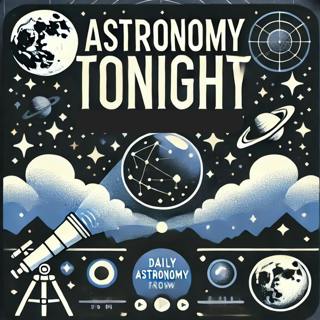
Oxygen: The Cosmic Breath That Illuminated Science

Oxygen: The Cosmic Breath That Illuminated Science

This is your Astronomy Tonight podcast. On August 1st, 1774, a cosmic coincidence occurred that would forever change our understanding of the atmosphere and chemistry. It was on this day that Joseph Priestley, an English chemist and natural philosopher, made a groundbreaking discovery that would quite literally give us all a breath of fresh air. Priestley, in his makeshift laboratory, was experimenting with different gases when he noticed something extraordinary. By focusing sunlight through a lens onto mercuric oxide, he produced a gas that caused a candle flame to burn more brightly. Little did he know, he had just isolated oxygen for the first time in history! Now, you might be wondering, "What does this have to do with astronomy?" Well, dear listeners, everything! This discovery was crucial in understanding the composition of our own atmosphere and, by extension, the atmospheres of other planets. It opened up a whole new field of study in astrophysics and planetary science. Imagine, if you will, Priestley's excitement as he realized the significance of his discovery. He might have looked up at the night sky, wondering if the same gas he had just isolated was present on other celestial bodies. And indeed it was! We now know that oxygen is present in the atmospheres of several planets and moons in our solar system, including Mars and Europa. Priestley's discovery also paved the way for our understanding of stellar evolution. We now know that oxygen is produced in the cores of massive stars through nuclear fusion, and is spread throughout the universe when these stars explode as supernovae. So, the next time you take a deep breath and look up at the stars, remember Joseph Priestley and his August 1st discovery. It's a perfect example of how earthbound experiments can lead to cosmic revelations! And that's it for today's episode of Astronomy Tonight. If you enjoyed this cosmic journey, please don't forget to subscribe to the Astronomy Tonight podcast. For more fascinating stories and mind-bending facts, check out QuietPlease.AI. Thank you for listening to another Quiet Please Production. Until next time, keep looking up! This content was created in partnership and with the help of Artificial Intelligence AI.

Denne episoden er hentet fra en åpen RSS-feed og er ikke publisert av Podme. Den kan derfor inneholde annonser.

Episoder(578)

# 1761 Venus Transit: The First Global Scientific Collaboration

# 1761 Venus Transit: The First Global Scientific Collaboration

# This is your Astronomy Tonight podcast. **The Venus Transit of June 4, 1761: When Venus Crossed the Sun's Face** Good evening, stargazers! Today we're celebrating one of the most momentous observa...

4 Jun 2min

**Ed White's Historic First American Spacewalk: June 3, 1965**

**Ed White's Historic First American Spacewalk: June 3, 1965**

# Astronomy Tonight Podcast This is your Astronomy Tonight podcast. Tonight, we're celebrating one of the most iconic moments in the history of space exploration that occurred on June 3rd – and boy,...

3 Jun 1min

# Venus Transit of 1882: Measuring the Solar System

# Venus Transit of 1882: Measuring the Solar System

# Astronomy Tonight Podcast This is your Astronomy Tonight podcast. Welcome back, stargazers! Today we're celebrating one of the most pivotal moments in modern astronomy—and it happened right here o...

24 Mar 1min

# Arthur Auwers: The Meticulous Star Mapper Who Built Celestial GPS

# Arthur Auwers: The Meticulous Star Mapper Who Built Celestial GPS

# Astronomy Tonight Podcast This is your Astronomy Tonight podcast. Welcome, stargazers! Today, March 23rd, marks a truly fascinating date in astronomical history. On this very date in 1882, the *Ge...

23 Mar 1min

Hubble's Flawed Vision: From Disaster to Discovery

Hubble's Flawed Vision: From Disaster to Discovery

# This is your Astronomy Tonight podcast. Good evening, stargazers! Today we're celebrating a truly monumental moment in space exploration history—March 22nd, the day the Hubble Space Telescope was l...

22 Mar 1min

# The Great Daylight Comet of 1960: A Celestial Surprise

# The Great Daylight Comet of 1960: A Celestial Surprise

# This is your Astronomy Tonight podcast. Good evening, stargazers! I'm thrilled to bring you tonight's astronomical retrospective, and boy, do we have a cosmic tale to tell you about March 21st! On...

21 Mar 1min

**Spring Equinox: Earth's Cosmic Balance and Ancient Wonder**

**Spring Equinox: Earth's Cosmic Balance and Ancient Wonder**

# Astronomy Tonight Podcast This is your Astronomy Tonight podcast. Good evening, stargazers! On this date—March 20th—we're celebrating one of the most dramatic and consequential events in astronomi...

20 Mar 1min

**The Hubble Deep Field: Universe's Most Profound Image**

**The Hubble Deep Field: Universe's Most Profound Image**

# Astronomy Tonight Podcast This is your Astronomy Tonight podcast. Well, hello there, stargazers and cosmic enthusiasts! Welcome back to another thrilling episode. Today we're celebrating a truly *...

19 Mar 1min

Populært innen Vitenskap

fastlegen
tingenes-tilstand
jss
rekommandert
liberal-halvtime
sinnsyn
forskningno
tomprat-med-gunnar-tjomlid
villmarksliv
kvinnehelsepodden
tidlose-historier
rss-paradigmepodden
rss-zahid-ali-hjelper-deg
rss-overskuddsliv
dekodet-2
rss-rekommandert
hva-er-greia-med
rss-inn-til-kjernen-med-sunniva-rose
abels-tarn
nevropodden