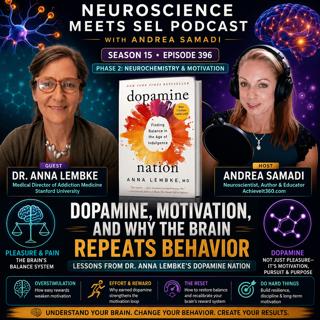
Dopamine, Motivation and Why the Brain Repeats Behavior with Dr. Anna Lembke

Dopamine, Motivation and Why the Brain Repeats Behavior with Dr. Anna Lembke

Host Andrea Samadi welcomes Dr. Anna Lembke to explain how pleasure and pain share the same neural circuitry and how dopamine governs motivation. The episode explores why overconsumption of easy rewards dulls motivation, creates withdrawal-like deficits, and shifts the brain toward pain.

Through clear takeaways—delay borrowed rewards, try temporary abstinence, create friction for temptations, and practice purposeful effort—the episode shows how recalibrating the brain’s reward system restores enjoyment in ordinary activities and builds sustainable motivation.

Welcome back to Season 15 of the Neuroscience Meets Social and Emotional Learning Podcast.

I'm Andrea Samadi, and on this podcast, we bridge the science behind social and emotional learning, emotional intelligence, and practical neuroscience so we can create measurable improvements in well-being, achievement, productivity, and results.

Season 15 Orientation

This season, we're exploring what I call:

The Brain's Operating System for Human Performance.

Instead of looking at neuroscience, health, learning, motivation, and emotional intelligence as separate topics, (like we did for the past 14 seasons) we're exploring how these systems come online in sequence.

Each phase builds on the one before it:

✔ Phase 1 — Regulation & Safety Is the nervous system safe enough to learn?

✔ Phase 2 — Neurochemistry & Motivation What drives behavior, focus, and sustained effort?

✔ Phase 3 — Movement, Learning & Cognition

✔ Phase 4 — Perception, Emotion & Social Intelligence

✔ Phase 5 — Integration, Insight & Meaning

By the end of this year my hope is that we can step back and ask:

    Where am I out of alignment? Is it regulation? Is it my thinking? Is it my focus? Or Belief? Is it how I’m learning or connecting with others? Or do I need some work with integration, insight and meaning?

Because once we can see our gap…

We can begin to close it.

“The goal is not more effort—it’s better alignment.”

“And when these systems are aligned…

    Effort feels easier Learning becomes faster And results become more consistent

Because peak performance is not about doing more.

It’s about aligning the systems that drive our results.

Recap Where We've Been

In EP 392[i], we introduced the Motivation Loop and explored how the brain decides what is worth doing.

In EP 393[ii], we looked at how our beliefs trigger neurochemistry that drives action, feedback, and repetition.

In EP 394[iii] we looked at how our thought patterns impact our neurochemistry and results with Dr. Caroline Leaf.

Then in EP 395[iv], reviewing Dr. John Medina's work on Theory of Mind, we explored something equally important:

The brain pays attention to what it believes matters.

Dr. Medina showed us that attention and reward are deeply connected.

When the brain predicts something will be valuable, relevant, or meaningful, attention increases.

And when attention and reward align:

✔ Learning improves

✔ Memory strengthens

✔ Motivation increases

✔ Behaviors become repeatable

But that leaves us with an important question:

What creates that sense of reward in the first place?

What makes the brain continue pursuing something?

What makes us stay motivated and what makes us lose interest?

And why can effort sometimes feel rewarding—and other times feel exhausting?

Today's Episode

To answer those questions, we're turning to Dr. Anna Lembke, author of the book: Dopamine Nation who we first met September 2021 on EP 162.[v]

Her work helps to explain the neurochemical engine underneath the Motivation Loop that we’ve been covering.

While John Medina helped us understand how attention and reward influence learning, Dr. Lembke helps us understand:

✔ Why the brain seeks reward

✔ How dopamine drives motivation

✔ Why pleasure and pain operate on the same neural system

✔ And what happens when the balance gets disrupted

Because the real goal isn't simply just feeling good.

The goal is understanding how the brain learns to associate effort with reward.

And when that happens, something powerful occurs:

Effort itself becomes rewarding.

That's where sustainable motivation begins.

EP 393 — Motivation Loop ↓ EP 394 — Belief triggers neurochemistry ↓ EP 395 — Theory of Mind: Attention + Reward determine what matters ↓ EP 396 — Dopamine Nation: Why the brain seeks reward and how effort becomes rewarding

It keeps the loop intact and shows listeners that Medina answered "What gets our attention?" while Lembke answers "Why does the brain keep pursuing it?".

CLIP 1: The Neuroscience of Pleasure and Pain Based on Dr. Anna Lembke's Dopamine Nation CLIP SUMMARY

Let’s see what Dr. Anna Lembke has to say about the neuroscience of pleasure and pain. In this clip, Dr. Lembke explains one of the most important concepts in modern neuroscience:

Pleasure and pain are processed in the same brain system and work like opposite sides of a balance.

Whenever we experience something pleasurable—whether it's social media, sugar, shopping, gaming, alcohol, or even achievement—the brain's balance tips toward pleasure.

But the brain is always seeking equilibrium.

To restore balance, it responds by tipping the scale in the opposite direction, creating a corresponding feeling of discomfort, craving, dissatisfaction, or pain.

The more often we seek quick pleasure, the harder the brain works to compensate.

Over time, this can leave us in what Lembke calls a "dopamine deficit state" where we need more stimulation just to feel normal.

The surprising solution?

Activities that require effort and involve manageable discomfort—exercise, cold exposure, fasting, learning difficult skills, and meaningful human connection—can help restore balance and rebuild motivation.

KEY TAKEAWAYS & HOW TO PUT THEM INTO ACTION 1. The Brain Is Always Seeking Balance

IMAGE CREDIT: Dr. Anna Lembke Dopamine Nation.

Dr. Lembke explains that pleasure and pain are not separate systems. They operate like opposite sides of a seesaw.

When we repeatedly tip the brain toward pleasure, (you can see an image in the show notes with some examples like with eating chocolate, shopping or using social media) the brain compensates by tipping toward pain to restore balance.

Brain Rule:

Every pleasure has a neurobiological cost.

Put This Into Action

Ask yourself:

Where am I getting large rewards with very little effort?

Examples might include:

✔ Social media

✔ Sugar

✔ Constant news consumption

✔ Streaming

✔ Or Online shopping

The goal isn't to eliminate pleasure.

The goal is just with our awareness.

Because what we measure, we can begin to manage.

2. Overconsumption Changes the Brain

What feels exciting today becomes normal tomorrow.

The brain adapts to repeated dopamine spikes through a process called neuroadaptation.

Over time:

✔ Rewards feel weaker

✔ Cravings increase

✔ Motivation decreases

✔ More stimulation is needed to create the same feeling

Put This Into Action

Choose one highly stimulating habit and observe it for a week.

Notice:

✔ How often you engage in it

✔ What triggers it

✔ How you feel afterward

Simply collecting data can reveal patterns you didn't realize existed.

3. Not All Dopamine Is Created Equal: Borrowed vs. Earned Dopamine (we have covered this topic previously).

Dr. Lembke's pleasure-pain balance helps explain an important distinction:

Borrowed Dopamine

Borrowed dopamine comes before effort.

Examples include:

✔ Scrolling social media

✔ Energy drinks before a workout

✔ Sugar when stressed

✔ Online shopping

✔ Gaming

✔ Endless entertainment

These rewards feel good immediately.

But because they require little effort, they often weaken motivation over time.

The brain begins expecting reward before work.

Earned Dopamine

Earned dopamine comes after effort.

Examples include:

✔ Finishing a difficult workout

✔ Completing a challenging project

✔ Climbing to the summit of a hike

✔ Finishing a podcast episode (for me)

✔ Learning a new skill

✔ Solving a difficult problem

These rewards feel different.

The brain learns:

Effort leads to reward.

And over time:

Effort itself becomes rewarding.

This strengthens the Motivation Loop.

Put This Into Action

Ask yourself:

Where am I borrowing dopamine?

And where am I earning it?

For the next week, look for opportunities to delay rewards until after effort.

Examples:

Instead of:

Reward → Effort

Try:

Effort → Reward

Instead of checking your phone before starting work...

Complete one task first.

Instead of rewarding yourself before your workout...

Reward yourself after the workout.

Instead of seeking immediate comfort...

Lean into a small challenge.

Each time you do this, you're teaching your brain:

"Reward follows effort."

And that's how motivation becomes sustainable.

4. Temporary Abstinence Reveals the Truth

One of Dr. Lembke's most powerful strategies is taking a break from a highly rewarding behavior.

When we step away from constant stimulation, the brain's reward system has an opportunity to recalibrate.

Only then can we see whether a behavior is serving us—or controlling us.

Put This Into Action

Consider a short experiment.

Choose one behavior that may be overstimulating your reward system and reduce or eliminate it temporarily.

Notice:

✔ Energy

✔ Focus

✔ Motivation

✔ Mood

✔ Cravings

The goal isn't punishment.

The goal is information.

5. Lasting Change Requires Systems, Not Willpower

Many people believe success comes from discipline alone.

Dr. Lembke argues that creating the right environment is often more powerful.

Instead of relying on willpower every day, create barriers that make unwanted behaviors harder to access.

Put This Into Action

Ask yourself:

How can I create more friction between myself and temptation?

Examples include:

✔ Turning off notifications

✔ Keeping unhealthy foods out of sight

✔ Scheduling device-free time

Small environmental changes often produce large behavioral results.

CLIP 2 How Chronic Overstimulation Creates a Dopamine Deficit State When The Motivation Loops Breaks

In this clip, Dr. Anna Lembke explains why many people struggling with depression, anxiety, insomnia, low motivation, or emotional distress may actually be experiencing the consequences of chronic overstimulation.

Her first recommendation is often surprisingly simple:

Remove the "drug of choice" for a period of time.

The "drug" isn't necessarily alcohol or drugs. It can be social media, gaming, shopping, sugar, constant entertainment, or any behavior that repeatedly floods the brain's reward pathways.

Lembke explains that people often feel worse before they feel better because the brain has adapted to high levels of dopamine stimulation.

When the stimulation is removed, the brain temporarily experiences withdrawal-like symptoms as it works to restore balance.

Over time, however, the brain's pleasure-pain system recalibrates, allowing people to experience pleasure from ordinary, everyday rewards again.

Her larger message is:

We live in a society with unprecedented access to pleasure, and many of us have unintentionally shifted our pleasure-pain balance toward pain.

The solution is not necessarily more pleasure.

The solution is restoring balance.

How Chronic Overstimulation Creates a Dopamine Deficit State KEY TAKEAWAYS & HOW TO PUT THEM INTO ACTION 1. Feeling Worse Can Be a Sign of Healing

One of the biggest misconceptions about behavior change is that improvement should feel good immediately.

The brain doesn't work that way.

When a highly stimulating behavior is removed:

✔ Cravings increase

✔ Discomfort rises

✔ Mood may temporarily decline

This is often the brain recalibrating rather than failing.

Put This Into Action

When reducing an overstimulating habit, don't judge success by how you feel in the first few days.

Instead ask:

"Could this discomfort be evidence that my brain is adjusting?"

Sometimes the discomfort isn't a sign you're moving backward.

It's a sign you're recovering.

2. The Brain Adapts to Excess Dopamine

The brain is remarkably efficient.

When exposed to constant stimulation, it reduces its sensitivity to reward.

What once felt exciting becomes normal.

What once felt normal may eventually feel boring.

This is why people often need more stimulation to achieve the same feeling.

Put This Into Action

Identify your "drug of choice."

Ask yourself:

What do I consistently turn to when I'm stressed, bored, anxious, or uncomfortable?

Examples:

✔ Social media

✔ Sugar

✔ Streaming

✔ Shopping

✔ Gaming

✔ Constant notifications

Awareness creates choice.

3. Modern Life Makes Overstimulation Easy

This is one of the central themes of Dopamine Nation.

For most of human history, pleasure was scarce.

Today:

✔ Entertainment is unlimited

✔ Food is always available

✔ Social media never stops

✔ Information is endless

The challenge is no longer finding pleasure.

The challenge is regulating access to it.

Put This Into Action

Look for places where you can create friction between yourself and temptation.

Examples:

✔ Turn off notifications

✔ Keep unhealthy foods out of sight

✔ Schedule screen-free time

✔ Create boundaries around technology use

Small barriers often create significant behavioral change.

4. Sustainable Motivation Lives Near Baseline

The goal isn't to feel intensely excited all the time.

The goal is to restore the ability to enjoy ordinary rewards.

IMAGE CREDIT: Dr. Anna Lembke Dopamine Nation

Put This Into Action

Reconnect with activities that once felt naturally rewarding.

Ask yourself:

What activities did I enjoy before constant digital stimulation?

Examples:

✔ Reading

✔ Walking

✔ Meaningful conversation

✔ Learning something new

✔ Creative work

As the reward system recalibrates, many people discover these activities become enjoyable again (if the pleasure for them had disappeared).

5. Doing Hard Things Strengthens the Brain

One of the most exciting findings in neuroscience involves the Anterior Mid-Cingulate Cortex (AMCC), sometimes called the "Do Hard Things" circuit.

This region appears to strengthen when we voluntarily engage in difficult activities.

Examples:

✔ Exercise

✔ Learning challenging skills

✔ Delayed gratification

✔ Difficult conversations

✔ Endurance challenges

The brain learns:

"I can handle discomfort."

Put This Into Action

Ask yourself each morning:

What's one hard thing I can do today on purpose?

Because we’ve learned that doing hard things is valuable. Every time you choose effort over comfort, you're strengthening the circuits that support resilience, persistence, and long-term motivation.

REVIEW & CONCLUSION

To review and conclude this week’s EP 396,

Clip 1 taught us that pleasure and pain share the same neural circuitry.

Clip 2 teaches us what happens when that balance is disrupted.

The lesson isn't that pleasure is bad.

The lesson is that when pleasure becomes too easy and too abundant, the brain stops valuing effort.

But when we reduce overstimulation, embrace manageable discomfort, and begin earning our dopamine instead of borrowing it, something remarkable happens:

Motivation returns.

Effort feels worthwhile.

And the Motivation Loop begins working the way it was designed to work.

As we close today's episode, let's return to our Phase 2 roadmap.

If you're looking at this graphic, you'll notice that Dr. Anna Lembke sits right in the center.

And that's intentional.

Because everything we've covered so far in Phase 2 flows through this central motivation system.

We began with Bob Proctor and the power of belief.

Belief creates expectation.

Expectation shapes what we think is possible.

Then Dr. Caroline Leaf showed us how our thoughts influence our neurochemistry.

The thoughts we repeatedly think shape the chemical signals that influence our behavior and performance.

Last week, Dr. John Medina helped us understand attention and reward.

The brain pays attention to what it believes matters.

And what gets rewarded gets repeated.

Today, Dr. Anna Lembke helped us understand the missing piece.

She showed us that dopamine is not simply about pleasure.

It's about motivation.

It's about anticipation.

It's about pursuit.

And ultimately, it's about what the brain decides is worth the effort.

When dopamine becomes disconnected from effort through constant stimulation and easy rewards, the Motivation Loop begins to break.

But when reward becomes connected to effort, challenge, growth, and progress, the loop strengthens.

And that's where sustainable motivation begins.

THE "DO HARD THINGS" CONNECTION

One final insight from today's episode.

Dr. Lembke's work helps explain why doing hard things matters so much.

Every time we choose effort over immediate gratification...

Every time we choose growth over comfort...

Every time we voluntarily do something difficult...

We strengthen the brain circuits that support persistence, resilience, and long-term motivation.

The brain begins learning:

Effort is worth it.

And eventually:

Effort becomes rewarding.

That's when motivation becomes self-sustaining.

Not because the work gets easier.

But because the brain learns that the effort itself has value.

Dr. Anna Lembke isn't just another stop in the loop—she's the core motivation system that sits in the center of everything.

But there's 2 more pieces still to cover in the Motivation Loop we haven't explored yet.

We've learned that belief shapes expectation.

Thoughts shape neurochemistry.

Attention and reward determine what matters.

And dopamine helps the brain decide what is worth pursuing.

But once we're motivated...

How do we turn that motivation into action?

That's where we'll turn next.

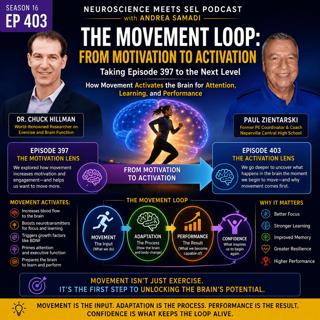
Next Week: Dr. Chuck Hillman Movement, Motivation, and Brain Activation

We'll explore:

✔ How exercise activates the brain

✔ Why movement improves attention and learning

✔ The connection between physical activity and motivation

✔ How movement strengthens cognitive performance

✔ Why action often comes before motivation

✔ And how movement helps keep the Motivation Loop moving forward

Because in Phase 2, we're not just asking:

What makes effort feel worth it?

We're also asking:

What helps us take action once motivation is present?

And Dr. Chuck Hillman's research shows that movement may be one of the most powerful ways to activate the brain for learning, performance, and sustained effort.

Until next time, I'm Andrea Samadi, reminding you that when we understand how the brain works, we can align our thoughts, emotions, behaviors, and actions to create measurable improvements in well-being, achievement, productivity, and results.

Thanks for listening, and I'll see you next week.

RESOURCES:

Full Interview with Dr. Lembke from Sept 2021 https://www.youtube.com/watch?v=5Pu82wZRZwo

CLIP 1: The Neuroscience of Pleasure and Pain

CLIP 2 How Chronic Overstimulation Creates a Dopamine Deficit State

REFERENCES:

[i] Neuroscience Meets Social and Emotional Learning Podcast EPISODE 392 https://andreasamadi.podbean.com/e/belief-first-the-neuroscience-of-motivation/

[ii]Neuroscience Meets Social and Emotional Learning Podcast EPISODE 393 https://andreasamadi.podbean.com/e/belief-first-the-neuroscience-of-motivation/

[iii]Neuroscience Meets Social and Emotional Learning Podcast EPISODE 394 https://andreasamadi.podbean.com/e/thoughts-as-biology-how-your-mind-shapes-neurochemistry/

[iv] Neuroscience Meets Social and Emotional Learning Podcast EPISODE 395 https://andreasamadi.podbean.com/e/theory-of-mind-the-missing-link-between-attention-reward-and-motivation/

[v]Neuroscience Meets Social and Emotional Learning Podcast EPISODE 162 https://andreasamadi.podbean.com/e/medical-director-of-addictive-medicine-at-stanford-university-dr-anna-lembke-on-dopamine-nation-finding-balance-in-the-age-of-indulgence/

Denne episoden er hentet fra en åpen RSS-feed og er ikke publisert av Podme. Den kan derfor inneholde annonser.

Episoder(402)

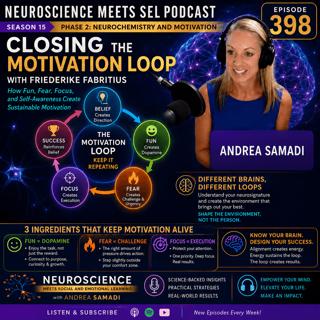
Fun, Fear, Focus: Closing the Motivation Loop with Friederike Fabritius

Fun, Fear, Focus: Closing the Motivation Loop with Friederike Fabritius

Episode 398 revisits neuroscientist Friederike Fabritius (from November 2022) to explain how three ingredients — fun (dopamine), fear (productive challenge), and focus — create the neurochemical condi...

9 Jun 23min
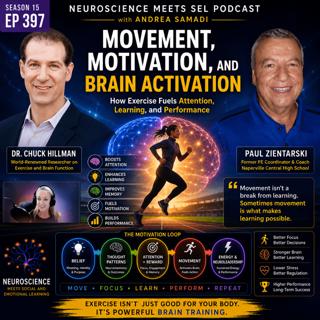
Move to Learn: How Movement Activates the Brain and Fuels Motivation (with Dr. Chuck Hillman and Paul Zientarski)

Move to Learn: How Movement Activates the Brain and Fuels Motivation (with Dr. Chuck Hillman and Paul Zientarski)

Season 15, Episode 397 revisits research and real-world practice showing movement is more than fitness: it activates the brain, boosts attention, enhances learning, and sustains motivation. Dr. Chuck ...

31 Mai 35min

Theory of Mind: The Missing Link Between Attention, Reward, and Motivation with John Medina

Theory of Mind: The Missing Link Between Attention, Reward, and Motivation with John Medina

Episode 395 explores how theory of mind — our ability to understand others' intentions — drives attention, emotional relevance, and reward, shaping motivation and behavior. Dr. John Medina explains wh...

17 Mai 37min

Thought Patterns & Neurochemistry — The Hidden Drivers of Your Life (Revisiting Dr. Caroline Leaf)

Thought Patterns & Neurochemistry — The Hidden Drivers of Your Life (Revisiting Dr. Caroline Leaf)

In this episode Andrea Samadi revisits her October 2022 interview with Dr. Caroline Leaf about how our thought patterns act as biological instructions that shape brain chemistry, behavior, and results...

26 Apr 25min

The Neuroscience of Belief: How Meaning, Identity and Frequency, Drive Motivation (Featuring Bob Proctor)

The Neuroscience of Belief: How Meaning, Identity and Frequency, Drive Motivation (Featuring Bob Proctor)

Andrea Samadi explores Phase Two of the brain roadmap, showing how belief—shaped by meaning, identity, and daily practice—starts the motivation loop and drives action. Featuring insights from Bob Proc...

19 Apr 28min

The Motivation Loop: How Your Brain Decides What’s Worth Doing

The Motivation Loop: How Your Brain Decides What’s Worth Doing

Season 15, Episode 392 introduces phase two of the roadmap: neurochemistry and motivation. Andrea Samadi breaks down the motivation loop—expectation, thought patterns, attention and action, feedback, ...

12 Apr 19min

When Brains Dream: How Sleep Integrates Emotion, Insight, and Creativity (Revisiting Antonio Zadra)

When Brains Dream: How Sleep Integrates Emotion, Insight, and Creativity (Revisiting Antonio Zadra)

Andrea Samadi revisits a conversation with sleep researcher Antonio Zadra on why the brain dreams, how REM sleep integrates emotions and memories, and the NextUp model (Network Exploration to Understa...

5 Apr 21min

Populært innen Fakta

fastlegen
dine-penger-pengeradet
relasjonspodden-med-dora-thorhallsdottir-kjersti-idem
foreldreradet
jakt-og-fiskepodden
rss-bisarr-historie
treningspodden
rss-strid-de-norske-borgerkrigene
mikkels-paskenotter
rss-kunsten-a-leve
sinnsyn
hverdagspsyken
gravid-uke-for-uke
hagespiren-podcast
lederskap-nhhs-podkast-om-ledelse
dopet
rss-sunn-okonomi
uroskolen
rss-mind-body-podden
rss-kull