Subsea Cables, Trusted Networks, and India's Strategic Opportunity

Subsea Cables, Trusted Networks, and India's Strategic Opportunity

Pooja opens with a mismatch that frames the entire conversation. India consumes around 20% of global internet traffic but accounts for just 2% of global subsea cable infrastructure. Even with the expansion of landing stations currently underway, the gap between India's digital ambitions and its physical cable footprint is significant. Part of this is historical: cable infrastructure was concentrated in Mumbai and Chennai, and building it out is prohibitively expensive. Part of it is structural: the raw materials, the technology, and crucially the cable-laying ships that make all of it possible are controlled by a very small number of countries.

On the question of China's expanding footprint, Pooja draws out a tension that runs through the whole conversation: private cable companies are driven by cost and scale, and will naturally gravitate towards cheaper components and partners regardless of where they come from. Sovereign concerns around espionage, trusted supply chains, and national security are a different conversation entirely, and the two do not always find a common language easily. This is where the idea of trusted networks becomes important, frameworks built around like-minded partners who share a common understanding of hardware standards, legal norms, and jurisdictional protections. Australia's approach of using its Exclusive Economic Zone provisions to protect cable infrastructure is one model Pooja thinks India should take seriously and preliminary discussions suggest it already is.

On Quad, Pooja notes that the cable connectivity and resilience partnership launched at the Leaders’ Summit was significant, and there is work happening beneath the surface even if it is not attracting media attention. She concludes by suggesting that more clarity from the government on where India stands on subsea cables, which bodies are responsible, and the national approach will help the broader conversation, especially aiding relevant stakeholders reach out to the right people within the government. That clarity, she argues, is the essential first step.

Every two weeks, Interpreting India brings you diverse voices from India and around the world to explore the critical questions shaping the nation's future. We delve into how technology, the economy, and foreign policy intertwine to influence India's relationship with the global stage.

As a Carnegie India production, hosted by Carnegie scholars, Interpreting India, a Carnegie India production, provides insightful perspectives and cutting-edge by tackling the defining questions that chart India's course through the next decade.

Stay tuned for thought-provoking discussions, expert insights, and a deeper understanding of India's place in the world.

Don't forget to subscribe, share, and leave a review to join the conversation and be part of Interpreting India's journey.

Denne episoden er hentet fra en åpen RSS-feed og er ikke publisert av Podme. Den kan derfor inneholde annonser.

Episoder(153)

India, Australia, and the Critical Minerals Opportunity

India, Australia, and the Critical Minerals Opportunity

The conversation opens with a useful baseline on both countries. Australia has world-class mining equipment, technology, and services capabilities, and its mining sector contributes roughly 10 to 15 p...

13 Aug 49min
Chokepoints, Economic Warfare and India's Strategic Options

Chokepoints, Economic Warfare and India's Strategic Options

Edward lays out three criteria for what makes something a genuine choke point: dominant market share, difficulty to substitute, and the ability to weaponize it with asymmetric impact, hurting the adve...

10 Jul 33min
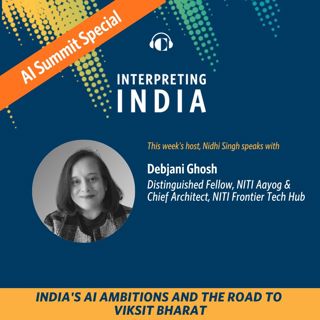
India's AI Ambitions and the Road to Viksit Bharat | AI Summit Special

India's AI Ambitions and the Road to Viksit Bharat | AI Summit Special

This is the final episode of our special series on the India AI Impact Summit, examining the conversations, decisions, and debates that are shaping global AI governance. This episode explores: India...

2 Jul 33min
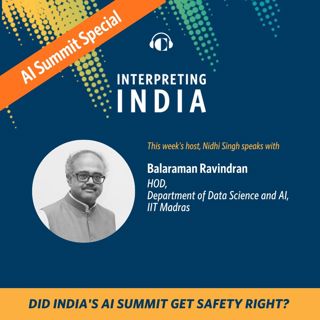
Did India's AI Summit Get Safety Right? AI Summit Special

Did India's AI Summit Get Safety Right? AI Summit Special

This episode is part of our special series on the India AI Impact Summit, examining the conversations, decisions, and debates that are shaping global AI governance. Professor Ravindran addresses early...

19 Jun 40min
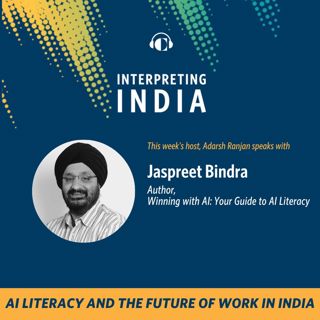
AI Literacy and the Future of Work in India

AI Literacy and the Future of Work in India

Jaspreet's framing for the AI and work debate is worth staying with. He is not dismissive of disruption: he thinks AI will destroy certain jobs, create new ones, and the rupture will be real. But he p...

26 Mai 44min
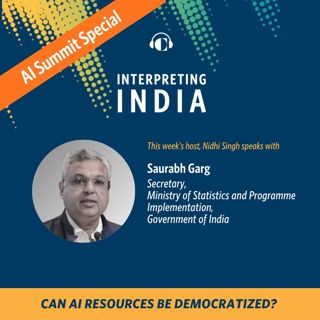
Can AI Resources Be Democratized? AI Summit Special

Can AI Resources Be Democratized? AI Summit Special

This episode is part of our special series on the India AI Impact Summit, examining the conversations, decisions, and debates that are shaping global AI governance. The working group was designed from...

15 Mai 28min

Space Security in the Age of AI

Space Security in the Age of AI

Almudena opens with a distinction that anchors the entire conversation: space security, unlike space safety, is about intentional harm. It concerns deliberate attempts to disrupt, deny, or destroy spa...

7 Mai 1h 7min

Populært innen Politikk og nyheter

giver-og-gjengen-vg
aftenpodden
forklart
stopp-verden
popradet
aftenpodden-usa
nokon-ma-ga
dine-penger-pengeradet
det-store-bildet
lydartikler-fra-aftenposten
rss-gukild-johaug
hanna-de-heldige
rss-ness
rss-penger-polser-og-politikk
aftenbla-bla
unitedno
frokostshowet-pa-p5
e24-podden
grasoner-den-nye-kalde-krigen
ta-dokumentar