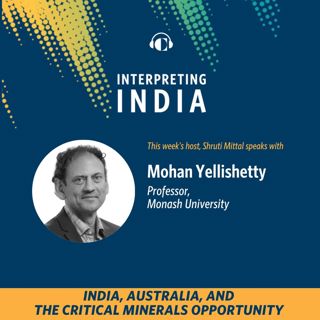
India, Australia, and the Critical Minerals Opportunity

India, Australia, and the Critical Minerals Opportunity

The conversation opens with a useful baseline on both countries. Australia has world-class mining equipment, technology, and services capabilities, and its mining sector contributes roughly 10 to 15 percent of GDP, yet it remains predominantly a raw material exporter with limited domestic demand. India has a large and growing demand for minerals to fuel its manufacturing ambitions, a vast talent pool, and competitive labour and energy costs, but has historically underinvested in systematic exploration, reserve creation, and processing relative to its long-term needs. The complementarity is clear, but Professor Yellishetty is equally clear about what is missing: while government-to-government and university-to-university engagement is working well through mechanisms such as the Comprehensive Strategic Partnership, the Ministry of Mines MoU, and KABIL's engagement with Australia's Critical Minerals Facilitation Office, the business-to-business piece

On the Australia-India Critical Minerals Research Hub (AICMRH), the conversation traces its origins to a community of practice that came together during the COVID-19 lockdown, eventually growing to around 150 researchers. The Hub has since hosted national symposiums, submitted recommendations to ministries on both sides, and facilitated student exchanges, with institutional partnerships including Monash University's collaborations with IIT Bombay and IIT Hyderabad. Professor Yellishetty notes that the Hub's policy recommendations fed into discussions around India's first critical minerals list and the announcement of Centres of Excellence (CoE) under the National Critical Minerals Mission, launched in 2025. The next step, he argues, is institutionalising this through a Joint Centre of Excellence that can anchor commercial outcomes alongside research, including moving promising technologies such as environmentally benign processing methods like deep eutectic solvents from laboratory to pilot scale and eventually to commercial deployment.

Looking ahead, Professor Yellishetty organises the India-Australia opportunity into five buckets: policy and trade, technology research and development, investment and financing, skills and capacity building, and ESG learning. He sees particular promise in co-developing processing technologies rather than simply transferring them, spanning rare earth extraction, lithium value chains, and environmentally safer processing, as well as co-investing in third countries like Indonesia and Vietnam that hold significant mineral reserves. He also situates the bilateral relationship within the wider Quad framework, where Australia contributes mining and ESG expertise, Japan brings capital and downstream processing experience, and the United States offers technology and intellectual property, alongside India's scale and human capital. The ambition, ultimately, is to build India into not just a consumer of critical minerals but a processing hub capable of serving western markets.

Every two weeks, Interpreting India brings you diverse voices from India and around the world to explore the critical questions shaping the nation's future. We delve into how technology, the economy, and foreign policy intertwine to influence India's relationship with the global stage.

As a Carnegie India production, hosted by Carnegie scholars, Interpreting India, a Carnegie India production, provides insightful perspectives and cutting-edge by tackling the defining questions that chart India's course through the next decade.

Stay tuned for thought-provoking discussions, expert insights, and a deeper understanding of India's place in the world.

Don't forget to subscribe, share, and leave a review to join the conversation and be part of Interpreting India's journey.

Denne episoden er hentet fra en åpen RSS-feed og er ikke publisert av Podme. Den kan derfor inneholde annonser.

Episoder(153)

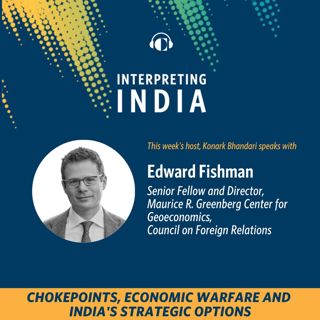
Chokepoints, Economic Warfare and India's Strategic Options

Chokepoints, Economic Warfare and India's Strategic Options

Edward lays out three criteria for what makes something a genuine choke point: dominant market share, difficulty to substitute, and the ability to weaponize it with asymmetric impact, hurting the adve...

10 Jul 33min
India's AI Ambitions and the Road to Viksit Bharat | AI Summit Special

India's AI Ambitions and the Road to Viksit Bharat | AI Summit Special

This is the final episode of our special series on the India AI Impact Summit, examining the conversations, decisions, and debates that are shaping global AI governance. This episode explores: India...

2 Jul 33min
Did India's AI Summit Get Safety Right? AI Summit Special

Did India's AI Summit Get Safety Right? AI Summit Special

This episode is part of our special series on the India AI Impact Summit, examining the conversations, decisions, and debates that are shaping global AI governance. Professor Ravindran addresses early...

19 Jun 40min
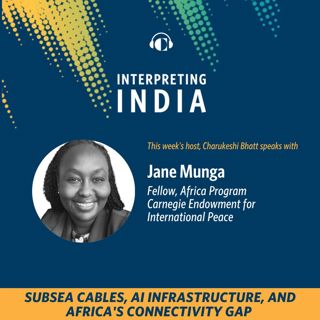
Subsea Cables, Trusted Networks, and India's Strategic Opportunity

Subsea Cables, Trusted Networks, and India's Strategic Opportunity

Pooja opens with a mismatch that frames the entire conversation. India consumes around 20% of global internet traffic but accounts for just 2% of global subsea cable infrastructure. Even with the expa...

4 Jun 46min
AI Literacy and the Future of Work in India

AI Literacy and the Future of Work in India

Jaspreet's framing for the AI and work debate is worth staying with. He is not dismissive of disruption: he thinks AI will destroy certain jobs, create new ones, and the rupture will be real. But he p...

26 Mai 44min
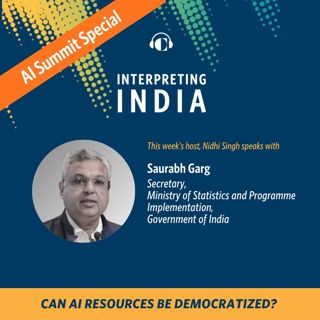
Can AI Resources Be Democratized? AI Summit Special

Can AI Resources Be Democratized? AI Summit Special

This episode is part of our special series on the India AI Impact Summit, examining the conversations, decisions, and debates that are shaping global AI governance. The working group was designed from...

15 Mai 28min

Space Security in the Age of AI

Space Security in the Age of AI

Almudena opens with a distinction that anchors the entire conversation: space security, unlike space safety, is about intentional harm. It concerns deliberate attempts to disrupt, deny, or destroy spa...

7 Mai 1h 7min

Populært innen Politikk og nyheter

giver-og-gjengen-vg
aftenpodden
forklart
stopp-verden
popradet
aftenpodden-usa
nokon-ma-ga
dine-penger-pengeradet
det-store-bildet
lydartikler-fra-aftenposten
rss-gukild-johaug
hanna-de-heldige
rss-ness
rss-penger-polser-og-politikk
aftenbla-bla
unitedno
frokostshowet-pa-p5
e24-podden
grasoner-den-nye-kalde-krigen
ta-dokumentar