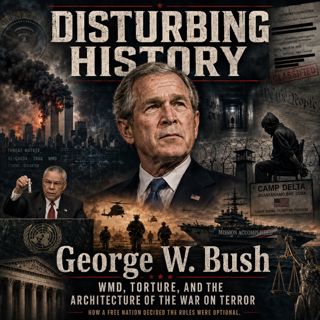

George W. Bush: The War On Terror

George W. Bush: The War On Terror

In this episode of the Disturbing History presidential series, we cross out of settled history and into living memory to examine the presidency of George W. Bush through the architecture of the War on Terror.

Beginning with the attacks of September 11, 2001, and the fear that reshaped American government overnight, we trace how that fear was translated into law, policy, and ultimately a global apparatus of detention, interrogation, surveillance, and war.

We walk through the legal scaffolding built inside the Justice Department's Office of Legal Counsel, where attorneys John Yoo and Jay Bybee drafted the August 1, 2002 "torture memos" that redefined torture so narrowly that only pain equivalent to organ failure or death would qualify, and that advanced the unitary executive theory placing the president's wartime authority beyond the reach of Congress and the courts.

We examine the opening of the Guantánamo Bay detention camp on January 11, 2002, deliberately sited beyond the expected reach of American courts, and the roughly 780 men held there, the overwhelming majority eventually released without charge.We follow the CIA's enhanced interrogation program from its first subject, Abu Zubaydah, through the network of secret black sites in Thailand, Poland, Romania, Lithuania, and Afghanistan, including the death of Gul Rahman from hypothermia at the site known as COBALT or the Salt Pit in November 2002. We cover the extraordinary rendition of innocent men, among them Canadian engineer Maher Arar, German citizen Khaled el-Masri, and the Milan cleric Abu Omar, whose abduction led to the in-absentia conviction of more than twenty CIA operatives in Italian courts.

The episode then turns to the case for the Iraq War: the aluminum tubes claim disputed by the Department of Energy and the State Department, the mobile biological weapons labs invented by the fabricator code-named Curveball (Rafid Ahmed Alwan al-Janabi), and the "sixteen words" about Niger uranium built on forged documents, along with the leak that exposed CIA officer Valerie Plame.

We revisit Secretary of State Colin Powell's February 5, 2003 presentation to the United Nations, which he later called a "blot" on his record, and the invasion of March 19, 2003, followed by the "Mission Accomplished" banner of May 1, 2003.

We document the conclusion of weapons inspectors David Kay and Charles Duelfer that no stockpiles ever existed.We confront the Abu Ghraib photographs that surfaced in April 2004, the death of detainee Manadel al-Jamadi, and the line connecting low-ranking soldiers to the policies authorized at the top.

We cover the warrantless surveillance program Stellar Wind, the 2004 hospital-room confrontation over its reauthorization, and its eventual legalization. We trace the Supreme Court's slow pushback through Rasul v. Bush, Hamdi v. Rumsfeld, Hamdan v. Rumsfeld, and Boumediene v. Bush. And we close with the December 9, 2014 Senate Intelligence Committee report, its findings that the program was ineffective and far more brutal than disclosed, that at least 26 of 119 detainees were wrongfully held, and that no senior official was ever prosecuted.

Throughout, we ask the question that outlives the administration: how a free nation decided the rules were optional, and why the machinery it built has never been turned off.This episode draws on the public record, including the Senate Select Committee on Intelligence report on the CIA's Detention and Interrogation Program, the Iraq Survey Group's Duelfer Report, the Senate's prewar intelligence assessment, declassified Office of Legal Counsel memoranda, and Supreme Court opinions.

Where the historical record remains genuinely contested, such as the question of intent versus error in the WMD case and the British Butler Report's defense of the uranium claim, both sides are presented.

This episode discusses torture, death in custody, and wartime atrocity. Listener discretion is advised.

Have a forgotten historical mystery, disturbing event, unsolved crime, or hidden conspiracy you think deserves investigation?

Send your suggestions to brian@paranormalworldproductions.com.

Disturbing History is a dark history podcast exploring unsolved mysteries, secret societies, historical conspiracies, lost civilizations, and the shadowy stories buried beneath the surface of the past.

Follow the show and enable automatic downloads so you never miss a deep dive into history’s most unsettling secrets.

Because sometimes the truth is darker than fiction.

Denne episoden er hentet fra en åpen RSS-feed og er ikke publisert av Podme. Den kan derfor inneholde annonser.

Episoder(154)

The 1990's

The 1990's

On July 16, 1990, Time magazine put a group of young adults on its cover beneath the word “twentysomething” and asked whether they were laid back, late blooming, or simply lost. The story said they st...

30 Sep 1h 12min
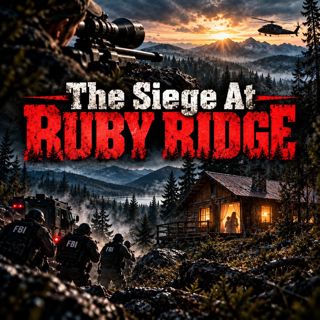
The Siege At Ruby Ridge

The Siege At Ruby Ridge

Listener discretion is advised. This episode contains descriptions of real-life violence and death, including the shooting deaths of a fourteen-year-old boy, his mother, and a federal law enforcement ...

27 Sep 1h 18min

The 1980's

The 1980's

The 1980s began with 52 Americans still being held hostage in Tehran and ended with crowds tearing open the Berlin Wall. Between those two moments came one of the most turbulent, contradictory decades...

25 Sep 1h 9min
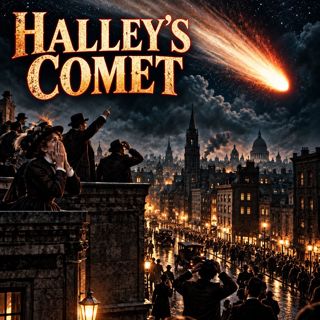
Halley's Comet

Halley's Comet

On the night of May 18, 1910, people across the world waited for Halley’s Comet to kill them.Hotels in New York opened their rooftops. Miners in Pennsylvania refused to go underground. A religious sec...

23 Sep 1h 1min
The Freeway Killer

The Freeway Killer

This episode discusses sexual violence against children and teenagers, torture, and murder and is not suitable for younger audiences. Listener discretion is strongly advised. On the night of June 11, ...

21 Sep 1h 19min
The 1970's

The 1970's

The 1970s opened in conflict.On April 30, 1970, President Richard Nixon announced the expansion of U.S. military operations into Cambodia.Days later, four students were killed by the Ohio National Gua...

18 Sep 1h 2min
The Bystander Effect

The Bystander Effect

On March 27, 1964, The New York Times published a story that would become one of the most famous examples of human indifference ever told. According to the report, 38 people in Queens watched as 28-ye...

16 Sep 1h
The 1960's

The 1960's

Everybody knows the line: “Don’t trust anyone over thirty.” It became shorthand for an entire generation, even though the man who said it was a 24-year-old Berkeley graduate student who would turn thi...

13 Sep 1h 2min

Populært innen Samfunn

rss-spartsklubben
giver-og-gjengen-vg
aftenpodden
konspirasjonspodden
aftenpodden-usa
popradet
rss-nesten-hele-uka-med-lepperod
rss-henlagt-andy-larsgaard
alt-fortalt
wolfgang-wee-uncut
rss-espen-lee-usensurert
grenselos
min-barneoppdragelse
synnve-og-vanessa
fladseth
frokostshowet-pa-p5
rss-herrepanelet
opptur-med-annette-og-ingeborg
rss-chit-chat-med-rakel-og-helle
krisemoter