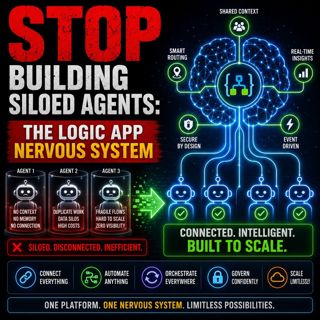
STOP BUILDING SILOED AGENTS: The Logic App Nervous System

STOP BUILDING SILOED AGENTS: The Logic App Nervous System

Everyone is building AI agents.Very few organizations are building agent architectures.Across Microsoft 365, Copilot Studio, Azure OpenAI, Power Platform, and custom AI solutions, enterprises are racing to deploy copilots, bots, assistants, and autonomous workflows. Teams are creating agents for customer service, IT support, HR onboarding, knowledge discovery, incident management, and business operations.Most of them work.At least in the demo.But something very different happens when organizations move beyond a single agent and attempt to coordinate dozens of AI-powered systems across multiple business units, multiple platforms, and multiple Microsoft 365 tenants.The result is often chaos.Disconnected bots. Duplicate integrations. Credential sprawl. Governance gaps. Broken workflows. Untraceable actions. And increasingly, AI agents that cannot collaborate because they were never designed to operate as part of a larger system.In this episode, we explore why enterprise AI is repeating the same architectural mistakes organizations made during the early API revolution, why point-to-point agent integrations are becoming unsustainable, and how Azure Logic Apps is emerging as the orchestration layer that connects reasoning, execution, governance, identity, and automation into a single enterprise nervous system.If your organization is investing in Copilot Studio, Azure OpenAI, Microsoft 365 Copilot, Power Platform, or custom AI agents, this episode provides a blueprint for building agent ecosystems that actually scale.

THE CHATBOT MIRAGE

Most enterprise AI projects begin with a simple success story.A team creates a bot.The bot answers questions.The demo works.The project gets funded.Then another department builds another bot.And another.And another.Soon the organization has dozens of isolated AI systems solving local problems but creating enterprise-wide complexity.We explore:
  • Why AI demos rarely reveal architectural weaknesses
  • The difference between local optimization and enterprise orchestration
  • How siloed agents create operational debt
  • Why successful pilots often fail at scale
  • The hidden cost of disconnected automation
The problem isn't the agents.The problem is the architecture beneath them.

THE POINT-TO-POINT INTEGRATION TRAP

Every agent needs data.Most agents get it the wrong way.Organizations frequently allow agents to connect directly to APIs, databases, SaaS platforms, and Microsoft Graph endpoints.Initially this feels efficient.Eventually it becomes unmanageable.This episode examines:
  • Point-to-point integration sprawl
  • Credential proliferation
  • Duplicate business logic
  • Decentralized error handling
  • Governance fragmentation
  • Observability challenges
The more agents you deploy, the more dangerous direct integration becomes.

WHY AGENTS FAIL AT ENTERPRISE SCALE

The most advanced language model in the world cannot compensate for poor architecture.We discuss why:
  • Reasoning is not orchestration
  • Intelligence is not governance
  • Conversation is not workflow management
  • Tool calling is not process execution
  • AI is not a replacement for enterprise integration
Enterprise success depends less on model sophistication and more on execution architecture.
THE STATEFUL GAPOne of the most important concepts in this episode is the distinction between reasoning and memory.Most AI agents are stateless.Enterprise processes are not.We explore:
  • Stateless automation
  • Stateful orchestration
  • Long-running workflows
  • Process persistence
  • Workflow recovery
  • Correlation and context management
An employee onboarding process may last days or weeks.A chatbot conversation may last minutes.These are fundamentally different workloads.

WHY COPILOTS NEED A NERVOUS SYSTEM

Human brains don't directly control every muscle individually.The nervous system coordinates actions.Enterprise AI requires the same model.This episode introduces the Logic App Nervous System architecture where:
  • Agents reason
  • Logic Apps orchestrate
  • Connectors execute
  • Policies govern
  • Identity secures
  • Observability monitors
The result is coordinated intelligence instead of isolated automation.

AZURE LOGIC APPS AS THE ORCHESTRATION LAYER

Azure Logic Apps was originally designed for enterprise integration.It is rapidly becoming one of the most important foundations for agentic workflows.We examine:
  • HTTP-triggered orchestrations
  • Event-driven automation
  • Workflow persistence
  • Long-running process support
  • Enterprise connectors
  • Business process orchestration
Logic Apps becomes the central coordination layer between agents and enterprise systems.

STANDARD VS CONSUMPTION

ot all Logic Apps are equal.Choosing the wrong hosting model can limit scalability before your architecture even launches.We compare:
  • Logic Apps Consumption
  • Logic Apps Standard
  • Stateful workflows
  • Stateless workflows
  • DevOps integration
  • Networking capabilities
  • Performance characteristics
For serious agent orchestration, the answer becomes increasingly clear.

STATEFUL WORKFLOWS: THE MEMORY LAYER

Memory is what transforms automation into orchestration.Stateful workflows provide:
  • Checkpointing
  • Persistence
  • Recovery
  • Waiting states
  • Approval handling
  • Cross-system coordination
We explain why workflow memory is often more important than model memory.

THE AGENT LOOP ACTION

One of Microsoft's most important innovations for agentic workflows is the Agent Loop action.This episode explores:
  • Think-Act-Learn cycles
  • Tool execution
  • Iterative reasoning
  • Memory retention
  • AI-assisted orchestration
  • Workflow-native agents
Rather than bolting AI onto workflows, Agent Loop embeds reasoning directly into the orchestration layer.

CONNECTORS AS NEURAL PATHWAY

SIn the nervous system analogy, connectors become the nerves.They connect orchestration to execution.We discuss:
  • Microsoft Graph
  • SharePoint
  • Teams
  • Outlook
  • Dataverse
  • Dynamics 365
  • Azure Services
  • Custom APIs
The orchestrator becomes the central intelligence that routes activity across the enterprise.

CUSTOM CONNECTORS AND LOGIC-IN-API

Modern enterprises cannot expose proprietary business logic directly to agents.Instead, they need contracts.We explore:
  • OpenAPI specifications
  • Custom connectors
  • Internal APIs
  • Enterprise service layers
  • Reusable business capabilities
  • Governance boundaries
Custom connectors become the contract layer between AI and enterprise systems.

THE CROSS-TENANT CHALLENGE

Most organizations no longer operate in a single Microsoft 365 tenant.Mergers, acquisitions, regional operations, and regulatory requirements have changed the landscape.This episode examines:
  • Multi-tenant architectures
  • Cross-tenant identity
  • Microsoft Entra collaboration
  • Sovereign boundaries
  • Tenant isolation
  • Enterprise coordination
Cross-tenant orchestration is becoming the default, not the exception.

MANAGED IDENTITIES EXPLAINED

Secrets are one of the biggest weaknesses in enterprise automation.We explain how managed identities eliminate:
  • Client secrets
  • Credential sprawl
  • Manual rotation
  • Shared credentials
  • Configuration risk
Identity becomes a platform capability instead of an operational burden.

WORKLOAD IDENTITY FEDERATION

Cross-tenant automation introduces a new challenge.How do workloads authenticate without secrets?This episode explores:
  • Workload identity federation
  • Azure AD Token Exchange
  • Federated credentials
  • Cross-tenant trust
  • Secretless authentication
  • Zero Trust architectures
This becomes one of the most important building blocks for enterprise-scale agent ecosystems.

MICROSOFT ENTRA AGENT ID

Identity is becoming a first-class concern for AI agents.We examine how Microsoft Entra Agent ID enables:
  • Agent governance
  • Agent identities
  • Blueprint-driven permissions
  • Security boundaries
  • Authorization controls
  • AI accountability
The future of AI governance begins with identity.

ERROR HANDLING AS INTELLIGENCE

Failures are inevitable.Resilience is optional.We explore advanced orchestration patterns including:
  • Scoped error handling
  • Adaptive retries
  • Compensating transactions
  • AI-assisted error triage
  • Self-healing workflows
  • Recovery orchestration
The goal is not preventing failure.The goal is surviving failure intelligently.

Become a supporter of this podcast: https://www.spreaker.com/podcast/m365-fm-modern-work-security-and-productivity-with-microsoft-365--6704921/support.

Denne episoden er hentet fra en åpen RSS-feed og er ikke publisert av Podme. Den kan derfor inneholde annonser.

Episoder(655)

From SharePoint Developer to Power Platform Architect: Building Secure and Scalable Solutions with Michel Mendes [MVP]

From SharePoint Developer to Power Platform Architect: Building Secure and Scalable Solutions with Michel Mendes [MVP]

In this episode of the M365 Podcast, Mirko Peters sits down with Microsoft MVP Michel Mendes to explore his remarkable journey from traditional SharePoint development to becoming a leading Power Platf...

16 Jun 44min

Building Multi-Agent AI Systems with Copilot Studio: From Ideas to Intelligent Automation with David Lorenzo Lopez  [MVP]

Building Multi-Agent AI Systems with Copilot Studio: From Ideas to Intelligent Automation with David Lorenzo Lopez [MVP]

Artificial Intelligence is rapidly evolving from simple chatbots into sophisticated multi-agent systems capable of automating complex business processes, collaborating across services, and delivering ...

15 Jun 54min
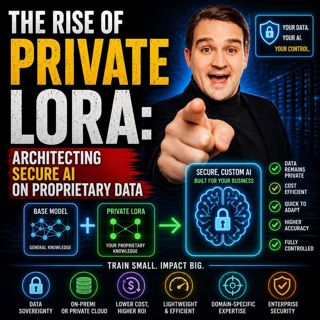
The Rise of Private LoRA: Architecting Secure AI on Proprietary Data

The Rise of Private LoRA: Architecting Secure AI on Proprietary Data

Everyone is talking about AI adoption. Far fewer are talking about AI sovereignty. Organizations have rushed to deploy Microsoft Copilot, Azure OpenAI, ChatGPT Enterprise, Claude, Gemini, and dozens o...

15 Jun 1h 22min
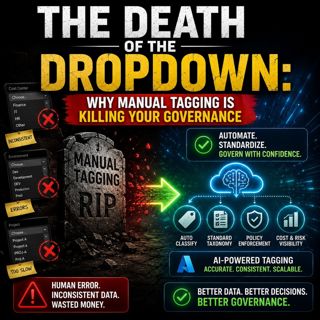
The Death of the Dropdown: Why Manual Tagging is Killing Your Governance

The Death of the Dropdown: Why Manual Tagging is Killing Your Governance

or years, organizations believed metadata governance was a training problem.If users understood the taxonomy better, governance would improve.If the dropdown lists were clearer, metadata quality would...

14 Jun 1h 22min
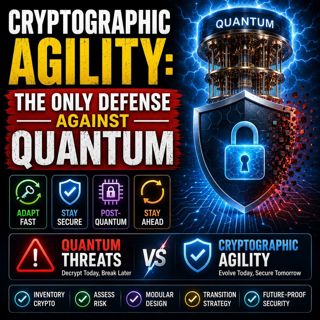
Cryptographic Agility: The Only Defense Against Quantum

Cryptographic Agility: The Only Defense Against Quantum

Most discussions about quantum computing focus on a single question:When will quantum computers break encryption?The better question is this:How quickly can your organization replace encryption when i...

13 Jun 1h 27min

Microsoft Purview in the Age of AI: Securing Copilot with Peter Rising [Microsoft]

Microsoft Purview in the Age of AI: Securing Copilot with Peter Rising [Microsoft]

As organizations race to adopt Microsoft 365 Copilot, AI Agents, and Generative AI, one critical question continues to emerge: is your data ready for AI? In this episode of M365 FM, Mirko Peters sits ...

12 Jun 59min
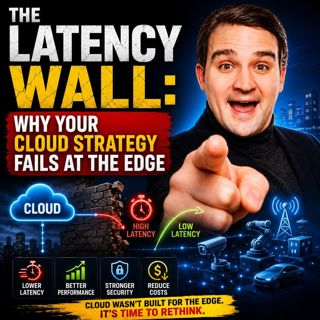
The Latency Wall: Why Your Cloud Strategy Fails at the Edge

The Latency Wall: Why Your Cloud Strategy Fails at the Edge

For years, organizations have followed a simple rule: move everything to the cloud.The strategy worked brilliantly for collaboration, analytics, business intelligence, and productivity workloads. Micr...

12 Jun 1h 20min

Populært innen Politikk og nyheter

giver-og-gjengen-vg
aftenpodden
aftenpodden-usa
fotballpodden-2
forklart
popradet
stopp-verden
det-store-bildet
rss-espen-lee-usensurert
nokon-ma-ga
lydartikler-fra-aftenposten
dine-penger-pengeradet
rss-gukild-johaug
hanna-de-heldige
rss-ness
e24-podden
aftenbla-bla
frokostshowet-pa-p5
rss-utenrikskomiteen-med-bogen-og-grasvik
chit-chat-med-helle