What Makes a Keynote Work: The Buzz Is the Business With Brian Miller

What Makes a Keynote Work: The Buzz Is the Business With Brian Miller

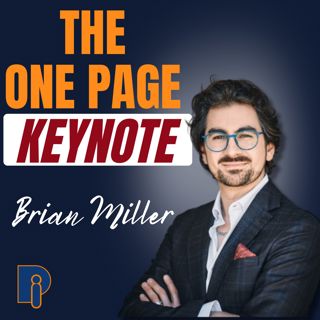
Magician-turned-keynote-speaker Brian Miller built a speaking career on the back of a TEDx talk that went viral in 2015, then watched that career dry up within eighteen months because charisma and entertainment weren't enough to make anyone act on what he'd said. In this episode, Brian and John dig into the real argument underneath most speaker training: is a keynote about how you deliver it, or what's actually in it? Brian's answer, and the thesis of his new book "The One Page Keynote," is that design beats delivery every time, and that the entertainment industry's instinct (be more charismatic, be funnier, be more captivating) is solving the wrong problem for most professional speakers.

The conversation covers what a keynote is actually for (hint: it's not the audience's experience in the room), why "the buzz is the business" is the only metric that matters to the people who write the cheques, how to build credible expertise without a PhD, why slides should be a last resort rather than a crutch, and why the most experienced experts are often the ones most paralysed by imposter syndrome.

Key takeaways:

  • A keynote's job is to shift perspective, not create lasting change. Real change needs repetition and reinforcement; a single talk from the front of the room can only move how someone thinks, which is the first domino.
  • Event planners judge success by one thing: are people still talking about your talk at the coffee break, in the Slack channel, on the Monday call. If they're not, it doesn't matter how entertaining you were.
  • Expertise doesn't require formal credentials. Brian built his on an unreasonable amount of obsessive attention to one niche topic, not a PhD.
  • The most credentialed, knowledgeable speakers are often the most riddled with imposter syndrome, because understanding the nuance and edge cases of your topic makes you aware of everything you could get wrong.
  • A talk should work with the power out and the slides gone. If it only works with the deck, the talk doesn't work.
  • You don't need to out-credential the most famous person in your field. You need a different angle on the same topic; one only you can offer.
  • Audiences don't care about your problem. Buyers booking and paying for keynotes care about theirs, and your talk has to speak to the problem they're already trying to solve, not the one you find interesting.

Get a copy of Brian's new book, The One Page Keynote, from all good booksellers, or even Amazon.

In the UK: https://amzn.to/4vRduAv

and for the USA: https://amzn.to/4ozkfo8

To connect with Brian: https://www.linkedin.com/in/brianmillerspeaks

To work with Brian: https://www.clarityupconsulting.com/

CHAPTERS:

00:00 Charisma Isn’t Enough

02:02 Magician to Speaker Origin

04:35 Viral TEDx and Fast Fees

07:28 Why Rebookings Dried Up

09:59 Design Beats Delivery

15:14 No Boring Topics

17:26 Creating Memorable Moments

19:34 Props and Paintings Example

23:33 Tools Over Talent Tricks

25:39 PowerPoint and Slides Debate

25:50 Slides Without Power

26:34 When Slides Help

29:28 Defining A Keynote

31:03 Shift Perspective Goal

32:19 Buzz Is Business

34:34 Expertise Over Inspiration

38:44 Nuance And Edge Cases

42:48 Topic Angle Buyer Problem

47:27 Book Launch And Offer

50:43 Host Wrap And Next Steps

4. FAQ

Does charisma actually matter for professional keynote speakers?

According to Brian Miller, author of "The One Page Keynote," charisma is far less important to a keynote's success than the design of the talk itself. Miller argues that a well-designed talk delivered without much charisma will outperform a highly charismatic, entertaining talk with no clear message, because audiences who can't articulate what they learned won't talk about the speech afterwards or act on it.

What does "the buzz is the business" mean in professional speaking?

"The buzz is the business" is a phrase Brian Miller uses to describe how event planners actually judge whether a keynote succeeded. Miller has asked thousands of event planners what success looks like, and the near-universal answer is whether attendees are still talking about the talk during coffee breaks, in Slack channels, or in the following Monday's meeting. John Ball and Miller agree that if the audience leaves the talk in the room, the speech has failed, regardless of how well it was delivered.

Do you need a PhD or formal credentials to become a professional keynote speaker?

No. Brian Miller, who has a bachelor's degree in philosophy and no graduate qualifications, argues that expertise can be built by spending an unreasonable amount of time obsessing over a niche topic: reading everything available, talking to practitioners, and understanding the nuance and edge cases well enough to know when standard advice would be wrong for someone. Miller built his expertise in human connection this way after his 2015 TEDx talk went viral.

Should professional speakers use slides during a keynote?

Brian Miller's rule of thumb is that a keynote should work even if the slides disappear and the power goes out. Slides become genuinely useful for talks over twenty minutes, for very large audiences who can't stay engaged through proximity alone, and for explaining highly technical or visual concepts that are difficult to convey in words. Below twenty minutes, Miller generally advises against using slides at all.

How do speakers find their unique angle when someone more famous already covers their topic?

Brian Miller advises against trying to out-credential the most recognised name in your topic area. Instead, he recommends identifying the specific perspective only you can bring to that topic, drawn from your own background or experience, so that buyers aren't comparing you directly to that famous person but considering you for a genuinely different angle on the same subject.

Why do experienced experts often feel more imposter syndrome than beginners?

Brian Miller describes this as the inverse of the Dunning-Kruger effect: understanding a topic well enough to know its edge cases, exceptions, and the situations where standard advice doesn't apply makes experts acutely aware of everything that could go wrong, while beginners with shallow knowledge often feel falsely confident.

Do you want to make sure you have speaker positioning that will get you booked? Grab my free speaker positioning tool and see if your positioning needs a tune-up or a complete overhaul: https://present-influence.kit.com/363f7c1d51

Want to get coached for free on the show? Fill in the form https://forms.gle/mo4xYkEiCjqtz9yP6, and if we think your challenge could help others, we'll invite you on.

For speaking enquiries or to connect with me, you can email john@presentinfluence.com or find me on LinkedIn

You can find all our clips, episodes and more on the Present Influence YouTube channel: https://www.youtube.com/@PresentInfluence

Thanks for listening. Rating the show 5* on Spotify helps their algo recommend the show, so please take a moment to follow the show and leave a rating.

Denne episoden er hentet fra en åpen RSS-feed og er ikke publisert av Podme. Den kan derfor inneholde annonser.

Episoder(200)

How One Speaker Built a $360K Business After An Overdose: His Principle, Money Follows Movement

How One Speaker Built a $360K Business After An Overdose: His Principle, Money Follows Movement

Most speakers can speak. Almost none of them can sell themselves. Ryan Botner can do both, and he learned the second skill the hard way: twenty years in sales, a million-dollar income before thirty, a...

1 Jul 38min

Stop Waiting to Be Discovered: How Speakers Build Businesses That Don't Depend on Luck

Stop Waiting to Be Discovered: How Speakers Build Businesses That Don't Depend on Luck

Most speakers are working hard. They're creating content, building relationships, showing up consistently, and still wondering why the enquiries aren't coming in the way they should.The issue usually ...

24 Jun 21min
The Authenticity Gap: Why Containing Your True Self Is Costing You on Stage

The Authenticity Gap: Why Containing Your True Self Is Costing You on Stage

Most speakers talk about authenticity. Fewer actually practise it. There is a version of you that turns up on stage and a version of you that exists everywhere else, and for many speakers, those two p...

10 Jun 28min

Speaker Demo Reels: What They Are Actually For (and Why Most Get It Wrong)

Speaker Demo Reels: What They Are Actually For (and Why Most Get It Wrong)

Bernadette Marciniak is a video producer who works specifically with speakers and event organisers, giving her a rare dual perspective on what actually gets speakers booked. She has captured footage a...

3 Jun 50min

Why Speakers Give Up Too Soon: The Results Lag

Why Speakers Give Up Too Soon: The Results Lag

There comes a point for almost every speaker and coach where the doubt becomes hard to ignore. You are doing the work, following good advice, showing up consistently — and nothing seems to be moving. ...

27 Mai 24min
Are You Killing Your Speaking Career with "How-To" Content? | David Newman

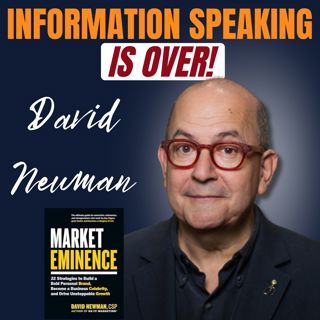
Are You Killing Your Speaking Career with "How-To" Content? | David Newman

David Newman is a speaker, consultant, and author of four books, including Do It Speaking and Market Eminence. He's spent decades helping experts, consultants, and professional speakers build what he ...

13 Mai 53min

Your Speaker Positioning Is Not Your Topic: Why Good Speakers Stay Invisible

Your Speaker Positioning Is Not Your Topic: Why Good Speakers Stay Invisible

If you're a good speaker who isn't getting booked at the rate or fee you think you deserve, this episode is going to be uncomfortable in the right way.The problem, in most cases, isn't your speaking. ...

5 Mai 22min

Populært innen Business og økonomi

stopp-verden
lydartikler-fra-aftenposten
dine-penger-pengeradet
e24-podden
rss-penger-polser-og-politikk
rss-borsmorgen-okonominyhetene
rss-skravla-gar
pengepodden-2
finansredaksjonen
livet-pa-veien-med-jan-erik-larssen
rss-pa-konto
utbytte
okonomiamatorene
morgenkaffen-med-finansavisen
aftenbladet-intervjuer
lederpodden
tid-er-penger-en-podcast-med-peter-warren
liberal-halvtime
pengesnakk
rss-impressions-2