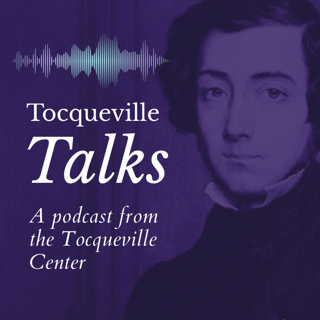
16. Trade Deficits, Tariffs, and the Future of American Industry — Mark DiPlacido

16. Trade Deficits, Tariffs, and the Future of American Industry — Mark DiPlacido

What if globalization didn’t just reshape markets—but quietly reshaped the structure of American life?

In this episode of Tocqueville Talks, Brent Nelsen and Beth L’Arrivée sit down with Mark DiPlacido of American Compass to explore a fundamentally different perspective on trade, tariffs, and economic policy.

DiPlacido argues that the core issue isn’t simply globalization—it’s imbalance. The United States now runs a massive trade deficit, consuming far more than it produces, and financing that gap by trading away assets and accumulating debt.

This isn’t just an abstract economic problem. It has real consequences for workers, communities, and the long-term stability of the American economy.

The conversation reframes the debate by challenging a dominant assumption: that economic success should be measured primarily through consumption. Instead, DiPlacido emphasizes the importance of production—of building an economy that creates meaningful work and sustains a broad middle class.

The episode explores the deeper structural shifts behind today’s policy debates:

  • The rise of persistent trade deficits and what they signal about the U.S. economy

  • How financial globalization changed the relationship between production and wealth

  • Why manufacturing decline has reshaped regional economies and opportunity

  • The limits of the “college-for-all” model in a changing labor market

  • How foreign industrial policy—especially from China—affects American workers

As DiPlacido explains, modern trade isn’t simply an exchange of goods—it increasingly involves the exchange of assets, debt, and long-term economic control.

The discussion also connects directly to Tocqueville’s central concern: What does independence mean in a democratic society—and can it survive without economic self-sufficiency?

Key questions include:

  • What does a trillion-dollar trade deficit actually mean in practice?

  • Are tariffs a distortion of markets—or a response to deeper distortions abroad?

  • Why has manufacturing decline had such uneven effects across American regions?

  • Is the current education model aligned with real economic opportunity?

  • Can a nation remain politically independent if it becomes economically dependent?

DiPlacido offers a provocative framework: An economy that prioritizes consumption over production may appear efficient—but it risks undermining the very foundations of independence, stability, and shared prosperity.

For students, policymakers, and anyone trying to understand the real stakes of globalization, this episode reveals a deeper tension between efficiency and resilience—and asks whether the United States can rebalance before the costs become irreversible.

Denne episoden er hentet fra en åpen RSS-feed og er ikke publisert av Podme. Den kan derfor inneholde annonser.

Episoder(28)

28. Why Americans Are So Patriotic | Tocqueville's Surprising Answer

28. Why Americans Are So Patriotic | Tocqueville's Surprising Answer

Why does patriotism seem so powerful in America—and what happens when it begins to disappear?As Americans celebrate the nation's 250th anniversary, Alexis de Tocqueville's reflections on patriotism ma...

10 Jul 23min

27. Why the Old Political Order Is Cracking | Populism, MAGA, and the Future of Democracy

27. Why the Old Political Order Is Cracking | Populism, MAGA, and the Future of Democracy

For generations, politics in Europe and America was dominated by large, stable political parties. Today, those old political alignments are breaking down.Why are voters abandoning established parties?...

3 Jul 35min

26. What Swimming Can Teach Us About Democracy | Tocqueville's Forgotten Insight

26. What Swimming Can Teach Us About Democracy | Tocqueville's Forgotten Insight

What can a neighborhood swim league teach us about democracy?More than you might think.When Alexis de Tocqueville visited America in 1831, he was astonished by what he called associations—ordinary cit...

25 Jun 41min

25. Is the Postwar Order Ending? Europe, Trump, Ukraine, and the Future of the West — Eleanor Beardsley

25. Is the Postwar Order Ending? Europe, Trump, Ukraine, and the Future of the West — Eleanor Beardsley

For eighty years, Europe and the United States built a common political, economic, and military order.Today, many Europeans wonder whether that world is ending.In this episode of Tocqueville Talks, Br...

18 Jun 27min

24. Why Everything Feels Increasingly Unreal — Beth and Rob L'Arrivée

24. Why Everything Feels Increasingly Unreal — Beth and Rob L'Arrivée

Why does everything feel increasingly unreal?The people most trapped in abstraction are often the people consuming the most information.Tocqueville saw this danger almost 200 years ago.In this episode...

11 Jun 22min

23. Can Europe Stay United? The EU, National Identity, and the Future of European Politics — On the Road with Dr. Nelsen

23. Can Europe Stay United? The EU, National Identity, and the Future of European Politics — On the Road with Dr. Nelsen

What does it mean to be European in the twenty-first century?In this episode of Tocqueville Talks, Brent Nelsen joins three Tocqueville Fellows—Madison (“Maddie”) Maddie, Zach LaComb, and Lane Lytle—f...

4 Jun 34min

22. Academic Freedom, Populism, and the Purpose of Higher Education — Reflections on a Year of Tocqueville Talks

22. Academic Freedom, Populism, and the Purpose of Higher Education — Reflections on a Year of Tocqueville Talks

What questions defined this year’s biggest conversations at the Tocqueville Center?In this special year-end reflection episode of Tocqueville Talks, Brent Nelsen, Beth L’Arrivée, and longtime Furman U...

28 Mai 23min

21. Why Students Still Read Books — Inside the Tocqueville Fellows Program at Furman University

21. Why Students Still Read Books — Inside the Tocqueville Fellows Program at Furman University

What does it take to build a community of students who still read books, ask difficult questions, and engage seriously with ideas?In this episode of Tocqueville Talks, Brent Nelsen sits down with Lucy...

21 Mai 21min
Populært innen Politikk og nyheter

giver-og-gjengen-vg
aftenpodden
forklart
aftenpodden-usa
popradet
stopp-verden
dine-penger-pengeradet
nokon-ma-ga
rss-espen-lee-usensurert
rss-gukild-johaug
hanna-de-heldige
fotballpodden-2
det-store-bildet
aftenbla-bla
rss-ness
rss-penger-polser-og-politikk
e24-podden
frokostshowet-pa-p5
bt-dokumentar-2
unitedno