The Death of the Generalist Bot: Why Your Copilot Needs a Mixture of Experts

The Death of the Generalist Bot: Why Your Copilot Needs a Mixture of Experts

Most organizations are building AI the same way.One copilot.One interface.One large model expected to handle every request.At first glance, the approach feels simple, scalable, and easy to govern. But as AI adoption accelerates, many organizations are discovering that the generalist AI model creates hidden costs, inconsistent quality, governance challenges, and growing operational complexity.In this episode of the M365 FM Podcast, we explore why the future of enterprise AI is not a single super-intelligent assistant but a governed network of specialized experts working together through intelligent routing, orchestration, and policy-driven decision making.

THE PROBLEM WITH THE GENERALIST AI MODEL

The idea of a single AI assistant sounds attractive.Users get one interface.IT gets one platform.Leadership gets one AI strategy.The reality is far more complicated.As organizations expand AI use cases, the same assistant suddenly becomes responsible for:
  • Knowledge retrieval
  • Policy interpretation
  • Workflow execution
  • Document summarization
  • Data extraction
  • Business automation
The episode explores why forcing one model to perform every role eventually creates cost, quality, and governance problems that become difficult to control at scale.

WHY AI COSTS EXPLODE FASTER THAN EXPECTED

Many organizations focus exclusively on model pricing while ignoring the architecture decisions driving overall AI costs.This discussion examines:
  • Premium model overuse
  • Blended cost analysis
  • High-volume routine workloads
  • Token consumption patterns
  • Cheap-first routing strategies
  • Escalation-based AI architectures
Listeners learn why most enterprise AI traffic consists of repetitive, predictable tasks that often do not require expensive frontier models.

SMALL MODELS ARE MORE POWERFUL THAN MOST PEOPLE THINK

One of the most surprising themes of the episode is the growing role of smaller AI models such as Microsoft's Phi family.The conversation explores why:
  • Classification tasks rarely need large models
  • Intent detection can run efficiently on smaller models
  • Extraction workloads benefit from specialization
  • Routing decisions favor low-latency models
  • Operational efficiency often beats raw intelligence
Rather than asking which model is smartest, organizations should ask which model is best suited for a specific task.

UNDERSTANDING MIXTURE OF EXPERTS

Mixture of Experts (MoE) is often misunderstood.Many people associate MoE only with advanced model architectures that activate specialized internal experts.This episode explores a more practical enterprise interpretation:A governed system of specialized AI services working together.Topics include:
  • Model-level MoE
  • System-level MoE
  • Expert specialization
  • Intelligent routing
  • Expert orchestration
  • Bounded responsibilities
The result is a flexible AI architecture where each component performs a clearly defined role.

COPILOT STUDIO VS AZURE AI FOUNDRY

One of the most important architectural discussions focuses on the relationship between Microsoft Copilot Studio and Azure AI Foundry.The episode explains why these platforms should not compete with one another.Instead:
  • Copilot Studio becomes the user experience layer
  • Azure AI Foundry becomes the reasoning layer
  • Routing logic manages model selection
  • Specialist agents perform bounded tasks
  • Governance controls span the entire architecture
Understanding these responsibilities helps organizations build AI systems that remain manageable as complexity increases.

WHY ROUTERS ARE THE MOST IMPORTANT AGENTS

Most organizations begin with answer generation.This episode argues for a different starting point.The first expert should be the router.A routing agent determines:
  • Task type
  • Complexity
  • Risk level
  • Domain ownership
  • Escalation requirements
By making intelligent routing decisions before expensive reasoning occurs, organizations can dramatically reduce costs while improving response quality.

DESIGNING SPECIALIZED AI EXPERTS

A successful expert fabric depends on clearly defined specialist roles.The discussion explores expert categories such as:
  • Knowledge experts
  • Policy experts
  • Workflow experts
  • Analytics experts
  • Extraction experts
  • Technical experts
Listeners learn why expert boundaries should be defined by task patterns rather than organizational charts.

THE ROLE OF RAG IN AN EXPERT FABRIC

Retrieval-Augmented Generation remains an essential capability, but this episode challenges a common misconception.RAG is not the expert.RAG is a capability used by experts.Topics include:
  • Modular RAG architectures
  • Knowledge segmentation
  • Permission-aware retrieval
  • Specialist knowledge indexes
  • Graph-based retrieval
  • Hybrid search strategies
This perspective helps organizations design more secure and more maintainable AI systems.

GOVERNANCE IN A MULTI-AGENT WORLD

As organizations move from single assistants to multi-agent systems, governance becomes dramatically more important.The conversation explores:
  • Agent ownership models
  • Identity management
  • Lifecycle governance
  • Auditability
  • Traceability
  • Permission management
The episode highlights why governance can no longer be treated as a post-deployment activity.

AGENT 365 AND THE FUTURE OF AGENT GOVERNANCE

Microsoft's Agent 365 vision introduces new approaches to managing AI agents across the enterprise.Topics include:
  • Agent identities
  • Agent registries
  • Lifecycle management
  • Discovery and inventory
  • Security integration
  • Governance automation
Listeners gain insight into how Microsoft is evolving enterprise AI governance beyond traditional application management approaches.

AZURE POLICY FOR AI MODEL GOVERNANCE

Model selection is increasingly becoming a governance challenge.This episode explores how Azure Policy can help organizations control:
  • Approved models
  • Approved publishers
  • Deployment standards
  • Production readiness
  • Model lifecycle management
  • Compliance requirements
Rather than allowing unrestricted model usage, organizations can create governed AI environments with predictable outcomes.

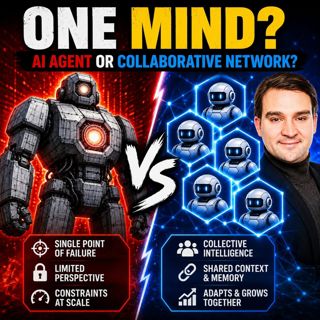
THE FUTURE OF AI ISN'T ONE MIND

Perhaps the most important takeaway from this episode is simple:The future of enterprise AI is not one giant assistant trying to solve every problem.It is a coordinated ecosystem of specialized experts.Each expert understands a specific task.Each expert operates within defined boundaries.Each expert contributes to a governed, observable, and scalable AI architecture.

FINAL THOUGHTS

As AI platforms mature, organizations must move beyond the idea that bigger models automatically create better solutions.The winners will be those that build intelligent routing systems, embrace specialization, implement strong governance, and create expert fabrics that balance performance, cost, security, and operational control.The question is no longer whether your organization will use AI.The real question is whether you will trust one mind to do everything—or build a governed network of experts designed to work together.

Become a supporter of this podcast: https://www.spreaker.com/podcast/m365-fm-modern-work-security-and-productivity-with-microsoft-365--6704921/support.

Denne episoden er hentet fra en åpen RSS-feed og er ikke publisert av Podme. Den kan derfor inneholde annonser.

Episoder(689)

Beyond the Portal: The Strategic Architecture of Microsoft Graph and PowerShell

Beyond the Portal: The Strategic Architecture of Microsoft Graph and PowerShell

For years, Microsoft 365 administration has been defined by portals. Administrators spend their days inside the Microsoft 365 Admin Center, Exchange Admin Center, SharePoint Admin Center, Teams Admin ...

3 Jul 1h 10min

Think Like an Attacker: Microsoft Security Exposure Management with Uros Babic [MVP-MCT]

Think Like an Attacker: Microsoft Security Exposure Management with Uros Babic [MVP-MCT]

Traditional cybersecurity focuses on vulnerabilities, alerts, and dashboards. Attackers don't. They look for opportunities, weak identities, exposed cloud resources, excessive permissions, forgotten e...

2 Jul 1h 9min
Stop Building Bots, Start Building Runtimes: A Field Guide to Microsoft Agents

Stop Building Bots, Start Building Runtimes: A Field Guide to Microsoft Agents

Everyone is calling Build 2026 the AI conference. Most of the attention went toward new copilots, voice experiences, and increasingly capable models. But beneath the headlines, Microsoft quietly intro...

2 Jul 1h 16min

EXTENSIBILITY FIRST: Building .NET Systems That Survive Change with Miguel Castro [MVP]

EXTENSIBILITY FIRST: Building .NET Systems That Survive Change with Miguel Castro [MVP]

Software rarely fails because developers cannot write code. It fails because applications are designed for today's requirements instead of tomorrow's changes. In this episode of the m365.fm Podcast, M...

1 Jul 1h 4min

The Death of the UI: Why CUA is the End of SaaS as We Know It

The Death of the UI: Why CUA is the End of SaaS as We Know It

For more than forty years, enterprise software has been built around one fundamental assumption: humans need graphical interfaces to interact with machines. Dashboards, forms, navigation menus, search...

1 Jul 1h 8min

Microsoft Copilot Adoption: What Actually Works - With Chris Hinch [Microsoft]

Microsoft Copilot Adoption: What Actually Works - With Chris Hinch [Microsoft]

Artificial Intelligence has moved beyond experimentation and into the heart of modern business. Yet while organizations are investing heavily in Microsoft Copilot, many struggle to achieve meaningful ...

30 Jun 54min
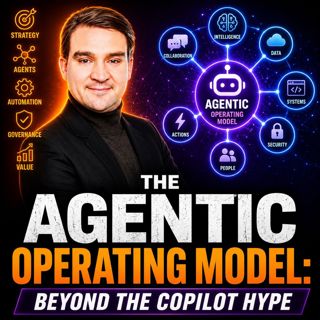
The Agentic Operating Model: Beyond the Copilot Hype

The Agentic Operating Model: Beyond the Copilot Hype

Most organizations believe they are implementing AI transformation. In reality, many are simply deploying chat interfaces on top of existing systems. While copilots and retrieval-based AI solutions ha...

30 Jun 1h 14min

Planner Beyond Tasks: Building Enterprise Project & Portfolio Management with Erik van Hurck [MVP]

Planner Beyond Tasks: Building Enterprise Project & Portfolio Management with Erik van Hurck [MVP]

Project management has evolved far beyond spreadsheets, email chains, and standalone task lists. As organizations grow, managing hundreds of concurrent projects, allocating resources effectively, trac...

29 Jun 58min

Populært innen Politikk og nyheter

giver-og-gjengen-vg
aftenpodden
aftenpodden-usa
fotballpodden-2
forklart
stopp-verden
popradet
det-store-bildet
nokon-ma-ga
rss-gukild-johaug
lydartikler-fra-aftenposten
hanna-de-heldige
rss-ness
rss-espen-lee-usensurert
rss-penger-polser-og-politikk
aftenbla-bla
dine-penger-pengeradet
ukrainapodden
ta-dokumentar
frokostshowet-pa-p5