The Death of Custom APIs: Microsoft Refine (Rayfin) as a Backend as a Service (BaaS)

The Death of Custom APIs: Microsoft Refine (Rayfin) as a Backend as a Service (BaaS)

For years, custom APIs have been the foundation of modern application development. Whenever organizations needed to connect systems, expose data, automate processes, or enable new digital experiences, the answer was almost always the same: build another API.At first, the approach worked.Each API solved a specific problem and helped teams move faster. But over time, those point solutions multiplied. What began as flexibility slowly transformed into complexity, creating a fragmented landscape of disconnected services, duplicated logic, inconsistent security controls, and growing technical debt.In this episode of the M365 FM Podcast, we explore why custom APIs have become one of the largest bottlenecks in enterprise technology and why a new generation of code-first, governance-driven backend platforms is emerging to replace them.

THE MIDDLEWARE CRISIS NOBODY TALKS ABOUT

Many organizations are now managing hundreds of APIs spread across different teams, cloud environments, databases, and security models.The result is a growing middleware crisis where development speed slows down despite increasing investments in technology.Topics discussed include:
  • API sprawl across multiple teams
  • Fragmented authentication models
  • Governance challenges
  • Hidden maintenance costs
  • Technical debt accumulation
The episode explains why middleware complexity often becomes a bigger problem than application development itself.

WHY CUSTOM APIS BECAME A LIABILITY

Custom APIs were originally designed to provide flexibility.Ironically, that flexibility often becomes the source of long-term complexity.The conversation explores how organizations unintentionally create fragmented architectures where every service has its own authentication model, monitoring strategy, deployment process, and governance requirements.Listeners learn why:
  • Security becomes inconsistent
  • Compliance becomes expensive
  • Change management slows down
  • Maintenance costs increase
  • Innovation becomes harder over time
THE ARCHITECTURE PROBLEM BEHIND THE PROBLEM

The issue is not simply the number of APIs.The deeper challenge lies in how traditional architectures separate data, business logic, governance, and security into different layers that require constant translation and synchronization.The discussion examines:
  • Layered architecture limitations
  • Data governance fragmentation
  • Compliance complexity
  • Operational silos
  • Lack of unified control planes
This architectural separation creates complexity that compounds as organizations scale.

THE AGENTIC AI INFLECTION POINT

Artificial Intelligence is exposing weaknesses that already existed in enterprise backends.Traditional APIs were designed for human-driven interactions.AI agents operate differently.They make decisions, orchestrate workflows, call multiple services, and maintain context across complex processes.Topics include:
  • Autonomous agents
  • Agent orchestration
  • Tool calling patterns
  • State management
  • Agent-safe architectures
  • AI-ready backend design
The episode explains why many current API strategies simply cannot support large-scale agentic systems.

INTRODUCING RAYFIN

At the center of the conversation is Rayfin, an open-source backend definition framework designed to replace traditional middleware approaches.Instead of manually building infrastructure components, developers define their backend entirely in code.Rayfin allows organizations to define:
  • Data models
  • APIs
  • Authentication
  • Authorization
  • Storage
  • Governance policies
All backend components become version-controlled, repeatable, and deployable through a single source of truth.

MICROSOFT FABRIC AS THE CONTROL PLANE

One of the most significant aspects of the discussion is Rayfin's integration with Microsoft Fabric.Rather than deploying isolated infrastructure across multiple cloud services, Rayfin deploys directly into the Fabric ecosystem.The conversation explores:
  • OneLake integration
  • Unified governance
  • Data lineage
  • Sensitivity labels
  • Access control
  • Operational and analytical convergence
The result is a backend architecture where governance becomes a native platform capability instead of an afterthought.

CODE-FIRST GOVERNANCE

Most organizations treat governance as something that happens after deployment.This episode challenges that model entirely.With Rayfin, governance becomes part of the backend definition itself.Topics covered include:
  • Governance as code
  • Version-controlled policies
  • Data classification
  • Access control definitions
  • Security by design
  • Compliance automation
Listeners discover how governance shifts from documentation into executable architecture.

THE STRANGLER FIG MODERNIZATION STRATEGY

One of the most practical sections focuses on modernization.Organizations rarely have the luxury of rebuilding everything from scratch.Instead, the episode explores the Strangler Fig pattern, where new governed backends gradually replace legacy APIs without disrupting business operations.Key concepts include:
  • Anti-corruption layers
  • API gateways
  • Incremental migration
  • Legacy coexistence
  • Gradual retirement strategies
This approach minimizes risk while enabling long-term transformation.

HORIZONDB AND AI-NATIVE DATA ARCHITECTURES

The conversation also explores HorizonDB and its role in supporting modern AI workloads.As enterprises build Retrieval-Augmented Generation (RAG) systems and agentic applications, traditional databases increasingly struggle to support hybrid data patterns.Topics include:
  • Vector search
  • Embeddings
  • AI-native databases
  • Semantic retrieval
  • RAG architectures
  • Hybrid search capabilities
Together, Rayfin and HorizonDB create a foundation for AI-powered enterprise applications.

OBSERVABILITY, SECURITY AND AGENT GOVERNANCE

AI systems require much deeper visibility than traditional applications.The episode explains why logs alone are no longer sufficient and why structured traces become essential for understanding agent decisions and system behavior.Discussion areas include:
  • Agent observability
  • Decision tracing
  • Audit readiness
  • Behavioral baselines
  • Security monitoring
  • Autonomous system governance
This visibility becomes critical as organizations increasingly rely on autonomous workflows.

THE ORGANIZATIONAL SHIFT

Technology is only part of the challenge.Successful modernization requires organizational change as well.The discussion explores how platform teams, domain teams, architects, security professionals, and governance boards must work together within a new operating model.Topics include:
  • Platform engineering
  • Governance boards
  • Organizational accountability
  • Standardization strategies
  • Team transformation
  • Backend ownership models
The shift is as much cultural as it is technical.

THE FUTURE OF AGENTIC APPLICATIONS

Looking ahead, the episode paints a picture of a future where AI agents become primary users of enterprise systems.These agents will orchestrate workflows, retrieve information, make decisions, and interact with governed APIs at machine speed.To support that future, organizations require:
  • Predictable APIs
  • Strong governance
  • Security boundaries
  • Unified observability
  • AI-ready infrastructure
Traditional custom API architectures were never designed for this reality.

FINAL THOUGHTS

Custom APIs are not disappearing because they are technically flawed.They are disappearing because they no longer align with the operational, governance, security, and scalability requirements of modern enterprises.As organizations move toward AI-powered workflows, autonomous agents, and governed data platforms, the backend itself must evolve.The future belongs to architectures that are code-first, policy-driven, AI-ready, and governed by design from day one.For technology leaders, architects, developers, and Microsoft Fabric professionals, this episode provides a roadmap for understanding why the age of fragmented middleware is ending—and what comes next.

Become a supporter of this podcast: https://www.spreaker.com/podcast/m365-fm-modern-work-security-and-productivity-with-microsoft-365--6704921/support.

Denne episoden er hentet fra en åpen RSS-feed og er ikke publisert av Podme. Den kan derfor inneholde annonser.

Episoder(689)

Beyond the Portal: The Strategic Architecture of Microsoft Graph and PowerShell

Beyond the Portal: The Strategic Architecture of Microsoft Graph and PowerShell

For years, Microsoft 365 administration has been defined by portals. Administrators spend their days inside the Microsoft 365 Admin Center, Exchange Admin Center, SharePoint Admin Center, Teams Admin ...

3 Jul 1h 10min

Think Like an Attacker: Microsoft Security Exposure Management with Uros Babic [MVP-MCT]

Think Like an Attacker: Microsoft Security Exposure Management with Uros Babic [MVP-MCT]

Traditional cybersecurity focuses on vulnerabilities, alerts, and dashboards. Attackers don't. They look for opportunities, weak identities, exposed cloud resources, excessive permissions, forgotten e...

2 Jul 1h 9min
Stop Building Bots, Start Building Runtimes: A Field Guide to Microsoft Agents

Stop Building Bots, Start Building Runtimes: A Field Guide to Microsoft Agents

Everyone is calling Build 2026 the AI conference. Most of the attention went toward new copilots, voice experiences, and increasingly capable models. But beneath the headlines, Microsoft quietly intro...

2 Jul 1h 16min

EXTENSIBILITY FIRST: Building .NET Systems That Survive Change with Miguel Castro [MVP]

EXTENSIBILITY FIRST: Building .NET Systems That Survive Change with Miguel Castro [MVP]

Software rarely fails because developers cannot write code. It fails because applications are designed for today's requirements instead of tomorrow's changes. In this episode of the m365.fm Podcast, M...

1 Jul 1h 4min

The Death of the UI: Why CUA is the End of SaaS as We Know It

The Death of the UI: Why CUA is the End of SaaS as We Know It

For more than forty years, enterprise software has been built around one fundamental assumption: humans need graphical interfaces to interact with machines. Dashboards, forms, navigation menus, search...

1 Jul 1h 8min

Microsoft Copilot Adoption: What Actually Works - With Chris Hinch [Microsoft]

Microsoft Copilot Adoption: What Actually Works - With Chris Hinch [Microsoft]

Artificial Intelligence has moved beyond experimentation and into the heart of modern business. Yet while organizations are investing heavily in Microsoft Copilot, many struggle to achieve meaningful ...

30 Jun 54min
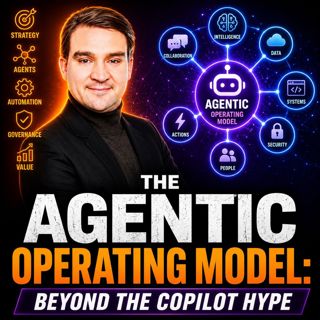
The Agentic Operating Model: Beyond the Copilot Hype

The Agentic Operating Model: Beyond the Copilot Hype

Most organizations believe they are implementing AI transformation. In reality, many are simply deploying chat interfaces on top of existing systems. While copilots and retrieval-based AI solutions ha...

30 Jun 1h 14min

Planner Beyond Tasks: Building Enterprise Project & Portfolio Management with Erik van Hurck [MVP]

Planner Beyond Tasks: Building Enterprise Project & Portfolio Management with Erik van Hurck [MVP]

Project management has evolved far beyond spreadsheets, email chains, and standalone task lists. As organizations grow, managing hundreds of concurrent projects, allocating resources effectively, trac...

29 Jun 58min

Populært innen Politikk og nyheter

giver-og-gjengen-vg
aftenpodden
aftenpodden-usa
fotballpodden-2
forklart
stopp-verden
popradet
det-store-bildet
nokon-ma-ga
rss-gukild-johaug
lydartikler-fra-aftenposten
hanna-de-heldige
rss-ness
rss-espen-lee-usensurert
rss-penger-polser-og-politikk
aftenbla-bla
dine-penger-pengeradet
ukrainapodden
ta-dokumentar
frokostshowet-pa-p5