
The End of Data Entry: Why Your Business Logic is Moving to Agents

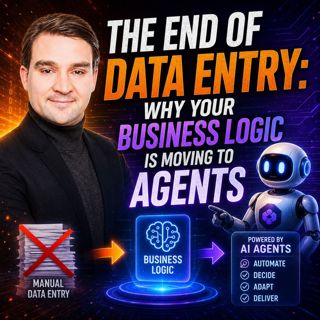
The End of Data Entry: Why Your Business Logic is Moving to Agents

For decades, enterprise software was built around a simple idea: store information in a central system and make it available when people need it. CRM systems stored customer data. ERP platforms stored transactions. Finance systems stored invoices. Organizations invested billions of dollars building systems of record designed to become the single source of truth. But something fundamental has changed. Enterprise software is no longer just storing information. Modern business platforms are beginning to observe events, reason about context, make decisions, and orchestrate actions across multiple systems. The future is no longer about systems of record. It is about systems of action powered by AI agents. In this episode, we explore why manual data entry is becoming obsolete, how agentic workflows are reshaping enterprise operations, and why organizations that adopt AI agents today will gain a significant competitive advantage over those that continue relying on humans as integration layers between disconnected systems.

THE SYSTEM OF RECORD ERA IS COMING TO AN END

For years, organizations believed that creating a centralized repository of business information would solve operational inefficiencies. The reality turned out very differently. Data may live inside business systems, but work often happens elsewhere. Employees spend countless hours moving information between emails, spreadsheets, CRMs, ERPs, ticketing systems, and procurement platforms. Sales representatives manually enter lead information. Finance teams reconcile invoices across multiple systems. Procurement managers spend their days reading supplier emails and updating purchase orders. Customer service teams route tickets manually based on limited information. These activities are not strategic work. They are operational workarounds. The episode explores how organizations unknowingly created an "integration tax" where highly skilled employees spend significant portions of their day acting as translators between systems that should already be communicating with each other.

FROM SYSTEM OF RECORD TO SYSTEM OF ACTION

The next evolution of enterprise software is already underway. Instead of simply storing information, modern platforms can now participate in business processes. This shift introduces a new operating model where software observes events, reasons using enterprise data, and executes actions automatically within predefined governance boundaries. Topics discussed include:
  • Event-driven business processes
  • Autonomous decision support
  • Workflow orchestration
  • Operational automation
  • AI-powered execution
The result is a dramatic reduction in operational friction and a significant increase in business velocity.

UNDERSTANDING THE AGENTIC SHIFT

Agentic AI represents a fundamental departure from traditional automation. Rather than following static workflows and rigid rules, agents continuously evaluate situations, gather context, apply business logic, and determine appropriate actions. Every agent follows a common pattern: First, an event occurs. Second, the agent reasons about that event using enterprise context. Third, the agent orchestrates actions across systems and workflows. This event-reasoning-orchestration model allows organizations to automate increasingly complex business scenarios while maintaining governance, compliance, and human oversight.

WHY GENERIC AI IS NOT ENOUGH

One of the most important discussions in this episode focuses on the difference between generic AI and enterprise agents. Large language models trained on public internet data can answer questions and generate content, but they do not understand the unique realities of your organization. They do not know:
  • Customer relationships
  • Contract terms
  • Approval policies
  • Security boundaries
  • Business processes
Enterprise agents are different because they operate using your organization's actual business data. Instead of guessing, they reason using customer records, invoices, support histories, purchase orders, financial policies, and operational workflows. This distinction is what separates enterprise AI from consumer AI.

SALES QUALIFICATION AGENTS AND THE END OF MANUAL LEAD RESEARCH

Sales teams often spend enormous amounts of time researching prospects before meaningful conversations even begin. A Sales Qualification Agent changes that process completely. When a lead arrives, the agent automatically enriches the opportunity using company information, historical account data, industry intelligence, and previous interactions. Rather than forcing sales representatives to spend hours researching prospects, the agent prepares actionable intelligence that allows them to focus on building relationships and closing deals. The discussion explores how organizations can dramatically improve lead quality, shorten sales cycles, and increase conversion rates by shifting research activities from humans to AI-powered agents.

ACCOUNT RECONCILIATION AGENTS IN FINANCE

Finance departments often experience some of the fastest ROI from agentic workflows. Traditional reconciliation processes require finance professionals to compare invoices, purchase orders, subledgers, and general ledger entries manually. Account Reconciliation Agents automate much of this effort. These agents identify discrepancies, determine likely causes, propose corrections, and prepare draft journal entries for review. Rather than spending days matching transactions, finance teams can focus on financial analysis, planning, and strategic decision-making. The episode highlights examples where organizations significantly reduced month-end close cycles through AI-driven reconciliation processes.

CUSTOMER INTENT AGENTS AND BETTER CUSTOMER EXPERIENCES

Customers rarely describe their actual problem directly. A billing issue may actually be a contract renewal concern. A support request may indicate a broader customer satisfaction problem. Customer Intent Agents analyze interaction history, support records, account data, contract information, and customer behavior to understand the true reason behind a customer interaction. Instead of routing tickets based solely on subject lines, organizations can route customers to the right people with the right context already available. This leads to:
  • Faster resolutions
  • Better customer experiences
  • Higher retention
  • Reduced escalations
  • Improved satisfaction scores
The result is more intelligent customer engagement across the entire customer lifecycle.

SUPPLIER COMMUNICATIONS AND PROCUREMENT AUTOMATION

Procurement teams process a constant stream of supplier updates, delivery changes, shipment delays, and contract communications. Many of these activities remain highly manual despite being repetitive and predictable. Supplier Communication Agents monitor incoming messages, evaluate business impact, update systems, notify stakeholders, and escalate only when necessary. Instead of spending hours processing routine updates, procurement professionals can focus on strategic supplier relationships, sourcing decisions, and risk management. The conversation demonstrates how agentic workflows can significantly improve supply chain responsiveness and operational efficiency.

FIELD SERVICE AGENTS AND CONTEXT-DRIVEN OPERATIONS

Field service organizations face a unique challenge: technicians often arrive on-site without complete information. Field Service Agents solve this problem by assembling contextual briefings before technicians begin their work. These agents combine:
  • Service history
  • Equipment records
  • IoT data
  • Inventory availability
  • Previous repairs
  • Operational recommendations
The result is improved first-time fix rates, reduced operational costs, higher customer satisfaction, and better utilization of field service resources.

Become a supporter of this podcast: https://www.spreaker.com/podcast/m365-fm-modern-work-security-and-productivity-with-microsoft-365--6704921/support.

Denne episoden er hentet fra en åpen RSS-feed og er ikke publisert av Podme. Den kan derfor inneholde annonser.

Episoder(697)

The PowerShell Ceiling: Why You Need Bicep

The PowerShell Ceiling: Why You Need Bicep

Every IT professional eventually reaches a point where automation stops feeling like freedom and starts becoming a burden. What begins as a handful of PowerShell scripts quickly grows into dozens of a...

7 Jul 1h 9min

Beyond the Prompt: Architecting Multi-Agent AI Solutions with Microsoft Copilot & SharePoint with Reshmee Auckloo [MVP]

Beyond the Prompt: Architecting Multi-Agent AI Solutions with Microsoft Copilot & SharePoint with Reshmee Auckloo [MVP]

Artificial Intelligence is rapidly moving beyond simple chatbots and prompt engineering. Today's enterprise AI solutions must reason, collaborate, orchestrate multiple agents, securely access business...

6 Jul 1h

How To Trick Microsoft Graph Into Securing Your Entire Tenant

How To Trick Microsoft Graph Into Securing Your Entire Tenant

Most Microsoft 365 administrators believe their tenant is secure because every dashboard is green, policies are enabled, and alerts appear to be flowing normally. Unfortunately, modern security doesn'...

6 Jul 1h 12min
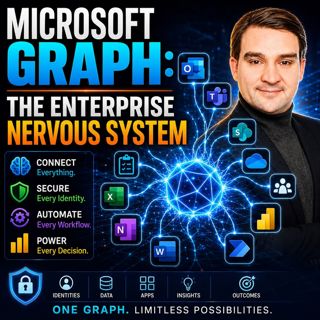
Microsoft Graph: The Enterprise Nervous System

Microsoft Graph: The Enterprise Nervous System

Enterprise IT has reached a tipping point. Organizations now manage millions of identities, files, applications, permissions, policies, and AI-powered workloads across Microsoft 365. Yet many IT depar...

5 Jul 1h 11min

Beyond the Script: The Architect's Guide to Microsoft Graph Platforms

Beyond the Script: The Architect's Guide to Microsoft Graph Platforms

Automation has become a cornerstone of digital transformation, yet many organizations unknowingly create more complexity than they eliminate. What starts as a simple PowerShell script or Power Automat...

5 Jul 1h 10min
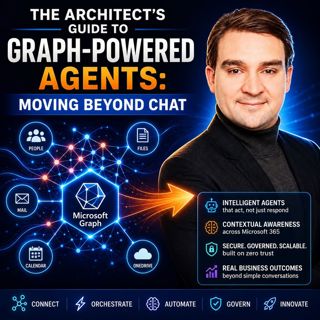
The Architect's Guide to Graph-Powered Agents: Moving Beyond Chat

The Architect's Guide to Graph-Powered Agents: Moving Beyond Chat

Artificial Intelligence has rapidly evolved from simple chatbots into sophisticated enterprise agents capable of reasoning, orchestrating workflows, and executing business processes. Yet many organiza...

4 Jul 1h 20min
The Hidden Logic of Microsoft Graph

The Hidden Logic of Microsoft Graph

Most Microsoft 365 professionals know Microsoft Graph as the API behind users, groups, Teams, and SharePoint. But beneath those familiar endpoints lies a much larger reality. Microsoft Graph has evolv...

4 Jul 1h 11min

Everything Microsoft Didn't Tell You About Teams with Everything Microsoft Didn't Tell You About Teams with Josh Blalock [MVP]

Everything Microsoft Didn't Tell You About Teams with Everything Microsoft Didn't Tell You About Teams with Josh Blalock [MVP]

Microsoft Teams has evolved from a simple collaboration platform into the digital workplace at the heart of modern business. But behind every successful Teams meeting lies far more than software. In t...

3 Jul 45min

Populært innen Politikk og nyheter

giver-og-gjengen-vg
aftenpodden
aftenpodden-usa
fotballpodden-2
forklart
popradet
stopp-verden
lydartikler-fra-aftenposten
det-store-bildet
hanna-de-heldige
rss-gukild-johaug
dine-penger-pengeradet
rss-ness
aftenbla-bla
nokon-ma-ga
rss-espen-lee-usensurert
e24-podden
grasoner-den-nye-kalde-krigen
ta-dokumentar
chit-chat-med-helle