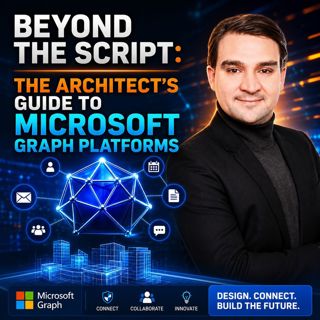
Beyond the Script: The Architect's Guide to Microsoft Graph Platforms

Beyond the Script: The Architect's Guide to Microsoft Graph Platforms

Automation has become a cornerstone of digital transformation, yet many organizations unknowingly create more complexity than they eliminate. What starts as a simple PowerShell script or Power Automate flow often grows into a fragile web of disconnected automations that depend on individual experts, undocumented processes, and aging infrastructure. In this episode, we explore why traditional scripting approaches eventually reach their limits and why modern enterprises are shifting toward platform-based automation built around Microsoft Graph, Azure, Logic Apps, Azure Functions, Managed Identities, and governance-first architecture.

WHY SCRIPT-BASED AUTOMATION EVENTUALLY FAILS
Many IT departments have accumulated hundreds of automation scripts over the years. While each one may solve a specific business problem, together they create operational complexity, technical debt, and hidden business risks. As organizations scale, maintaining these disconnected automations becomes increasingly difficult. The challenge isn't writing better PowerShell or finding another connector—it's fundamentally changing how automation is architected.Instead of relying on isolated scripts maintained by individual administrators, modern organizations are moving toward centralized automation platforms where orchestration, monitoring, governance, and resilience are built directly into the architecture rather than added as an afterthought.

UNDERSTANDING AUTOMATION MATURITY
Automation maturity isn't a straight line. Most enterprises simultaneously operate manual processes, scheduled scripts, cloud workflows, APIs, and modern event-driven services. This fragmented landscape creates operational chaos and slows innovation.Key indicators that your organization has reached the limits of traditional automation include:
  • Hundreds of disconnected PowerShell scripts
  • Unknown script ownership and documentation gaps
  • Manual recovery whenever automation fails
  • Increasing maintenance costs
  • Difficulty scaling automation across departments
The organizations moving fastest today aren't necessarily writing more code—they're building better automation platforms.

MICROSOFT GRAPH AS THE CENTRAL ORCHESTRATION LAYER
Microsoft Graph has evolved into the unified interface connecting Microsoft 365 services including Exchange Online, SharePoint, Teams, OneDrive, and Microsoft Entra ID. Rather than creating direct integrations between every application, Graph enables organizations to establish a centralized orchestration layer where systems communicate through a consistent interface.This architectural shift dramatically reduces coupling between systems while making automation easier to maintain, extend, and govern. Combined with Graph subscriptions and Delta Queries, organizations can build event-driven solutions that react instantly while maintaining reliable reconciliation mechanisms to ensure nothing is ever missed.

BUILDING RESILIENT AUTOMATION PLATFORMS
Reliable automation isn't just about triggering workflows—it requires designing for failure from day one. Webhooks expire, APIs change, subscriptions fail silently, and network interruptions occur. High-performing organizations assume failures will happen and build recovery directly into their architecture.Modern automation platforms combine real-time event processing with scheduled reconciliation jobs, ensuring every business process remains accurate even when individual components experience temporary issues.Critical platform capabilities include:
  • Event-driven Graph subscriptions
  • Delta Query reconciliation
  • Azure Logic Apps orchestration
  • Azure Functions for compute-intensive workloads
  • Automated monitoring and alerting
CHOOSING THE RIGHT AZURE ARCHITECTURE
One of the biggest architectural decisions involves choosing between workflow orchestration and compute orchestration. Logic Apps excel at connecting business systems through visual workflows, while Azure Functions provide scalable compute for complex business logic.Rather than treating these technologies as competitors, successful organizations combine both approaches. Logic Apps coordinate business processes while Azure Functions execute specialized business logic, creating highly scalable, maintainable solutions with optimized operational costs.This hybrid architecture provides flexibility while reducing long-term maintenance effort.

MANAGED IDENTITIES AND SECURITY BY DESIGN
Identity has become one of the most important components of enterprise automation. Static credentials, service accounts, and embedded secrets create unnecessary operational and security risks.Managed Identities eliminate these concerns by allowing Azure resources to authenticate securely without storing credentials. Combined with Azure Key Vault, organizations can automate credential management while improving security posture and reducing operational overhead.This security-first approach enables organizations to adopt Zero Trust principles throughout their automation landscape.

GOVERNANCE AS CODE
Traditional governance often relies on documentation, approval meetings, and manual compliance reviews. Unfortunately, documents cannot prevent misconfigurations or insecure deployments.Modern governance treats policies as executable infrastructure. Azure Policy, Conditional Access, Microsoft Purview, and automated deployment pipelines ensure security rules are enforced automatically rather than relying on human intervention.This dramatically accelerates innovation because teams can move quickly within predefined technical guardrails.Governance should provide:
  • Automated policy enforcement
  • Least-privilege identity management
  • Built-in compliance controls
  • Continuous auditing
  • Infrastructure-as-Code deployment standards
FROM AUTOMATION TO AUTONOMOUS SYSTEMS
The next evolution extends beyond automation into intelligent autonomous systems. Rather than executing predefined instructions, modern AI-powered agents observe events, evaluate context, make decisions, and execute business processes with minimal human intervention.Technologies like Microsoft Graph, Model Context Protocol (MCP), Azure AI, and emerging Agent platforms are transforming automation from workflow execution into intelligent orchestration. However, these capabilities only become viable when built on secure identities, governance, orchestration layers, and resilient monitoring.Organizations attempting to deploy AI agents without this architectural foundation risk creating uncontrolled autonomous systems that introduce significant operational and compliance challenges.

BUILDING YOUR MIGRATION STRATEGY
Migration should never involve replacing every script overnight. Instead, successful organizations adopt an incremental platform strategy. Existing automations continue running while new platform-based solutions are introduced one workload at a time. This approach minimizes operational risk while allowing teams to continuously improve architecture, governance, and monitoring.Long-term success comes from standardization, reusable templates, centralized monitoring, CI/CD pipelines, Git-based source control, automated testing, and shared architectural patterns rather than isolated development efforts.

FINAL THOUGHTS
The future of enterprise automation isn't about writing more scripts—it's about building platforms that can evolve alongside rapidly changing business requirements. Organizations investing today in Microsoft Graph orchestration, Azure-native architectures, governance-as-code, managed identities, event-driven integrations, and AI-ready infrastructure will be significantly better positioned for autonomous business operations over the coming years.The transition from scripts to platforms represents far more than a technology upgrade. It is a fundamental shift in how enterprises design, secure, operate, and scale automation. Those who embrace platform thinking today will be prepared for the next generation of intelligent business systems, while those who continue expanding isolated script libraries will find themselves carrying an ever-growing burden of technical debt and operational complexity.

Become a supporter of this podcast: https://www.spreaker.com/podcast/m365-fm-modern-work-security-and-productivity-with-microsoft-365--6704921/support.

Denne episoden er hentet fra en åpen RSS-feed og er ikke publisert av Podme. Den kan derfor inneholde annonser.

Episoder(693)

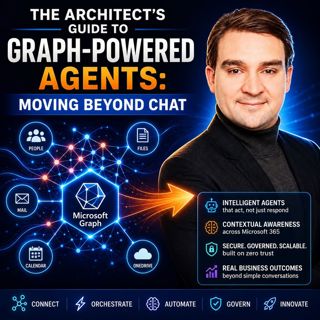
The Architect's Guide to Graph-Powered Agents: Moving Beyond Chat

The Architect's Guide to Graph-Powered Agents: Moving Beyond Chat

Artificial Intelligence has rapidly evolved from simple chatbots into sophisticated enterprise agents capable of reasoning, orchestrating workflows, and executing business processes. Yet many organiza...

4 Jul 1h 20min
The Hidden Logic of Microsoft Graph

The Hidden Logic of Microsoft Graph

Most Microsoft 365 professionals know Microsoft Graph as the API behind users, groups, Teams, and SharePoint. But beneath those familiar endpoints lies a much larger reality. Microsoft Graph has evolv...

4 Jul 1h 11min

Everything Microsoft Didn't Tell You About Teams with Everything Microsoft Didn't Tell You About Teams with Josh Blalock [MVP]

Everything Microsoft Didn't Tell You About Teams with Everything Microsoft Didn't Tell You About Teams with Josh Blalock [MVP]

Microsoft Teams has evolved from a simple collaboration platform into the digital workplace at the heart of modern business. But behind every successful Teams meeting lies far more than software. In t...

3 Jul 45min
Beyond the Portal: The Strategic Architecture of Microsoft Graph and PowerShell

Beyond the Portal: The Strategic Architecture of Microsoft Graph and PowerShell

For years, Microsoft 365 administration has been defined by portals. Administrators spend their days inside the Microsoft 365 Admin Center, Exchange Admin Center, SharePoint Admin Center, Teams Admin ...

3 Jul 1h 10min

Think Like an Attacker: Microsoft Security Exposure Management with Uros Babic [MVP-MCT]

Think Like an Attacker: Microsoft Security Exposure Management with Uros Babic [MVP-MCT]

Traditional cybersecurity focuses on vulnerabilities, alerts, and dashboards. Attackers don't. They look for opportunities, weak identities, exposed cloud resources, excessive permissions, forgotten e...

2 Jul 1h 9min
Stop Building Bots, Start Building Runtimes: A Field Guide to Microsoft Agents

Stop Building Bots, Start Building Runtimes: A Field Guide to Microsoft Agents

Everyone is calling Build 2026 the AI conference. Most of the attention went toward new copilots, voice experiences, and increasingly capable models. But beneath the headlines, Microsoft quietly intro...

2 Jul 1h 16min

EXTENSIBILITY FIRST: Building .NET Systems That Survive Change with Miguel Castro [MVP]

EXTENSIBILITY FIRST: Building .NET Systems That Survive Change with Miguel Castro [MVP]

Software rarely fails because developers cannot write code. It fails because applications are designed for today's requirements instead of tomorrow's changes. In this episode of the m365.fm Podcast, M...

1 Jul 1h 4min

Populært innen Politikk og nyheter

giver-og-gjengen-vg
aftenpodden
aftenpodden-usa
fotballpodden-2
forklart
stopp-verden
popradet
lydartikler-fra-aftenposten
det-store-bildet
rss-gukild-johaug
hanna-de-heldige
dine-penger-pengeradet
rss-ness
nokon-ma-ga
aftenbla-bla
rss-espen-lee-usensurert
rss-penger-polser-og-politikk
e24-podden
grasoner-den-nye-kalde-krigen
ukrainapodden