
Architecture Over Chat: Building the Agent Fabric

Architecture Over Chat: Building the Agent Fabric

Most organizations believe they are building AI agents. In reality, they are building chatbots trapped inside applications. These systems can answer questions and generate content, but they forget everything when a session ends. They cannot coordinate across systems, maintain long-term context, or operate as true workforce participants. In this episode, we explore one of the biggest architectural shifts happening in enterprise AI today: the move from isolated conversational experiences to persistent agent fabrics. Instead of treating AI as a chatbot inside Teams, Slack, or a web application, organizations must begin thinking about agents as long-running, governed, identity-driven participants that can operate across devices, applications, and business processes. The discussion examines why the problem isn't the intelligence of modern models. The real limitation is the infrastructure surrounding them. Memory, identity, governance, orchestration, observability, interoperability, and security have become the critical building blocks for the next generation of enterprise AI systems.

THE CHATBOX ILLUSION

Most AI deployments today are still built around conversations. While chat interfaces are familiar and easy to adopt, they create significant limitations when organizations attempt to scale AI beyond simple question-and-answer scenarios. Key topics include:
  • Why chat is the wrong abstraction for enterprise agents
  • The limitations of stateless architectures
  • Why agents need persistent memory
  • The difference between assistants and workforce participants
BREAKING DOWN THE SILO PROBLEM

Organizations are creating AI capabilities inside CRM systems, project management tools, customer service platforms, and productivity applications. Unfortunately, these agents often operate independently and cannot collaborate effectively. The episode explores how siloed architectures create operational bottlenecks, force human intervention, and prevent AI systems from solving end-to-end business problems. Instead of creating isolated intelligence, enterprises must build connected agent ecosystems capable of sharing context and coordinating work.

SESSION PERSISTENCE AS A FOUNDATIONAL REQUIREMENT

One of the most important concepts discussed is persistent sessions. Without persistence, agents repeatedly lose context, restart tasks, and require users to reintroduce information. Persistent session architectures enable agents to continue work across devices, applications, and time periods while maintaining complete continuity. Topics include:
  • Session management
  • State recovery
  • Cross-device continuity
  • Long-running workflows
  • Persistent audit trails
MULTI-DEVICE AGENTS AND THE FUTURE OF WORK

Modern workers move continuously between desktops, laptops, tablets, and mobile devices. AI agents must follow them. This episode explores how future architectures separate the agent from the interface, allowing a single persistent intelligence layer to support multiple experiences simultaneously. The discussion highlights why thin clients combined with centralized agent runtimes represent a major shift in enterprise AI design.

THE GITHUB COPILOT SDK BLUEPRINT

A significant portion of the conversation focuses on the GitHub Copilot SDK and why it provides a blueprint for future enterprise agent architectures. Rather than building separate intelligence layers for every application, organizations can create a single reasoning engine that powers multiple experiences across development environments, web applications, command-line interfaces, and productivity platforms. The episode examines:
  • Agent runtimes
  • Tool orchestration
  • Portable reasoning engines
  • Session management
  • Standardized integrations
WHY IDENTITY CHANGES EVERYTHING

Agents are rapidly becoming more than software tools. They are evolving into digital workforce participants. To operate safely, agents require their own identities, permissions, governance models, and audit capabilities. The discussion explores how Entra Agent IDs and emerging governance frameworks create the foundation for secure enterprise-scale deployments. Areas covered include:
  • Agent identities
  • Conditional access
  • Role-based permissions
  • Auditability
  • Lifecycle management
ORCHESTRATION AND SPECIALIZED AGENTS

A single agent cannot effectively perform every task within an organization. The future belongs to orchestrated systems composed of specialized agents working together toward common objectives. The episode explores coordinator agents, domain specialists, task delegation, agent handoffs, and workflow orchestration patterns that enable scalable automation across complex business environments.

MEMORY, SECURITY, AND GOVERNANCE

Persistent memory creates extraordinary opportunities, but it also introduces new security challenges. The discussion examines memory poisoning, prompt injection, data leakage, retention policies, privacy concerns, and governance requirements that emerge when agents begin accumulating knowledge over long periods. Topics include:
  • Memory governance
  • Data protection
  • Agent auditing
  • Compliance requirements
  • Risk management
AGENT 365 AND THE CONTROL PLANE VISION

As organizations deploy hundreds or even thousands of agents, centralized governance becomes essential. This episode explores the concept behind Microsoft Agent 365 and the broader vision of agent control planes that provide visibility, policy enforcement, observability, interoperability, and security across entire agent ecosystems. The discussion highlights why governance must evolve alongside AI adoption and why successful organizations will treat agents as first-class citizens within their technology environments.

THE ROAD TO AGENTIC ENTERPRISES

The future of enterprise AI is not about smarter chatbots. It is about persistent, governed, interoperable agents capable of operating continuously across systems, devices, and workflows. Organizations that continue building isolated AI experiences will struggle with scale, governance, and operational complexity. Those that invest in agent fabrics, identity-driven architectures, orchestration frameworks, and persistent infrastructure will unlock entirely new levels of automation and business value. This episode provides a comprehensive roadmap for understanding that transition and explains why the next era of enterprise AI will be defined not by models alone, but by the systems that connect them together.

Become a supporter of this podcast: https://www.spreaker.com/podcast/m365-fm-modern-work-security-and-productivity-with-microsoft-365--6704921/support.

Denne episoden er hentet fra en åpen RSS-feed og er ikke publisert av Podme. Den kan derfor inneholde annonser.

Episoder(697)

The PowerShell Ceiling: Why You Need Bicep

The PowerShell Ceiling: Why You Need Bicep

Every IT professional eventually reaches a point where automation stops feeling like freedom and starts becoming a burden. What begins as a handful of PowerShell scripts quickly grows into dozens of a...

7 Jul 1h 9min

Beyond the Prompt: Architecting Multi-Agent AI Solutions with Microsoft Copilot & SharePoint with Reshmee Auckloo [MVP]

Beyond the Prompt: Architecting Multi-Agent AI Solutions with Microsoft Copilot & SharePoint with Reshmee Auckloo [MVP]

Artificial Intelligence is rapidly moving beyond simple chatbots and prompt engineering. Today's enterprise AI solutions must reason, collaborate, orchestrate multiple agents, securely access business...

6 Jul 1h

How To Trick Microsoft Graph Into Securing Your Entire Tenant

How To Trick Microsoft Graph Into Securing Your Entire Tenant

Most Microsoft 365 administrators believe their tenant is secure because every dashboard is green, policies are enabled, and alerts appear to be flowing normally. Unfortunately, modern security doesn'...

6 Jul 1h 12min
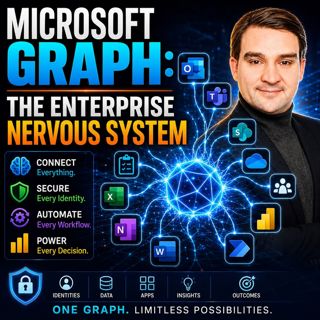
Microsoft Graph: The Enterprise Nervous System

Microsoft Graph: The Enterprise Nervous System

Enterprise IT has reached a tipping point. Organizations now manage millions of identities, files, applications, permissions, policies, and AI-powered workloads across Microsoft 365. Yet many IT depar...

5 Jul 1h 11min

Beyond the Script: The Architect's Guide to Microsoft Graph Platforms

Beyond the Script: The Architect's Guide to Microsoft Graph Platforms

Automation has become a cornerstone of digital transformation, yet many organizations unknowingly create more complexity than they eliminate. What starts as a simple PowerShell script or Power Automat...

5 Jul 1h 10min
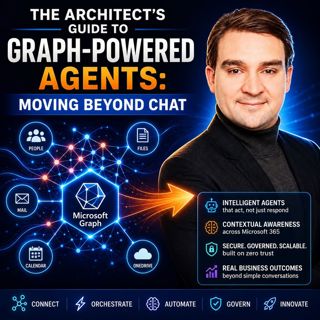
The Architect's Guide to Graph-Powered Agents: Moving Beyond Chat

The Architect's Guide to Graph-Powered Agents: Moving Beyond Chat

Artificial Intelligence has rapidly evolved from simple chatbots into sophisticated enterprise agents capable of reasoning, orchestrating workflows, and executing business processes. Yet many organiza...

4 Jul 1h 20min
The Hidden Logic of Microsoft Graph

The Hidden Logic of Microsoft Graph

Most Microsoft 365 professionals know Microsoft Graph as the API behind users, groups, Teams, and SharePoint. But beneath those familiar endpoints lies a much larger reality. Microsoft Graph has evolv...

4 Jul 1h 11min

Everything Microsoft Didn't Tell You About Teams with Everything Microsoft Didn't Tell You About Teams with Josh Blalock [MVP]

Everything Microsoft Didn't Tell You About Teams with Everything Microsoft Didn't Tell You About Teams with Josh Blalock [MVP]

Microsoft Teams has evolved from a simple collaboration platform into the digital workplace at the heart of modern business. But behind every successful Teams meeting lies far more than software. In t...

3 Jul 45min

Populært innen Politikk og nyheter

giver-og-gjengen-vg
aftenpodden
aftenpodden-usa
fotballpodden-2
forklart
popradet
stopp-verden
lydartikler-fra-aftenposten
det-store-bildet
hanna-de-heldige
rss-gukild-johaug
dine-penger-pengeradet
rss-ness
aftenbla-bla
nokon-ma-ga
rss-espen-lee-usensurert
e24-podden
grasoner-den-nye-kalde-krigen
ta-dokumentar
chit-chat-med-helle