
Fun Facts About Beetles

Fun Facts About Beetles

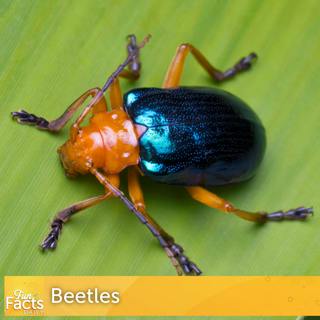
Beetles represent one of the most biologically diverse groups on Earth, comprising approximately 25 percent of all documented animal species with over 400,000 distinct variations discovered across nearly every ecological niche. A primary evolutionary feature defining these insects is the elytron, a hardened, rigid forewing that forms a protective sheath over their delicate flight wings and respiratory systems, enabling them to burrow through dense soil and wood safely. This specialized structural anatomy reaches extraordinary levels in species like the diabolical ironclad beetle of Western North America, which features fused, jigsaw-like microscopic seams capable of absorbing crushing forces up to 39,000 times its body weight, allowing it to survive immense structural pressure. Other species utilize volatile chemical defenses, such as the bombardier beetle, which instantly synthesizes hydroquinone and hydrogen peroxide within an internal reaction chamber to deploy a toxic, boiling defensive spray at temperatures reaching 100°C (212°F). Beyond defensive armor, beetles exhibit remarkable variations in physical scale, mechanical strength, and sensory navigation. The Amazonian titan beetle stands as one of the largest longhorn insects, growing over 16 centimeters in length and maintaining jaws powerful enough to snap wooden pencils, though the non-feeding adults live for only a few weeks solely to reproduce via airborne pheromone tracking. In terms of proportional power, rhinoceros beetles utilize lightweight exoskeletons to lift up to 850 times their own body mass during territorial battles, a ratio equivalent to a human hauling an armored military tank. For nocturnal travel, the African dung beetle relies on sophisticated astronomical orientation, navigating across uneven terrain by tracking the overarching light gradients of the Milky Way galaxy's core. These diverse traits extend to common variations like ladybugs, which serve as highly effective natural predators capable of consuming up to 50 destructive aphids daily, making them vital components of ecological pest management. If you wanted to learn about the musical group, check out my other episode: Fun Facts About the Beatles ⁠Listen Ad-Free on Patreon. ⁠ For just $3 per month, you can get ad-free versions of Fun Facts Daily, Who ARTed and Art Smart. Head over to ⁠https://www.patreon.com/cw/FunFactsDailyPod⁠ if you are interested. Want to learn more? Head over to my website www.funfactsdailypod.com and be sure to listen to my other podcasts Who ARTed: Weekly Art History for All Ages or Art Smart. For family fun, check out my son's podcast Rainbow Puppy Science Lab The image used in the episode cover art came from Adobe's stock photos. Fun Facts Daily is an Airwave Media Podcast. If you are interested in advertising on this or any other Airwave Media show, email: advertising@airwavemedia.com Learn more about your ad choices. Visit megaphone.fm/adchoices

Denne episoden er hentet fra en åpen RSS-feed og er ikke publisert av Podme. Den kan derfor inneholde annonser.

Episoder(313)

Fun Facts About Peanut Butter

Fun Facts About Peanut Butter

Peanuts, which are scientifically classified as legumes rather than tree nuts, grow in underground pods and serve a variety of purposes, including human consumption, livestock forage, and soil enrichm...

30 Jun 14min

Fun Facts About the Washington Monument

Fun Facts About the Washington Monument

The Washington Monument, a towering obelisk standing at 555 feet and 5 and 1/8 inches, is an architectural marvel constructed from 3,491 blocks of white marble, granite, and blue stone gneiss. Remarka...

29 Jun 14min

Fun Facts About NeeDoh

Fun Facts About NeeDoh

NeeDoh is a popular line of visco-elastic stress balls and fidget toys produced by Schilling Incorporated, a toy company founded in 1975 by Jack Schilling. Unlike traditional stress balls that rely on...

26 Jun 16min

Fun Facts About Crows

Fun Facts About Crows

Crows, belonging to the biological family Corvidae, are highly intelligent birds with cognitive capabilities that rival those of great apes. While they lack a mammalian cerebral cortex, crows possess ...

25 Jun 16min

Fun Facts About Emperor Norton

Fun Facts About Emperor Norton

Joshua Abraham Norton, historically remembered as Emperor Norton, was an English-born resident of San Francisco who famously declared himself "Emperor of these United States" in 1859, adding the secon...

24 Jun 16min

Fun Facts About Pistachios

Fun Facts About Pistachios

Pistachios have a rich history and distinct botanical characteristics. Though commonly categorized as nuts, they are scientifically classified as the edible seeds of a stone fruit, or drupe, closely r...

23 Jun 14min

Fun Facts About Pitch Lake

Fun Facts About Pitch Lake

Pitch Lake, located in La Brea, Trinidad, is the largest natural deposit of asphalt in the world, encompassing roughly 100 acres and reaching depths of up to 250 feet at its center. Composed primarily...

22 Jun 14min

Populært innen Fakta

fastlegen
dine-penger-pengeradet
relasjonspodden-med-dora-thorhallsdottir-kjersti-idem
foreldreradet
treningspodden
jakt-og-fiskepodden
rss-strid-de-norske-borgerkrigene
rss-kunsten-a-leve
mikkels-paskenotter
rss-kull
sinnsyn
smart-forklart
rss-sarbar-med-lotte-erik
hverdagspsyken
rss-bisarr-historie
gravid-uke-for-uke
rss-var-forste-kaffe
level-up-med-anniken-binz
rss-impressions-2
rss-det-virker-en-podkast-om-spesialpedagogikk