He Knew Better. He Did It Anyway

He Knew Better. He Did It Anyway

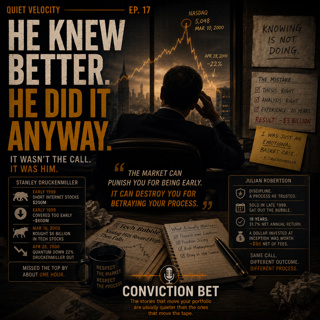
In March 2000, Stanley Druckenmiller had the internet bubble exactly right. He had shorted it, written the thesis, and run money for two decades without a losing year. Then he watched two junior traders down the hall get rich, picked up the phone three times and put it back down, and bought $6 billion of technology stock — missing the top, by his own estimate, by about an hour.

Six weeks later he was down $3 billion. His own explanation: he was "just an emotional basket case and couldn't help myself." Not that he'd missed something — that he already knew. This episode is about the gap between knowing and doing, why more research doesn't close it, and what a 1954 aviation experiment says about the only thing that does.

In this episode:

Two men, the same call, both destroyed. Druckenmiller capitulated and lost $3 billion in six weeks; the Nasdaq set a record close on March 10, 2000 that it wouldn't see again for fifteen years. Julian Robertson did the opposite — he held, and closed Tiger Management that same month. Partners had earned 31.7% a year after fees for eighteen years, and investors still pulled $7.7 billion out from under him. He shut the firm citing "a market which I frankly do not understand." Neither failure was a failure of analysis.

Your inner ear is lying to you. Below roughly two degrees per second, the semicircular canals detect no rotation at all. After ten to twenty seconds in a steady turn, the sensation of turning simply stops — you're banking, and your body reports level flight. What follows is the graveyard spiral: the altimeter unwinds, the obvious correction tightens the turn, and every instinct makes it worse.

The behavior is measurable, not anecdotal. Terrance Odean's 1998 study of 10,000 brokerage accounts found investors realized 14.8% of their available winners against 9.8% of their losers — and the winners they sold went on to beat the losers they kept by 3.4 percentage points. Barber and Odean's 66,000 households: gross returns clustered between 18.5% and 18.7% across every turnover group, but the most active traders netted 11.4% while the market returned 17.9%. Same stock picking. Different behavior.

The professionals drift too — and the index funds don't. Vanguard's analysis of twenty-five years of Morningstar data found large-cap funds with "value" in their legal name persistently tilt toward growth. The drift predicts nothing. The portfolios that stuck closest to their stated discipline were the ones with no manager watching anyone else get rich.

What works isn't calmness — it's procedure. One month of the year reverses the entire pattern, and it isn't because anyone got braver in December. Plus: what the 2022 Science Advances replication actually found about meditation and the amygdala, Buffett's twenty-punch card, and the real result of the 1954 study that the famous "178 seconds to live" line completely buries — twenty pilots, all of whom lost control, and what six hours of instruction did to that.

The bear case, taken seriously. Discipline held through a mania is genuinely hard to distinguish from stubbornness — Robertson is the proof. So the episode draws a line more defensible than "never sell": price is real information, and ignoring it is its own blindness — but it is not proof that value changed. A large move should trigger a re-underwriting, not a trade.

What it means for you: write the decision down before the horizon disappears. What would actually have to happen for you to sell. How large one idea is allowed to get. What you're obliged to do on a bad day. A sound framework is half the problem — the other half is the state you're in when you have to use it, and you don't fix that half by becoming a calmer person.

New episodes weekly. Subscribe on Apple Podcasts, Spotify, YouTube, or Amazon Music.

Conviction Bet is independent investment commentary. Nothing in this episode is investment advice.

Denne episoden er hentet fra en åpen RSS-feed og er ikke publisert av Podme. Den kan derfor inneholde annonser.

Episoder(21)

Why You Won't Spend Your Own Money

Why You Won't Spend Your Own Money

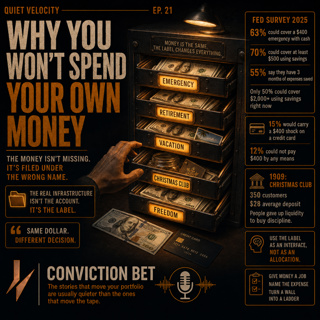
Your balance tells you what you have. The label shapes what you'll actually use. And you're the one who wrote it.The Federal Reserve asked Americans two versions of the same question. 70% said they co...

25 Aug 32min

You Can Copy The Key, Not The Locksmith: Nick Sleep's 921% Manual Is Free

You Can Copy The Key, Not The Locksmith: Nick Sleep's 921% Manual Is Free

Two men, no analysts, no leverage, two letters a year. Twelve and a quarter years later: 921.1% against 116.9% for the MSCI World. A dollar became $10.21. Then they closed the fund, handed the capital...

13 Aug 37min
Can You Survive Being Right Too Early?

Can You Survive Being Right Too Early?

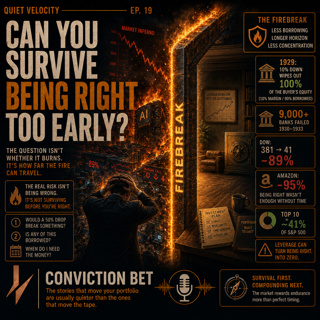
In late July, the market decided the AI build-out had gone too far. The Nasdaq fell into its second correction of the year, the Philadelphia Semiconductor Index dropped into a technical bear market, a...

6 Aug 32min
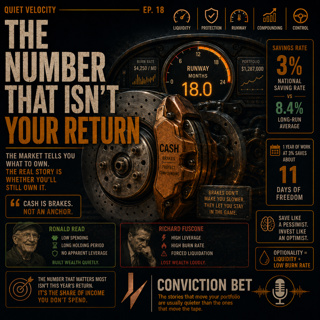
The Number That Isn't Your Return

The Number That Isn't Your Return

A Vermont gas station attendant died in 2014 holding $8 million and a five-inch stack of stock certificates. That same year, a former Merrill Lynch executive who once ran the firm's Latin America arm ...

30 Jul 39min
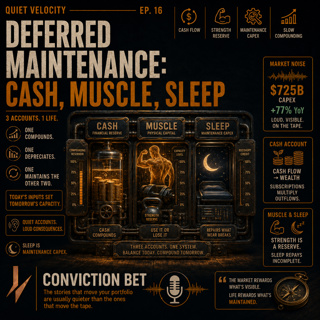
Deferred Maintenance: Cash, Muscle, Sleep

Deferred Maintenance: Cash, Muscle, Sleep

The four biggest tech companies are planning as much as $725 billion of capital spending this year — up 77% in a single year — much of it on machines that never have to sleep. The people underwriting ...

16 Jul 39min

The Rulebook You Never Read

The Rulebook You Never Read

At Monday's close, funds tracking the Nasdaq-100 lined up to buy an estimated $4 billion of SpaceX stock. Nobody at those funds decided SpaceX was worth owning — a rulebook decided. And three weeks ea...

9 Jul 32min
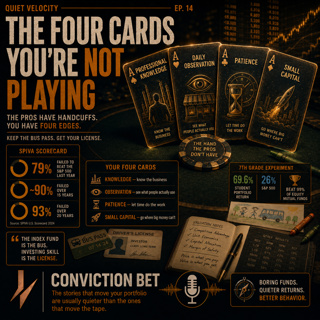
The Four Cards You're Not Playing

The Four Cards You're Not Playing

79% of professional large-cap fund managers lost to the S&P 500 last year. Stretch the window to fifteen years and the failure rate hits roughly 90%. The internet's favorite conclusion: if the pros ca...

1 Jul 28min

Populært innen Business og økonomi

stopp-verden
dine-penger-pengeradet
rss-penger-polser-og-politikk
e24-podden
rss-borsmorgen-okonominyhetene
rss-pa-konto
rss-skravla-gar
lydartikler-fra-aftenposten
finansredaksjonen
utbytte
pengepodden-2
livet-pa-veien-med-jan-erik-larssen
tid-er-penger-en-podcast-med-peter-warren
rss-orjasater
stormkast-med-valebrokk-stordalen
lederpodden
pengesnakk
morgenkaffen-med-finansavisen
liberal-halvtime
rss-markedspuls-2