
Why You Won't Spend Your Own Money

Why You Won't Spend Your Own Money

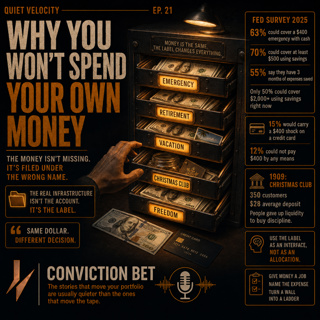
Your balance tells you what you have. The label shapes what you'll actually use. And you're the one who wrote it.

The Federal Reserve asked Americans two versions of the same question. 70% said they could cover a $500 emergency out of savings. 63% said they would cover a $400 one with cash. The Fed's own reading of the gap: some people with savings available still choose another way to pay.

This episode is about what a name on a pile of money actually does — why the label you write on an account changes what you save, what you sit through, and what you let yourself spend. And why the label does almost nothing on its own.

In this episode:

Two measures that refuse to line up55% of U.S. adults say they have three months of expenses set aside. Only 50% say they could cover $2,000 from savings right now. The Fed flags the discrepancy itself, and offers one possible explanation: there are assets people would tap after three months without income that they don't count as available today. Plus the split that outruns income — 86% of adults who always have money left at month end have three months saved, against 13% of those who never do.

The best bad financial product in AmericaIn 1909, Merkel Landis of the Carlisle Trust Company in Pennsylvania launched a savings plan you couldn't get at until December. Weekly deposits, reduced access, a date built into the structure. Americans took it up for most of a century. Richard Thaler named the behavior behind it in 1985 and won the Nobel in 2017 — and Hastings and Shapiro caught it in 10.5 million gasoline transactions across 61,494 households.

5% traded. The other number was 14 points.Vanguard's 2026 report covers nearly 5 million workers: participation up from 65% to 86%, 61% of plans on automatic enrollment, and just 5% of participants trading through a volatile year. Morningstar's Mind the Gap 2026 found the average dollar in crypto ETFs lost about 5.8% a year while the funds themselves returned 8.5% — a gap of more than 14 percentage points. What the two datasets can and can't tell you about why.

Permission to spendThe harder half of the argument: a label is what lets you use money you already have. Bengen's framework run at small scale — what a cat and a music subscription actually cost at 25x — why naming the account is what makes you do the arithmetic you were avoiding, and why the savings goal you quietly abandoned this year may have done more for you than you think.

The bear case, concededMichael Kitces calls bucket strategies an "asset allocation mirage." Javier Estrada tested them across 21 countries and 115 years, and they underperformed the static portfolios he compared them against. A 2025 replication supported 11 of Thaler's 17 classic problems. All of it conceded — plus what Congress built in 2022, gave a matching contribution, and almost nobody adopted.

What it means for youManage the money as one portfolio, not as separate universes with separate names. But if naming the pieces helps you save, stay invested, or spend on purpose, the label is the cheapest input on the list — and it is the one you set yourself, in a calm moment, before the volatility arrives.

New episodes weekly. Subscribe on Apple Podcasts, Spotify, YouTube, or Amazon Music.

Conviction Bet is independent investment commentary. Nothing in this episode is investment advice.

Denne episoden er hentet fra en åpen RSS-feed og er ikke publisert av Podme. Den kan derfor inneholde annonser.

Episoder(21)

You Can Copy The Key, Not The Locksmith: Nick Sleep's 921% Manual Is Free

You Can Copy The Key, Not The Locksmith: Nick Sleep's 921% Manual Is Free

Two men, no analysts, no leverage, two letters a year. Twelve and a quarter years later: 921.1% against 116.9% for the MSCI World. A dollar became $10.21. Then they closed the fund, handed the capital...

13 Aug 37min

Can You Survive Being Right Too Early?

Can You Survive Being Right Too Early?

In late July, the market decided the AI build-out had gone too far. The Nasdaq fell into its second correction of the year, the Philadelphia Semiconductor Index dropped into a technical bear market, a...

6 Aug 32min
The Number That Isn't Your Return

The Number That Isn't Your Return

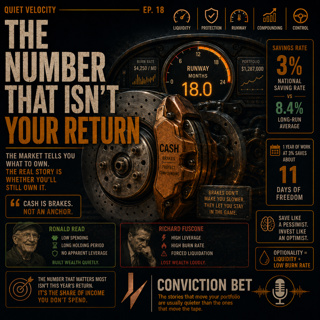
A Vermont gas station attendant died in 2014 holding $8 million and a five-inch stack of stock certificates. That same year, a former Merrill Lynch executive who once ran the firm's Latin America arm ...

30 Jul 39min

He Knew Better. He Did It Anyway

He Knew Better. He Did It Anyway

In March 2000, Stanley Druckenmiller had the internet bubble exactly right. He had shorted it, written the thesis, and run money for two decades without a losing year. Then he watched two junior trade...

23 Jul 33min
Deferred Maintenance: Cash, Muscle, Sleep

Deferred Maintenance: Cash, Muscle, Sleep

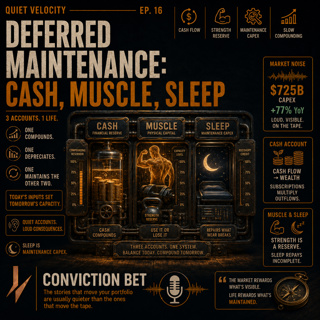
The four biggest tech companies are planning as much as $725 billion of capital spending this year — up 77% in a single year — much of it on machines that never have to sleep. The people underwriting ...

16 Jul 39min

The Rulebook You Never Read

The Rulebook You Never Read

At Monday's close, funds tracking the Nasdaq-100 lined up to buy an estimated $4 billion of SpaceX stock. Nobody at those funds decided SpaceX was worth owning — a rulebook decided. And three weeks ea...

9 Jul 32min

The Four Cards You're Not Playing

The Four Cards You're Not Playing

79% of professional large-cap fund managers lost to the S&P 500 last year. Stretch the window to fifteen years and the failure rate hits roughly 90%. The internet's favorite conclusion: if the pros ca...

1 Jul 28min

Populært innen Business og økonomi

stopp-verden
dine-penger-pengeradet
rss-penger-polser-og-politikk
e24-podden
rss-borsmorgen-okonominyhetene
rss-pa-konto
rss-skravla-gar
lydartikler-fra-aftenposten
finansredaksjonen
utbytte
pengepodden-2
livet-pa-veien-med-jan-erik-larssen
tid-er-penger-en-podcast-med-peter-warren
rss-orjasater
stormkast-med-valebrokk-stordalen
lederpodden
pengesnakk
morgenkaffen-med-finansavisen
liberal-halvtime
rss-markedspuls-2