Five Years, 1,905 Recoveries: How Daily Movement Rewires Your Brain (Bonus Episode)

Five Years, 1,905 Recoveries: How Daily Movement Rewires Your Brain (Bonus Episode)

Andrea Samadi shares a five-year self-experiment using a WHOOP wearable to track sleep, recovery, movement, and biological age. She reveals how daily low-intensity movement and consistent recovery—not one intense workout—produced lasting improvements in heart rate, recovery scores, and biological age.

Andrea distills five lessons: movement prepares the brain, consistency beats intensity, recovery is where adaptation happens, small habits compound over time, and every step is an investment in your future brain. Practical takeaways include walking daily, adding 2–3 strength sessions per week, protecting sleep, and tracking trends instead of perfection.

In this Bonus Episode you'll learn:
    Why recovery matters more than you think. What 1,905 recoveries taught me about human performance. Why consistency beats intensity. How movement changes the brain. How to create lasting biological adaptation. Why every walk is an investment in your future brain.

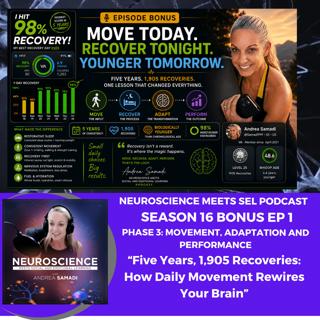
EPISODE BONUS

Move Today. Recover Tonight. Younger Tomorrow.

Five Years. 1,905 Recoveries. One Lesson That Changed Everything.

Welcome Back

Welcome back to the Neuroscience Meets Social and Emotional Learning Podcast.

I'm Andrea Samadi.

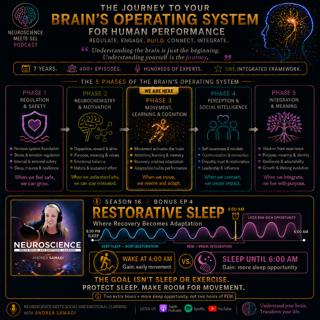
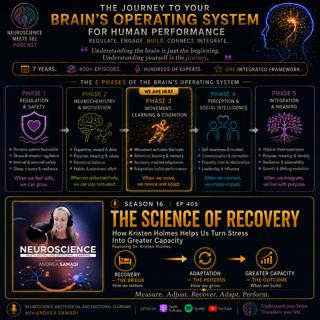
Over the past seven years, I've had the privilege of interviewing many of the world's leading experts in neuroscience, psychology, learning, leadership, health, and human performance. Throughout Season 16, we've been connecting those conversations into a simple framework I call The Brain's Operating System for Human Performance—a practical way of understanding how the brain and body work together to help us learn better, think more clearly, live healthier, and perform at our highest potential.

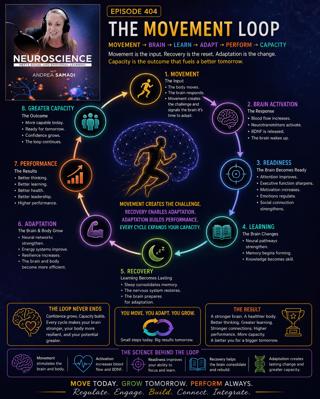
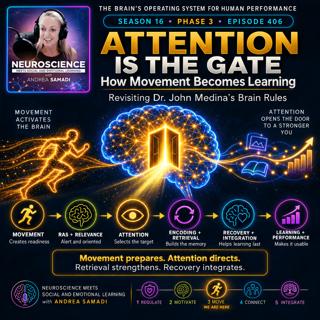
In Episode 402[i], we introduced The Movement Loop, built around one simple idea:

Movement is the input.

Adaptation is the process.

Performance is the outcome.

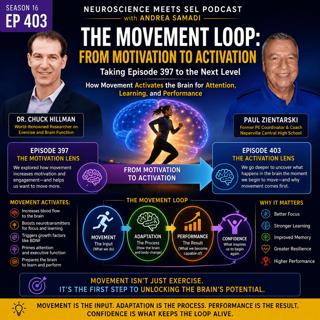
Then, in Episode 403[ii], Dr. Chuck Hillman helped us understand why movement changes the brain.

Every step increases blood flow.

Exercise stimulates Brain-Derived Neurotrophic Factor—BDNF—often called fertilizer for the brain.

Movement strengthens the neural networks responsible for learning, memory, attention, and executive function.

But after recording those episodes, I found myself asking a different question.

What happens when we apply those principles consistently—not for days, weeks, or even months—but for years?

Today's bonus episode is my attempt to answer that question.

Not from another research study.

Not from another interview.

And definitely not to give you one more thing to add to your already busy schedule.

Instead...

I'd like to share a five-year experiment I never realized I was conducting—one that completely changed the way I think about health, movement, recovery, and human performance.

Five Years Looking for the Answer

When I started wearing a WHOOP device back in April of 2021, just before my fiftieth birthday, I thought I was buying a fitness tracker.

I thought it would help me train harder.

I thought it would reward intensity.

Instead...

It spent the next five years teaching me something far more valuable.

How to recover.

Over those five years I've tracked nearly everything I could measure.

Sleep.

Movement.

Recovery.

Resting heart rate.

Heart rate variability.

VO₂ Max.

Biological age.

Blood work.

Thousands of workouts.

And more than 1,905 recoveries.

Nearly two thousand mornings of waking up and asking my body the same question.

How well did I recover?

At first, I didn't really know what I was looking for.

I simply assumed the harder I trained...

the healthier I'd become.

The Mystery

Then WHOOP introduced a new metric.

WHOOP Age.

The first time I looked at it, I honestly couldn't believe what I was seeing.

My biological age measured 48.7 years old.

I was fifty-five.

More than six years younger biologically than chronologically.

Of course, my first question wasn't, "That's great."

My first question was...

Why?

What was I doing that created this result?

Naturally, I assumed it was my hardest hikes.

My toughest strength workouts.

The mornings I pushed myself until I was completely exhausted.

But that's not what the data showed.

Not even close.

The biggest contributor wasn't intensity.

It was consistency.

Daily walks.

Steady hikes.

Hours spent moving in Heart Rate Zones 1 through 3.

The very workouts I used to think "didn't count."

Ironically, even today, after finishing a workout, I still catch myself hoping to see more time in Zone 4 or Zone 5.

Old beliefs don't disappear overnight.

Part of me still believes harder must be better.

But five years of data kept telling me a different story.

A Belief I Had to Unlearn

For most of my life, I believed exercise was supposed to leave me exhausted.

If I wasn't completely out of breath...

If I wasn't drenched in sweat...

If I wasn't barely able to walk back to my car...

I assumed I hadn't worked hard enough.

Maybe you've felt that way too.

We grew up hearing...

"No pain, no gain."

But neuroscience—and my own data—kept challenging that belief.

The movement that felt the easiest...

was quietly producing the greatest return.

Daily walks.

Easy hikes with friends.

Walking my dogs along the canal.

Consistent aerobic movement.

Those weren't "easy days."

Those were adaptation days.

And slowly, my definition of success began to change.

The Moment Everything Changed

A few days ago something happened.

After nearly five years...

and more than 1,905 recoveries...

I recorded my highest recovery ever.

98%.

For a few moments I celebrated the score.

Then something much more meaningful hit me.

That number wasn't created overnight.

It wasn't the result of one perfect night's sleep.

Or one incredible workout.

Or one supplement.

Or one recovery tool.

It represented five years of learning to work with my biology instead of against it.

That's when everything finally clicked.

Recovery isn't passive.

Recovery is where adaptation happens.

It's where muscles rebuild.

It's where the brain consolidates learning.

It's where the nervous system recalibrates.

It's where hormones rebalance.

It's where your cardiovascular system grows stronger.

It's where yesterday's movement becomes tomorrow's performance.

Movement starts the conversation.

Recovery is where your body answers.

The Missing Piece

That's when I realized something I wish someone had explained to me years ago.

Movement isn't the goal.

Recovery isn't even the goal.

Adaptation is the goal.

Movement is simply the signal that tells your biology...

"Build something stronger."

Recovery is when your body actually does the work.

Adaptation is the result.

Performance becomes the evidence.

That is The Movement Loop.

Move.

Recover.

Adapt.

Perform.

One connected system.

What My Data Shows

When I stopped looking at individual workouts and started looking at years of trends, the story became remarkably clear.

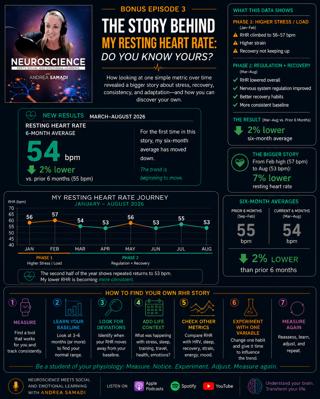
My resting heart rate dropped.

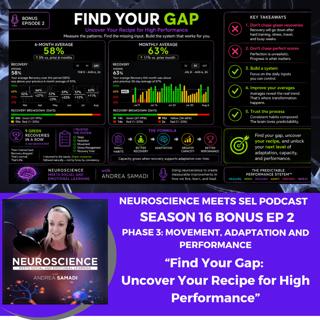
My recovery improved.

My biological age became younger.

My weekly movement consistently averaged more than seven hours in Heart Rate Zones 1 through 3.

None of those changes happened because of one extraordinary workout.

They happened because of thousands of ordinary choices repeated over and over again.

That's how biology changes.

Quietly.

Consistently.

Patiently.

Five Lessons Five Years and 1,905 Recoveries Taught Me

Looking back over nearly five years—and more than 1,905 recoveries—I realize I wasn't simply collecting health data. I was watching my brain and body adapt in real time.

Here are the five lessons I wish I had understood when I first started this journey.

Lesson 1: Movement prepares the brain.

One of the biggest insights from Dr. Chuck Hillman's research is that movement doesn't just strengthen our muscles—it prepares our brains to learn and perform.

Every walk increases blood flow.

Every hike stimulates Brain-Derived Neurotrophic Factor, or BDNF, helping the brain build and strengthen neural connections.

I've noticed this in my own life. On the days I move first, I think more clearly, focus longer, solve problems more easily, and simply show up as a better version of myself.

Movement isn't something I do after work anymore.

It's how I prepare for my work.

Lesson 2: Consistency beats intensity.

For years, I believed the hardest workout was the best workout.

My data taught me something completely different.

The biggest improvements in my health didn't come from one exhausting hike or one intense strength session.

They came from showing up every single day.

Walking the canal.

Taking the dogs out.

Choosing another easy hike. Stopping to talk with people on the trails. It took me years to ask one person their name, after seeing them on the trails for over 10 years!

Repeating those small decisions (and actions) over and over again.

The body doesn't transform because we occasionally do something extraordinary.

It transforms because we consistently do the ordinary.

Lesson 3: Recovery is where adaptation happens.

This may have been the biggest surprise of all.

For years, I thought recovery meant taking a break from making progress.

Now I understand that recovery is the progress.

Recovery is where muscles rebuild.

It's where the brain consolidates learning.

It's where the nervous system recalibrates.

It's where your body responds to the signal that movement created.

Without recovery, movement is simply stress.

With recovery, movement becomes adaptation.

Lesson 4: Small daily habits create extraordinary results.

When I recorded my highest recovery ever—98%—(just this week) I realized something important.

That number wasn't created by one perfect night of sleep.

It wasn't one workout.

It wasn't one supplement.

It wasn't one infrared sauna session.

It represented thousands of small decisions repeated consistently over five years.

Morning sunlight.

Walking.

Strength training.

Prioritizing sleep.

Breathwork.

Meditation.

Recovery.

None of those habits seem remarkable on their own.

Together, they completely changed my biology.

And then I was able to create PREDICTABLE results with recovery, once I fully understood it.

Lesson 5: Every step is an investment in your future brain.

This may be the most important lesson of all.

Most of us exercise because we want to look better or feel better today.

But neuroscience tells us something even more powerful.

Every walk you're taking today is helping build the brain you'll rely on years from now.

Every time you move, you're strengthening the systems that support attention, memory, emotional regulation, cardiovascular health, and resilience.

You may not notice those changes tomorrow.

I certainly didn't.

It took me nearly five years—and 1,905 recoveries—to truly appreciate what my body had been quietly building all along.

That's why I no longer think of movement as exercise.

I think of it as one of the greatest investments I can make in my future health, my future brain, and the quality of my life.

Because every step you take today is a vote for the person you're becoming tomorrow.

Practical Application

If you're wondering where to start...

Start walking.

Walk before work.

Walk after dinner.

Walk with your family.

Walk with your dog.

Strength train two or three times each week. It doesn’t take a lot to see noticeable gains.

Protect your sleep.

Track trends instead of chasing perfection.

Then tomorrow morning ask yourself one simple question.

Not...

"How hard should I train today?"

Instead...

How can I move today?

One question.

One decision.

Repeated consistently.

That's how change begins.

Review and Conclusion

As we wrap up this bonus episode, let's step back and look at what we've learned throughout this first part of Phase 3.

Movement prepares the brain.

Recovery builds the body.

Adaptation changes our biology.

Performance becomes the evidence.

Five years ago, I thought movement was the goal.

Today I know better.

Movement is the signal.

Recovery is the builder.

Adaptation is the transformation (that we can see)

Performance is the evidence (or what we were aiming for in the first place).

After nearly 1,905 recoveries, I finally understand why recovery matters.

Not because it helps us rest.

Because it helps us become.

Looking back, I wasn't simply collecting health data.

I was watching neuroscience unfold in real time.

The greatest improvements in my health didn't come from my hardest workouts.

They came from thousands of ordinary decisions repeated consistently over time.

We can go back to our early episodes[iii] to hear the importance of repetition.

That's how human performance is built.

Not through one breakthrough moment.

But through daily choices that quietly reshape the brain, strengthen the body, and prepare us for whatever comes next.

So wherever you're listening today...

Whether you're heading out for a walk...

Driving home from work...

Finishing a workout...

Or simply deciding how you'll move tomorrow...

Remember this.

Every step is a vote for your future self.

Move today.

Recover tonight.

Adapt tomorrow.

Live younger tomorrow.

Until next time...

Keep moving.

Keep learning.

Keep adapting.

Because every step you take today is helping build a healthier, stronger, and more resilient version of yourself tomorrow.

REFERENCES:

[i] Neuroscience Meets Social and Emotional Learning Podcast EPISODE 402 “Phase 3 Intro: How Movement Builds the Brain https://andreasamadi.podbean.com/e/movement-loop-how-everyday-action-rewires-your-brain-and-boosts-performance/

[ii]Neuroscience Meets Social and Emotional Learning Podcast EPISODE 403 “How movement Activates the Brain and Learning” https://andreasamadi.podbean.com/e/movement-first-how-a-20%e2%80%91minute-walk-lights-up-the-brain/

[iii]Neuroscience Meets Social and Emotional Learning Podcast EPISODE 38 https://andreasamadi.podbean.com/e/assistant-coach-to-the-winnipeg-jets-todd-woodcroft-on-the-daily-grind-in-the-nhl/

Denne episoden er hentet fra en åpen RSS-feed og er ikke publisert av Podme. Den kan derfor inneholde annonser.

Episoder(408)

The Movement Loop: How Movement Activates the Brain for Learning, Adaptation & Performance

The Movement Loop: How Movement Activates the Brain for Learning, Adaptation & Performance

Welcome back to Season 16 of the Neuroscience Meets Social and Emotional Learning Podcast. I'm Andrea Samadi, and this is where we bridge neuroscience, social and emotional learning, and human perform...

19 Jul 34min

How Movement Builds the Brain, the Body & Human Performance (Phase 3 Introduction)

How Movement Builds the Brain, the Body & Human Performance (Phase 3 Introduction)

Season 16, Episode 402 explores the Brain's Operating System for Human Performance, focusing on Phase 3: movement, adaptation, and performance. Andrea Samadi explains how movement triggers neurochemic...

12 Jul 25min

Trust as the Foundation with Greg Hill: How Great Leaders Create the Conditions for Learning, Growth and Performance

Trust as the Foundation with Greg Hill: How Great Leaders Create the Conditions for Learning, Growth and Performance

In episode 401 Andrea Samadi welcomes Greg Hill to explore why trust is the essential foundation for learning, growth, and high performance. They discuss how trust creates psychological safety, encour...

27 Jun 37min

Episode 400: Sales Leadership Under Pressure with Majid Samadi: 7 Lessons Learned from 7 Years of Neuroscience

Episode 400: Sales Leadership Under Pressure with Majid Samadi: 7 Lessons Learned from 7 Years of Neuroscience

In this milestone episode (400), Andrea Samadi celebrates seven years of the Neuroscience Meets SEL Podcast with her husband Majid Samadi. They reflect on the journey of translating neuroscience into ...

20 Jun 47min

Phase 2 Review: The Motivation Loop: How to Keep Effort Worthwhile

Phase 2 Review: The Motivation Loop: How to Keep Effort Worthwhile

Episode 399 reviews Phase 2 of Season 15 and introduces the Motivation Loop — the sequence of meaning, belief, attention, action, reward, and recovery that drives sustained effort. The episode explain...

14 Jun 28min

Fun, Fear, Focus: Closing the Motivation Loop with Friederike Fabritius

Fun, Fear, Focus: Closing the Motivation Loop with Friederike Fabritius

Episode 398 revisits neuroscientist Friederike Fabritius (from November 2022) to explain how three ingredients — fun (dopamine), fear (productive challenge), and focus — create the neurochemical condi...

9 Jun 23min

Move to Learn: How Movement Activates the Brain and Fuels Motivation (with Dr. Chuck Hillman and Paul Zientarski)

Move to Learn: How Movement Activates the Brain and Fuels Motivation (with Dr. Chuck Hillman and Paul Zientarski)

Season 15, Episode 397 revisits research and real-world practice showing movement is more than fitness: it activates the brain, boosts attention, enhances learning, and sustains motivation. Dr. Chuck ...

31 Mai 35min

Populært innen Fakta

fastlegen
dine-penger-pengeradet
relasjonspodden-med-dora-thorhallsdottir-kjersti-idem
foreldreradet
treningspodden
mikkels-paskenotter
rss-strid-de-norske-borgerkrigene
hverdagspsyken
rss-kunsten-a-leve
sinnsyn
rss-sarbar-med-lotte-erik
gravid-uke-for-uke
fryktlos
dopet
rss-bisarr-historie
tomprat-med-gunnar-tjomlid
jakt-og-fiskepodden
rss-impressions-2
rss-renters-rente
sovnlos