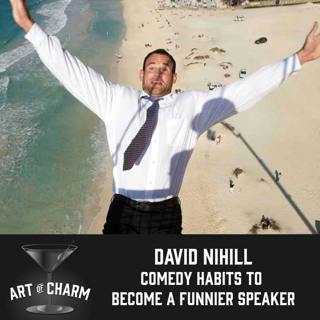

341: David Nihill | Comedy Habits to Become a Funnier Speaker
The Art of Charm17 Nov 2014

341: David Nihill | Comedy Habits to Become a Funnier Speaker

Humor connects you and your audience. "There's nobody more judged than a stand-up comedian."-Jerry Seinfeld The Cheat Sheet: How to have people talking about your speech after it ends, in a good way. 22 hours of work go into 1 minute of a 60-minute stand up comedy set: true or false? Are keynotes dead? The rule of 3 ('tree'): what is it and how to use it. What is rehearsed spontaneity? And so much more... Have you ever been in the audience for a speech so boring everyone around you stopped listening and starting doing other things? Is it your worst fear that someday YOU will be speaking and will be that dull? David Nihill is here to help us all be better public speakers through comedy. David is a comedian and public speaker who was once terrified of being in front of an audience! Hear how he went from a terrified public speaker to a stand up comedian killing it on stage, and all the applicable comedy habits he learned along the way. Join us for all of that and more on episode 341 of The Art of Charm. More About This Show: For many of us public speaking is our top fear, even greater than our fear dying. As the joke goes "We'd rather be IN the casket than giving the eulogy at a funeral." But if you're wanting to face that, or are in a position where you must face that fear, today's chat with David Nihill will give you some tools you can use to overcome your fear and give a great presentation. Not long ago David was rubbish at public speaking, he dropped far too many F bombs and was generally a nervous, sweaty mess. When one of his friends suffered a severe spinal cord injury David wanted to help raise funds. He suggested organizing a comedy show with top comedians as a fundraiser and the idea took off. The only glitch? David's friend insisted he give the opening speech, and David was petrified. Instead of backing down from the challenge, David emulated one of his mentors Tim Ferriss and rose to the occasion. He took a very Tim-like approach to the subjects of comedy and public speaking. He wanted to break down the best speeches and comedic routines to figure out how he could follow in their footsteps. Were there common processes for both? Did the two overlap and if they did, how could he fuse them together to make his opening speech funny and well-received at his friend's fundraiser? David went through a laborious and intensive study, and it paid off. His opening for the fundraiser was well-received, so much so that he was invited to open for a group of comedians at The Punch Line in San Francisco. And that opened a new door for him. Today he has performed comedy routines at some of the top comedy clubs in California, he held the first Funny Bizz conference in 2014 and has just published his first book 7 Comedy Habits to Be a Funnier Speaker. On today's show David explains a few of the many lessons he's learned about public speaking and comedy. The first topic we touch on is how to use humor in your presentations and speeches. Humor is the easiest way for others to relate to you, so use it early on in your speech to connect with your audience. If you're coming to their town learn something about the city you're in and use it humorously to show your audience you care about where they live and what their lives are like there. Humor also makes your speech or presentation memorable;it accomplishes this by breaking down barriers between you and them. If you can break down those barriers and make people laugh, they will remember you and will be talking about you long after you've finished speaking. All of that is well and good but how do you make people laugh? Is there a formula or a process we can take from comedy and apply to public speaking? There are several and we go into each of them on this episode; the one we'll discuss here is evaluating your performance. The best public speakers and the best comedians all evaluate themselves. Yes it's awkward, uncomfortable and unpleasant, but it is how anyone improves anything they do (especially public speaking and stand up comedy). So record yourself and dissect what you do, how you do it. Look at what worked, what didn't work, trim out everything you can and hone in on the good stuff. Get a coach to help you if you can. David dishes out other ways we can make our speeches and presentations funny and memorable including using the art of the callback and the rule of 3. So tune in to hear all of that and more, then join me in thanking him for the laughs and the learning. He was an awesome guest and you're awesome for listening. Thanks and we'll see you next time! THANKS DAVID NIHILL! If you enjoyed this session of The Art of Charm Podcast, let David know by clicking on the link below and sending him a quick shout out on Twitter: Click here to thank David on Twitter! Resources from this episode: Funny BizzDavid Nihill's web site7 Comedy Habits to Become a Funnier SpeakerRobin Williams crashes TED BBC ConferenceDavid Nihill on Twitter You'll also like: -The Art of Charm Toolbox -Best of The Art of Charm Podcast Wanna leave a comment? Too bad! Email me instead (we read everything)! HELP US SPREAD THE WORD! If you dug this episode, please subscribe in iTunes and write us a review! This is what helps us stand out from all the fluff out there. FEEDBACK + PROMOTION Hit us up with your comments and guest suggestions. We read EVERYTHING. Download the FREE AoC app for iPhone Email jordan@theartofcharm.com Give us a call at 888.413.7177 Stay Charming! Learn more about your ad choices. Visit megaphone.fm/adchoices

Denne episoden er hentet fra en åpen RSS-feed og er ikke publisert av Podme. Den kan derfor inneholde annonser.

Episoder(1182)

Waffling | Social Intelligence Briefing

Waffling | Social Intelligence Briefing

The moment someone challenges your idea, do you defend it—or accidentally convince the room you weren’t confident in it to begin with? AJ and Johnny break down why smart, analytical professionals oft...

10 Sep 14min

The Hidden Forces Behind Your Choices | Glenn Hutchinson

The Hidden Forces Behind Your Choices | Glenn Hutchinson

You think you know why you make the choices you make. Your unconscious mind may have gotten there first. AJ and Johnny sit down with psychologist Glenn to explore the hidden forces behind temptation,...

8 Sep 59min

Social Gravity | Social Intelligence Briefing

Social Gravity | Social Intelligence Briefing

Being the smartest person in the room won’t help your career if nobody remembers what you contributed when the decision gets made. AJ and Johnny break down why talented, analytical professionals ofte...

4 Sep 17min

The Hidden Power of Negative Emotions | George Loewenstein

The Hidden Power of Negative Emotions | George Loewenstein

Your emotions don’t just change how you feel—they can change what you remember, how you judge other people, and even who you become in the moment. AJ sits down with behavioral economist George Loewen...

31 Aug 1h 12min

The Nice Tax | Social Intelligence Briefing

The Nice Tax | Social Intelligence Briefing

Being easy to work with can quietly make you miserable—and invisible. AJ and Johnny break down the “nice tax”: the price you pay every time you agree with something you don’t actually agree with just...

27 Aug 15min

The Easier Way to Reach Your Goals | Jia Jiang

The Easier Way to Reach Your Goals | Jia Jiang

Discipline gets a lot easier when you stop treating misery as proof that you’re doing it right. AJ and Johnny sit down with author and rejection expert Jia Jiang to challenge the traditional idea tha...

24 Aug 58min

The Secret to Living Guilt-Free | Dr Jennifer Reid

The Secret to Living Guilt-Free | Dr Jennifer Reid

Guilt can feel like proof that you care—but when it becomes your default way of relating to work, family, and yourself, it quietly turns care into obligation. AJ sits down with psychiatrist Jennifer ...

17 Aug 1h 3min

Why "That's Fine" Is the Most Expensive Sentence You Say | Social Intelligence Briefing

Why "That's Fine" Is the Most Expensive Sentence You Say | Social Intelligence Briefing

Silence is where negotiators accidentally give away money. AJ and Johnny break down why the hardest part of a negotiation often isn’t knowing what to ask for—it’s resisting the urge to speak when the...

14 Aug 19min

Populært innen Business og økonomi

stopp-verden
dine-penger-pengeradet
e24-podden
rss-penger-polser-og-politikk
lydartikler-fra-aftenposten
rss-borsmorgen-okonominyhetene
rss-skravla-gar
utbytte
rss-pa-konto
rss-orjasater
pengepodden-2
tid-er-penger-en-podcast-med-peter-warren
livet-pa-veien-med-jan-erik-larssen
pengesnakk
finansredaksjonen
stormkast-med-valebrokk-stordalen
lederpodden
morgenkaffen-med-finansavisen
liberal-halvtime
rss-markedspuls-2