248: Disruption of PIKfyve triggers lysosomal repair and mitochondrial adaptation

248: Disruption of PIKfyve triggers lysosomal repair and mitochondrial adaptation

Kutchukian C et al., Nature Communications - Disruption of the PIKfyve/Fig4/Vac14 complex drives ULK1-dependent trafficking of PI4KIIα and ATG9A to lysosomes, elevating lysosomal PI(4)P to promote membrane repair and induce mitochondrial fragmentation with increased respiration. Key terms: PIKfyve, PI4KIIα, PI(4)P, ULK1, lysosomal repair.

Study Highlights:
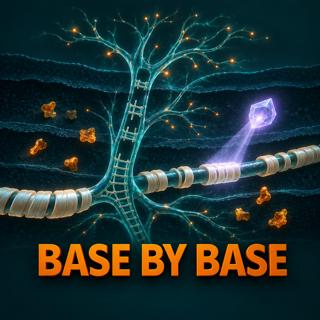
PIKfyve complex disruption or pharmacological inhibition reduces mTORC1 signaling, activating ULK1 and driving ATG9A-dependent trafficking of PI4KIIα from the TGN to lysosomes. PI4KIIα accumulation elevates lysosomal PI(4)P, recruiting OSBP/ORP proteins to transfer cholesterol and phosphatidylserine and enhance lysosomal membrane repair. Elevated lysosomal PI(4)P recruits ORP1L at ER–lysosome–mitochondria three-way contacts, enabling PI(4)P transfer to mitochondria, Drp1 recruitment, mitochondrial fragmentation, and increased oxygen consumption. Inhibition of ULK1 or PI4KIIα or mitochondrial targeting of Sac1 reverses these lysosomal and mitochondrial phenotypes.

Conclusion:
A ULK1-dependent PI4KIIα–PI(4)P pathway links PIKfyve complex dysfunction to coordinated lysosomal membrane repair and adaptive mitochondrial remodeling

Music:
Enjoy the music based on this article at the end of the episode.

Article title:
Disruption of the PIKfyve complex unveils an adaptive mechanism to promote lysosomal repair and mitochondrial homeostasis

First author:
Kutchukian C

Journal:
Nature Communications

DOI:
10.1038/s41467-025-65798-6

Reference:
Kutchukian C., Casas M., Dixon R. E., Dickson E. J. Disruption of the PIKfyve complex unveils an adaptive mechanism to promote lysosomal repair and mitochondrial homeostasis. Nature Communications. 2025;16:10761. https://doi.org/10.1038/s41467-025-65798-6

License:
This episode is based on an open-access article published under the Creative Commons Attribution 4.0 International License (CC BY 4.0) – https://creativecommons.org/licenses/by/4.0/

Support:
Base by Base – Stripe donations: https://donate.stripe.com/7sY4gz71B2sN3RWac5gEg00

Official website https://basebybase.com

On PaperCast Base by Base you’ll discover the latest in genomics, functional genomics, structural genomics, and proteomics.

Episode link: https://basebybase.com/episodes/pikfyve-lysosome-mitochondria

QC:
This episode was checked against the original article PDF and publication metadata for the episode release published on 2026-01-03.

QC Scope:
- article metadata and core scientific claims from the narration
- excludes analogies, intro/outro, and music
- transcript coverage: Audited the transcript's coverage of the paper's mechanism: acute PIKfyve disruption activates a ULK1-dependent PI4KIIα/ATG9A trafficking program, increases lysosomal PI(4)P, recruits OSBP/ORP proteins for membrane repair, enhances ER–lysosome–mitochondria three-way contacts with ORP1L and Drp1-driven mitochondrial fra
- transcript topics: ULK1-dependent trafficking of PI4KIIα and ATG9A from the TGN to lysosomes; PI(4)P redistribution to lysosomes and PI4KIIα relocation from the TGN; OSBP/ORP-mediated lipid transfer and lysosomal membrane repair (PITT pathway); ER–lysosome–mitochondria three-way contact sites and ORP1L/Drp1 recruitment; Mitochondrial fragmentation and enhanced respiration (Seahorse data); ULK1/mTOR signaling modulation

QC Summary:
- factual score: 10/10
- metadata score: 10/10
- supported core claims: 7
- claims flagged for review: 0
- metadata checks passed: 4
- metadata issues found: 0

Metadata Audited:
- article_doi
- article_title
- article_journal
- license

Factual Items Audited:
- Acute PIKfyve inhibition reduces mTORC1 signaling and ULK1 activation
- ULK1-dependent trafficking of PI4KIIα and ATG9A from the TGN to lys...

Denne episoden er hentet fra en åpen RSS-feed og er ikke publisert av Podme. Den kan derfor inneholde annonser.

Episoder(441)

439: Coembedding Sequence and Structure: CLSS Maps the Protein Universe

439: Coembedding Sequence and Structure: CLSS Maps the Protein Universe

Longo LM et al., PNAS - This episode summarizes a PNAS study introducing CLSS, a contrastive two-tower protein language model that coembeds domain sequences, structures, and subsequences into a shared...

11 Aug 23min

438: Mapping AIRE: a proactive atlas of 9,790 missense variants

438: Mapping AIRE: a proactive atlas of 9,790 missense variants

Axakova A et al., The American Journal of Human Genetics - Axakova et al. generated a variant effect map for AIRE using an insulin‑promoter GFP reporter in HEK293 cells to measure the functional impac...

10 Aug 24min

437: Cell villages and Dirichlet modeling map human cell fitness genetics

437: Cell villages and Dirichlet modeling map human cell fitness genetics

Hanson C et al., The American Journal of Human Genetics - Hanson et al. combine pooled multi-donor human neural progenitor cell "villages" with Townlet, a hierarchical Dirichlet regression model, to e...

9 Aug 28min

436: KIAP4 and the ARND family: building the Leishmania adhesion plaque

436: KIAP4 and the ARND family: building the Leishmania adhesion plaque

Owino BO et al., PNAS - Using TurboID proximity proteomics and microscopy, researchers identify KIAP4 as the canonical member of a conserved Adhesion Related NTPase-like Domain (ARND) family that loca...

8 Aug 24min

435: E. coli TGT binds two tRNAs — cryo-EM reveals dual engagement

435: E. coli TGT binds two tRNAs — cryo-EM reveals dual engagement

Ember M et al., PNAS - This episode examines a cryo-EM study of Escherichia coli tRNA-guanine transglycosylase (TGT) that solves the enzyme structure and its covalent intermediate with tRNATyr. Unexpe...

7 Aug 19min

434: High‑coverage genomes recast Japan's prehistoric demography

434: High‑coverage genomes recast Japan's prehistoric demography

Ishiya K et al., PNAS - This episode examines a PNAS study that reports two high-coverage ancient human genomes from mainland Japan (an Initial Jomon >67× and a Middle Yayoi >46×). The genomes enable ...

6 Aug 27min

433: Lactate, HSP90α and the Mitochondrial Switch

433: Lactate, HSP90α and the Mitochondrial Switch

Wu G et al., Proceedings of the National Academy of Sciences - This episode examines a PNAS study that identifies site-specific lactylation of HSP90α as a metabolic signal linking glycolysis to mitoch...

23 Jul 23min

432: Echovirus 18: Capsid opening releases the genome

432: Echovirus 18: Capsid opening releases the genome

Mukhamedova L et al., Proceedings of the National Academy of Sciences - Using cryo-electron tomography and single-particle cryo-EM of infected Cos-7 cells, the authors show that echovirus 18 (E18) rel...

23 Jul 18min

Populært innen Vitenskap

fastlegen
tingenes-tilstand
abels-tarn
romkapsel
jss
liberal-halvtime
rekommandert
vett-og-vitenskap-med-gaute-einevoll
sinnsyn
dekodet-2
villmarksliv
rss-rekommandert
fjellsportpodden
tomprat-med-gunnar-tjomlid
rss-overskuddsliv
rss-inn-til-kjernen-med-sunniva-rose
rss-nysgjerrige-norge
kvinnehelsepodden
diagnose
abid-nadia-skyld-og-skam