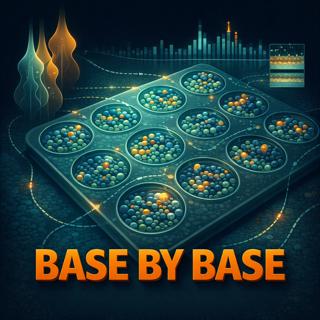

437: Cell villages and Dirichlet modeling map human cell fitness genetics

437: Cell villages and Dirichlet modeling map human cell fitness genetics

Hanson C et al., The American Journal of Human Genetics - Hanson et al. combine pooled multi-donor human neural progenitor cell "villages" with Townlet, a hierarchical Dirichlet regression model, to estimate donor-specific proliferation and treatment responses from Census-seq. They identify 16p11.2 deletion–associated NPC hyperproliferation and nominate common variants near ZFHX3 for proliferation and an ARNT2-linked locus for lead (Pb) sensitivity. Key terms: cell villages, Dirichlet regression, neural progenitor cells, 16p11.2 deletion, lead (Pb) sensitivity.

Study Highlights:
The authors developed and validated cell villages of 12–39 donor-derived NPC lines and Townlet, a Dirichlet regression framework, to analyze compositional time-series Census-seq data and estimate donor proliferation and treatment effects. Using this system they detected hyperproliferation of NPCs carrying the 16p11.2 deletion, mapped a common variant near ZFHX3 associated with proliferation, and identified ARNT2-linked variants associated with differential sensitivity to lead. Villages preserved donor-intrinsic growth rates while reducing technical variation, and Townlet outperformed standard models in simulations and empirical benchmarks.

Conclusion:
Pooled multi-donor NPC villages combined with the Townlet Dirichlet model provide a scalable, reproducible platform to map genetic and gene–environment effects on human cell fitness, nominating 16p11.2, ZFHX3, and ARNT2 as contributors to NPC proliferation and Pb sensitivity.

Music:
Enjoy the music based on this article at the end of the episode.

Article title:
Cell villages and Dirichlet modeling map human cell fitness genetics

First author:
Hanson C

Journal:
The American Journal of Human Genetics

DOI:
10.1016/j.ajhg.2026.07.005

Reference:
Hanson C., Derebenskiy T., Rodriguez Vega A., et al. Cell villages and Dirichlet modeling map human cell fitness genetics. The American Journal of Human Genetics. 2026;113:1–21. doi:10.1016/j.ajhg.2026.07.005

License:
This episode is based on an open-access article published under the Creative Commons Attribution 4.0 International License (CC BY 4.0) – https://creativecommons.org/licenses/by/4.0/

Support:
Base by Base is independent and ad-free — no sponsors, no paywall. If an episode was worth your time, chip in and keep the papers audited and the original songs coming:
❤️ Support monthly: https://buy.stripe.com/cNifZhclVebvagk2JDgEg01
☕ One-time donation: https://donate.stripe.com/7sY4gz71B2sN3RWac5gEg00
More at basebybase.com

On PaperCast Base by Base you'll discover the latest in genomics, functional genomics, structural genomics, and proteomics.

Episode link: https://basebybase.com/episodes/cell-villages-dirichlet-modeling-human-cell-fitness

QC:
This episode was checked against the original article PDF and publication metadata for the episode release published on 2026-08-09.

QC Scope:
- article metadata and core scientific claims from the narration
- excludes analogies, intro/outro, and music
- transcript coverage: Audited the transcript sections describing Townlet and cell villages, validation against array cultures, 16p11.2 deletion hyperproliferation, GWAS identifying ZFHX3-associated proliferation variants, and lead (Pb) resistance modifiers linked to ARNT2; also reviewed environmental exposome implications and limitations di
- transcript topics: Cell villages concept and Townlet model; Census-seq and compositional data challenges; Village vs array validation and donor-intrinsic proliferation; 16p11.2 deletion NPC hyperproliferation in villages; GWAS in villages identifying ZFHX3 locus and rs34470044; Lead (Pb) exposure and ARNT2-associated Pb resistance

QC Summary:
- factual score: 10/10
- metadata score: 10/10
- supported core claims:...

Denne episoden er hentet fra en åpen RSS-feed og er ikke publisert av Podme. Den kan derfor inneholde annonser.

Episoder(463)

462: A vessel gene tied to AMD dims low-light vision in mice

462: A vessel gene tied to AMD dims low-light vision in mice

Cheng et al., Proceedings of the National Academy of Sciences - Genome-wide studies have found dozens of risk loci for age-related macular degeneration, but for many of them the gene doing the work is...

30 Sep 20min
461: Adult Ank3 loss quiets neurons and lowers a myelin protein

461: Adult Ank3 loss quiets neurons and lowers a myelin protein

Yoon et al., Proceedings of the National Academy of Sciences - ANK3, which encodes the scaffolding protein ankyrin-G, is a major risk gene for bipolar disorder and schizophrenia, yet what it does in a...

24 Sep 24min

460: The lupus variant that also sharpens antiviral defense

460: The lupus variant that also sharpens antiviral defense

Virolainen et al., The American Journal of Human Genetics - A lupus signal on chromosome 11p15 narrows to a coding haplotype in IRF7 that most people in the world carry. This study shows the risk form...

21 Sep 24min

459: Cerebral palsy genetics: 515 candidate genes, evidence for 89

459: Cerebral palsy genetics: 515 candidate genes, evidence for 89

Arterbery et al., The American Journal of Human Genetics - Hundreds of genes have been reported as causes of cerebral palsy, yet there is no agreed model of what a pathogenic variant in a child with C...

13 Sep 24min

458: Somatic or inherited? Reading TP53 risk from shared DNA

458: Somatic or inherited? Reading TP53 risk from shared DNA

MacGregor et al., The American Journal of Human Genetics - Pathogenic TP53 variants found in blood have long been read as inherited Li-Fraumeni alleles, but many turn out to be somatic clones that gre...

10 Sep 25min

457: A deletion that raises Alzheimer risk, a duplication that lowers it

457: A deletion that raises Alzheimer risk, a duplication that lowers it

Quenez O et al., The American Journal of Human Genetics - Rare copy-number variants were called from 22,319 exomes covering early-onset Alzheimer disease, late-onset disease and unaffected controls, t...

9 Sep 24min

456: Beyond exons: where heritability hides as traits get more polygenic

456: Beyond exons: where heritability hides as traits get more polygenic

Fuhrer J et al., The American Journal of Human Genetics - Across 34 complex traits and disorders, a MiXeR-based framework partitions SNP heritability over 74 functional annotations and finds that exon...

8 Sep 45min

455: Agentic genomics: the bottleneck moves from code to judgment

455: Agentic genomics: the bottleneck moves from code to judgment

Corpas M et al., Cell Genomics - A Perspective arguing that autonomous AI agents which discover, configure and chain bioinformatics operations from natural-language instructions have shifted the bottl...

7 Sep 13min

Populært innen Vitenskap

fastlegen
tingenes-tilstand
romkapsel
liberal-halvtime
jss
tomprat-med-gunnar-tjomlid
forskningno
rss-paradigmepodden
rekommandert
sinnsyn
rss-kunstig-intelligens-med-elisabeth-maren-og-morten
rss-rekommandert
rss-nysgjerrige-norge
fjellsportpodden
nordnorsk-historie
rss-inn-til-kjernen-med-sunniva-rose
tidlose-historier
villmarksliv
dekodet-2
vett-og-vitenskap-med-gaute-einevoll