The Galaxy’s Sugary Center Could Change How Life Began

The Galaxy’s Sugary Center Could Change How Life Began

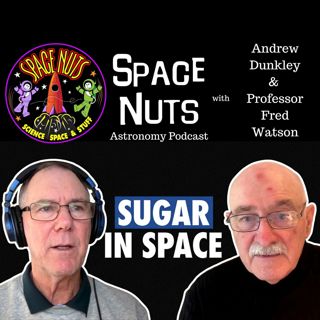
This episode covers three very different astronomy stories and then moves into a lively Q&A with listener questions. Andrew Dunkley and Professor Fred Watson discuss a possible sugary molecule in the center of the Milky Way, the risk lunar landers may contaminate ice that could preserve clues to life’s origins, and a new way to track lost dogs using satellite connectivity. The second half of the episode answers questions about moons with atmospheres, secret astronomy, hot Jupiters, and black hole mergers.
Key topics
In this episode, Fred Watson explains an update from Peter Verweyen on MOND, now referred to as Aether Scalar Tensor Theory, and how it relates to dark matter and dark energy debates.
We discuss the detection of erythrulose, a sugar molecule found in interstellar gas clouds near the center of the Milky Way, and why this matters for prebiotic chemistry.
Fred describes how molecules like sugar can form in cold molecular clouds before stars and planets exist, making some ingredients for life surprisingly common.
We discuss a new study warning that rocket exhaust from future lunar landings could contaminate ice in permanently shadowed craters at the Moon’s south pole.
The Moon’s polar ice may contain ancient prebiotic molecules delivered by comets, asteroids, and dust, making it a possible time capsule for the chemistry that led to life.
We discuss the practical and ethical problem that landers have to use rocket engines, and those exhaust plumes may spread methane and other organics across the lunar surface very quickly.
Fred shares how satellite-based direct-to-cell or direct-to-mobile systems could help locate lost dogs in remote places without cell coverage.
We discuss how this kind of tracking builds on existing GPS pet trackers, and how it could be useful in wilderness areas, while also noting the limits and concerns in national parks.
Timestamps
(00:00) Start of the episode and what’s coming up
(03:12) MOND update and the new AEST name
(07:10) A sugary molecule in the center of our galaxy
(09:51) Why sugar can form in deep space before stars exist
(12:24) Why lunar landings could contaminate the Moon’s ice
(14:54) The Moon as a time capsule for prebiotic molecules
(16:24) Methane exhaust and rapid contamination risk
(18:37) Should the Moon be protected like a national park?
(20:28) Satellite tracking for lost dogs in remote areas
(24:52) Direct-to-mobile satellite technology explained
(25:44) The Judas goat program and invasive species control

Become a supporter of this podcast: https://www.spreaker.com/podcast/space-nuts-astronomy-insights-cosmic-discoveries--2631155/support.

Denne episoden er hentet fra en åpen RSS-feed og er ikke publisert av Podme. Den kan derfor inneholde annonser.

Episoder(666)

The Dark Matter Hint That Could Rewrite Physics

The Dark Matter Hint That Could Rewrite Physics

Space Nuts: Dark matter clues, Saturn’s new decagon, Mars and Titan missions.Andrew Dunkley and Professor Fred Watson cover a packed astronomy episode that moves from a tentative dark matter signal to...

10 Sep 30min
Cosmic Q&A: From Redshift to the Moon's Hidden Temperatures

Cosmic Q&A: From Redshift to the Moon's Hidden Temperatures

Space Nuts: Q&A on the Swift Satellite, Redshift, and Hypothetical White HolesIn this engaging Q&A edition of Space Nuts, hosts Andrew Dunkley and Professor Fred Watson dive into a myriad of intriguin...

7 Sep 30min
The Starless Galaxy That Shouldn’t Exist - But Does

The Starless Galaxy That Shouldn’t Exist - But Does

Space Nuts: Spanish Eclipse, Nancy Grace Roman Launch, Cloud Nine, and Venus's Mysterious CloudsAndrew Dunkley and Professor Fred Watson cover four big astronomy stories in this episode, from Fred’s t...

3 Sep 38min

Waves, Signals, and Cosmic Aromas: A Q&A Journey Through Space

Waves, Signals, and Cosmic Aromas: A Q&A Journey Through Space

In this intriguing Q&A episode of Space Nuts, hosts Andrew Dunkley and Professor Jonti Horner tackle a variety of cosmic queries from listeners. Join them as they explore the fascinating world of radi...

31 Aug 37min
SpaceX Hit the Moon, and the Real Problem Is Just Beginning

SpaceX Hit the Moon, and the Real Problem Is Just Beginning

Space Nuts: Moon impact, Roman Observatory launch, and Neptune’s odd moonsAndrew Dunkley is joined by Professor Jonti Horner, Professor of Astrophysics at the University of Southern Queensland, for a ...

27 Aug 45min

From Diamond Rain to Rogue Planets: Unpacking Cosmic Curiosities

From Diamond Rain to Rogue Planets: Unpacking Cosmic Curiosities

Sponsor Link:This episode of Space Nuts is brought to you with the support of NordVPN. Protect your online activities with a special deal at www.nordvpn.com/spacenuts.In this Q&A episode of Space Nuts...

24 Aug 37min
How One Dinosaur-Killing Impact May Have Triggered Global Firestorms

How One Dinosaur-Killing Impact May Have Triggered Global Firestorms

Sponsor Link:This episode of Space Nuts is brought to you with the support of NordVPN. Secure your online presence and enjoy a special deal at www.nordvpn.com/spacenuts.  Asteroid or comet, dinosaur i...

20 Aug 43min

Exploring Moons with Atmospheres, Hot Jupiters, and the Mysteries of Black Holes

Exploring Moons with Atmospheres, Hot Jupiters, and the Mysteries of Black Holes

Sponsor Link:This Q&A episode of Space Nuts is brought to you with the support of NordVPN. When you decide to get serius about your security online, do what we did and get NordVPN. We have a special d...

17 Aug 34min

Populært innen Vitenskap

fastlegen
romkapsel
tingenes-tilstand
jss
rekommandert
liberal-halvtime
forskningno
villmarksliv
rss-paradigmepodden
sinnsyn
vett-og-vitenskap-med-gaute-einevoll
tomprat-med-gunnar-tjomlid
fjellsportpodden
tidlose-historier
rss-rekommandert
rss-overskuddsliv
nevropodden
dekodet-2
rss-inn-til-kjernen-med-sunniva-rose
aldring-og-helse-podden