Ep 385: Lateral Ankle Sprains Masterclass

Ep 385: Lateral Ankle Sprains Masterclass

In episode 385 of The Physical Performance Show, host Brad Beer sits down with fellow physiotherapist Lewis Craig for a lateral ankle sprain masterclass. Drawing on material the pair recently presented at a Gold Coast orthopedic evening, Brad and Lewis cover the burden and prevalence of lateral ankle sprains, the three-part clinical assessment process, key differential diagnoses, rehabilitation phases, and preventative strategies including bracing and taping.

The episode explores why lateral ankle sprains — despite their reputation as a minor injury — carry a significant risk of chronic ankle instability, and why a thorough, structured assessment is essential to a smooth recovery. Brad and Lewis unpack the different ligament and tendon structures that can be involved, the red flags practitioners need to rule out, the impairment categories drawn from Jay Hertel's model of chronic ankle instability, and how rehabilitation should progress from protection through to return to sport and long-term prevention.

Show Sponsor:

Pogo Physio also offers online Telehealth Consultations for endurance athletes managing bone, tendon, or joint issues — book online at https://www.pogophysio.com.au.

And...

PILLAR Performance is leading a new frontier in the sports nutrition industry through micronutrition innovation. Their Performance Health range is designed to support the crucial hours outside of training and racing, helping athletes return to the start line in peak condition.

One of their newest releases is Collagen Repair, developed in collaboration with Gelita Laboratories and featuring the clinically trialled collagen peptide TENDOFORT. For 15% off your first purchase, head to pillarperformance.shop or, for North American listeners, thefeed.com and use the code PHYSICALPERFORMANCE at checkout.

Pillar Performance continues to lead the way in sports nutrition through micro-nutrition innovation, now expanding into the Performance Health range. One of their newest releases, Collagen Repair, was developed with Gelita Laboratories (Germany) using a clinically trialled collagen peptide (Tendofort) to support tendon and ligament health in conditions like hamstring tendinopathy, Achilles tendonitis, shin splints, and patellofemoral pain.

Head to Pogo Physio also offers online Telehealth Consultations for endurance athletes managing bone, tendon, or joint issues — book online at https://www.pillarperformance.shop (or https://www.thefeed.com for North American listeners) and use code PHYSICALPERFORMANCE for 15% off your first purchase.

Partners / links mentioned:

Ortho Tools (Cumberland Ankle Instability Tool / CAIT): mentioned in-episode as the online questionnaire resource

Contact: Lewis Craig — l.craig@pogophysio.com.au

In this episode, you'll hear:

Episode context: Lewis Craig's return to the show after being last on around episode 109, and his progress toward finishing his Sports Masters through the University of Queensland

The burden of lateral ankle sprains: why they're the most common musculoskeletal injury in sport across field and court sports, contact and non-contact alike

Recurrence risk: why roughly 40% of people who sprain their ankle go on to develop chronic instability, and why the one-year mark is a key risk-reduction milestone

Early predictors of chronic ankle instability: the Doherty 2016 study on single-leg landing and drop-jump testing at two weeks post-injury

The three priorities of assessment: ruling out red flags and fractures, forming an accurate diagnosis, and identifying impairments

Screening for fractures: mechanism of injury, the Ottawa ankle rules, weight-bearing ability, and key bony landmarks to palpate

Differential diagnosis: ATFL and CFL sprains (70–80% of ankle sprains), peroneal tendon injuries, bifurcate ligament sprains, deltoid ligament tears, syndesmosis injuries, and talar dome injuries

Why getting a clear mechanism of injury from the athlete is critical to an accurate diagnosis

Identifying impairments: the ROAST consensus and Jay Hertel's updated model of chronic ankle instability — pathomechanical, sensory-perceptual and motor-behavioural impairments

Clinical and objective testing: balance progressions, calf raise endurance and strength benchmarks, and power tests including triple hop, crossover hop and timed lateral hop

The role of patient-reported outcome tools: the Cumberland Ankle Instability Tool (CAIT) and FAAM, and why they're useful for tracking progress and motivation

Rehabilitation framework: protection and appropriate early loading, followed by strength, stability and mobility phases

Managing specific injury types: use of moon boots, orthotics, low-dye taping and ASO ankle braces depending on the structures involved

Addressing dorsiflexion loss: why regaining ankle range of motion is often one of the hardest parts of rehab, and the Torillin infographic on identifying the source of restriction

Late-stage rehab and return-to-sport: hopping, change of direction, and integrating exercises into an athlete's normal training week for ongoing prevention

Bracing and taping as secondary/tertiary prevention strategies to reduce recurrence

Long-term consequences of poorly managed ankle sprains, including links to post-traumatic osteoarthritis and eventual ankle surgery

The biggest mistake athletes make: assuming rehab is "done" once they can run, despite still having deficits in power, change of direction and stability

Lewis's top tip: get every ankle sprain properly assessed, no matter how minor

Quotes / takeaways:

"It's just a simple lateral ankle sprain... and then someone who goes missing for months at a time."

"Four out of ten people who have an ankle sprain go on to develop a chronic instability."

"The better quality of the assessment, the more likely there's an accurate diagnosis."

"It's really hard to sprain your ankle when it's really well strapped or with an appropriate brace."

"Once someone gets running... you can run in a straight line really well and have really considerable deficits still."

"Get it assessed. Understand what you've done and understand what impairments you might have."

Time Stamps:

00:17 – Episode introduction and breakthrough experience

00:23 – Episode 385 introduction: lateral ankle sprain masterclass with Lewis Craig

00:50 – Sponsor: PILLAR Performance and Performance Health

01:15 – Collagen Repair: formulation, TENDOFORT and collagen health

01:44 – 15% PILLAR Performance discount with code PHYSICALPERFORMANCE

02:19 – Welcoming Lewis Craig back to the show

02:48 – Lewis's tenure at Pogo Physio and progress on his Sports Masters at UQ

03:45 – Introducing today's topic: lateral ankle sprains

04:37 – How common and burdensome are lateral ankle sprains?

05:36 – The "she'll be right" attitude and why it's changing

07:02 – Lewis's personal history with recurrent ankle sprains

08:02 – Impact on Lewis's own running and trail running

08:28 – The one-year mark and recurrence risk statistics

09:26 – Predictors of chronic ankle instability: single-leg landing and drop jump

09:53 – The Doherty 2016 study explained

10:51 – The three priorities of assessment

11:21 – Ruling out red flags and fractures

12:45 – Why assessment quality drives rehab outcomes

13:14 – Screening for fractures: mechanism, Ottawa ankle rules, bony landmarks

14:39 – Deciding on imaging: x-ray or MRI

15:06 – Differential diagnosis: the many subcategories of ankle sprain

15:35 – ATFL and CFL: the most common ligament sprains

16:35 – Peroneal tendon injuries

17:04 – Bifurcate ligament sprains

18:04 – Deltoid ligament tears with lateral ankle sprains

18:33 – Syndesmosis injuries and mechanism differences

19:31 – Clinical tests for syndesmosis

20:01 – Talar dome injuries and other easily missed diagnoses

20:30 – Why getting a clear mechanism from the athlete matters

21:29 – Identifying impairments: what it means and why it's important

22:51 – Jay Hertel's model of chronic ankle instability

23:48 – Balancing patient education without causing fear

24:17 – Motor outcomes: strength, power and kinetic chain

24:43 – Assessment time and thoroughness at Pogo Physio

25:08 – Objective testing: dynamometers, balance and calf tests

25:38 – Balance test progressions as return-to-sport criteria

26:37 – Strength testing: inversion, eversion and calf raise endurance

27:07 – Power testing: triple hop, crossover hop and lateral hop tests

27:33 – Using objective markers to guide return-to-sport decisions

28:01 – Patient questionnaires: Cumberland Ankle Instability Tool (CAIT) and FAAM

28:57 – Coping vs non-coping athletes and objective scoring

29:25 – Moving into rehabilitation: individualised management

29:54 – Protection and appropriate early loading

30:20 – Moon boots and protecting specific structures

31:16 – ASO ankle braces for lower-grade sprains

31:45 – The strength, stability, mobility rehab framework

32:14 – Early loading phase: range of motion, balance and strength

32:43 – Addressing dorsiflexion loss

33:13 – The Torillin infographic on restriction sources

33:40 – Progressing balance and strength exercises

34:10 – Preventative efforts and integrating rehab into training

34:40 – Late-stage rehab and return-to-play criteria

35:39 – Bracing and taping to prevent recurrence

36:08 – Long-term consequences: osteoarthritis and ankle surgery risk

37:34 – Lewis's own experience with taping and bracing

38:02 – The biggest mistake athletes make in managing ankle sprains

39:29 – Lewis's top tip: get every ankle sprain assessed

40:27 – Where to reach Lewis Craig for questions

40:52 – Episode close and sponsor reminder

41:20 – Pogo Physio Telehealth Consultations and closing details

THE TEAM:

Join the The Physical Performance Show LEARNINGS membership through weekly podcasts here: https://www.patreon.com/TPPShow

Our goal is to get you back to your Physical Best. Find out more about Telehealth Consultations and book online.

Your Hosts:

🏃 Brad Beer - Instagram & X @Bradbeer and YouTube on @PogophysioAu

💪 Lewis Craig - Physiotherapist and Clinical Lead, Pogo Physio Instagram: @_lewiscraig_

The Physical Performance Show can be found at: Facebook: facebook.com/thephysicalperformanceshowpodcast X: @tppshow1 Instagram: @physicalperformanceshow

Please direct any questions, comments, and feedback to the above social media handles.

Denne episoden er hentet fra en åpen RSS-feed og er ikke publisert av Podme. Den kan derfor inneholde annonser.

Episoder(386)

Ep 384: Tibial Bone Injury Q&A - All Your Questions Answered

Ep 384: Tibial Bone Injury Q&A - All Your Questions Answered

In episode 384 of The Physical Performance Show, Brad Beer and fellow physiotherapist Tim Studley tackle a wide-ranging Q&A on tibial bone stress injuries. Following the recent bone stress injury mini...

7 Aug 34min

Ep 383: Prof  Franco Impellizzeri on Load Management, Data & the Truth About ACWR

Ep 383: Prof Franco Impellizzeri on Load Management, Data & the Truth About ACWR

Physical Performance Show – Episode 383 Show Notes In episode 383 of The Physical Performance Show, host Brad Beer sits down with Professor Franco Impellizzeri, one of the most influential and outspok...

30 Jul 50min
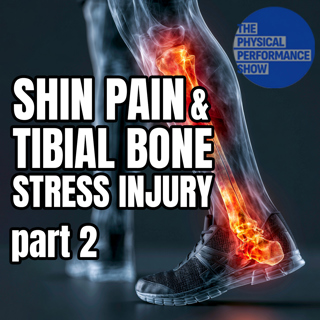
Ep 382: Tibial Bone Stress Masterclass Part 2 (Fixing Shin Pain & Tibia Injuries)

Ep 382: Tibial Bone Stress Masterclass Part 2 (Fixing Shin Pain & Tibia Injuries)

Physical Performance Show – Episode 382 Show Notes In this episode of The Physical Performance Show, host Brad Beer sits down with Pogo Physio's Tim Studley for Part 2 of their two-part mini-series o...

24 Jul 33min
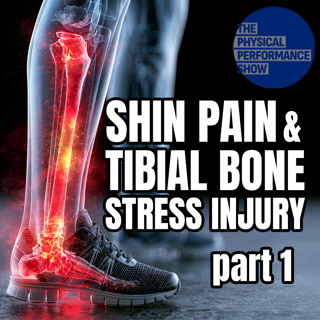
Ep 381: Tibial Bone Stress Masterclass Part 1 (Shin Pain, Shin Splints or Stress Fracture?)

Ep 381: Tibial Bone Stress Masterclass Part 1 (Shin Pain, Shin Splints or Stress Fracture?)

In episode 381 of The Physical Performance Show, host Brad Beer — sports and exercise physiotherapist — sits down with Pogo physiotherapist Tim Studley for the first instalment of a two-part mini-seri...

17 Jul 36min
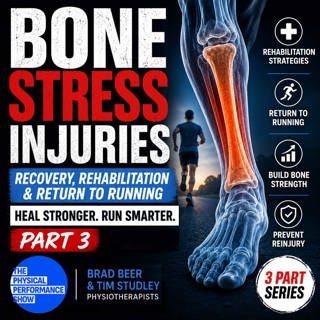
Ep 380: Bone Stress Injuries: Recovery, Rehabilitation & Return to Running (Part 3)

Ep 380: Bone Stress Injuries: Recovery, Rehabilitation & Return to Running (Part 3)

In episode 380 of The Physical Performance Show, host Brad Beer and Pogo Physio physiotherapist Tim Studley conclude their three-part expert series on bone stress injuries by focusing on what happens ...

10 Jul 29min
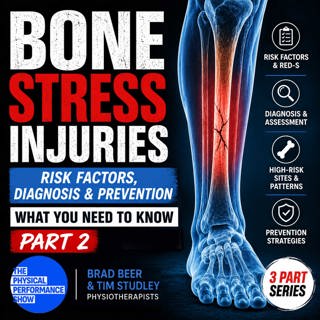
Ep 379: Bone Stress Injuries: Risk Factors, Diagnosis & Prevention (Part 2)

Ep 379: Bone Stress Injuries: Risk Factors, Diagnosis & Prevention (Part 2)

In episode 379 of The Physical Performance Show, host Brad Beer and Pogo Physio physiotherapist Tim Studley continue their three-part expert series on bone stress injuries by shifting the focus from t...

3 Jul 28min
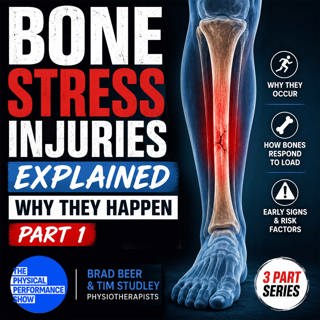
Ep 378: Bone Stress Injuries: Causes, Symptoms & Early Warning Signs (Part 1)

Ep 378: Bone Stress Injuries: Causes, Symptoms & Early Warning Signs (Part 1)

*]:pointer-events-auto R6Vx5W_threadScrollVars scroll-mb-[calc(var(--scroll-root-safe-area-inset-bottom,0px)+var(--thread-response-height))] scroll-mt-[calc(var(--header-height)+min(200px,max(70px,20s...

25 Jun 29min

Populært innen Helse

fastlegen
lydartikler-fra-aftenposten
rss-gukild-johaug
psykodrama
hvordan-har-du-det-mann
leger-om-livet
relasjonspodden-med-dora-thorhallsdottir-kjersti-idem
rss-skravla-gar
bak-fasaden-en-reise-i-livet-med-sykepleier-ine
morten-ramm-lar-kakla-ga-til-du-sovner
foreldreradet
hjernesterk
treningsprat
g-punktet
rss-lopedrommen
klimaks
rss-garne-damer
kjed-deg-i-sovn-verdens-kjedeligste-podcast
rss-kunsten-a-leve
rss-loping-for-nybegynnere