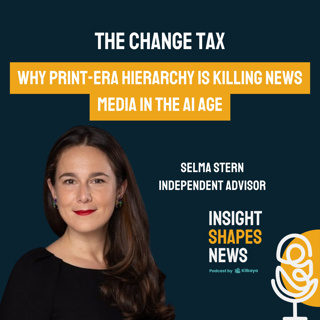
#20 The Change Tax: Why Print-Era Hierarchy Is Killing News Media in the AI Age. Selma Stern, Independent Advisor

#20 The Change Tax: Why Print-Era Hierarchy Is Killing News Media in the AI Age. Selma Stern, Independent Advisor

Most people in media have not heard the term "change tax," but they have felt it. Selma Stern describes it as work that keeps coming back without ever getting resolved, like the same alignment meeting held three times in a year, with nothing decided each time.

In this episode, host Nils Ove Håland Riise talks with Selma Stern, an independent advisor to media companies. Stern has worked as Chief of Staff at Axel Springer, Chief Membership Officer at Business Insider, and Chief Customer Officer at Fortune, after starting her career at BCG.

Her main point centers on how newsroom structures have not kept pace with how the work itself has changed. In the print era, roles were fixed and predictable. An editor-in-chief's job description barely changed from year to year, and the workflow, from writer to editor to press, was linear and well understood. Digital broke that. Editors now need to work fluently with product, data, and technology teams that speak a different language and move on a different rhythm. AI is accelerating that shift again, requiring even more flexibility and cross-team coordination than the digital transition already demanded. Stern argues that many media companies are still organized the way they were for print, and that structure is becoming a real constraint as the pace of change increases.

To see whether this pattern holds up across the industry, Stern analyzed employee reviews from 20 publishers in 9 countries, looking for language about friction (silos, unclear ownership) versus language about integration (clear roles, teams working well together). Publishers with the most friction language were shrinking or had recently laid off staff. Publishers that were growing, including the New York Times, the Economist, and Le Monde, showed more integration language than friction.

That pattern shows up clearly in a real example. In the same week in February 2026, the New York Times announced record subscriber growth while the Washington Post's struggles were widely reported. Stern argues the real difference is not who owns each company, but how each one is organized.

The episode ends with a look ahead: micropayments, AI agents that could buy articles on a reader's behalf, and whether subscriptions are still the right model for news.

Topics covered:

  • What the change tax is, in Selma Stern's own words
  • Why print-era roles and workflows do not translate to digital and AI
  • How editors now need to work across product, data, and technology teams
  • How Stern measured this across 20 publishers using employee reviews
  • New York Times and Washington Post: same week, opposite results
  • Micropayments, AI agents, and the future of subscriptions


Subscribe to Insight Shapes News for conversations on journalism, AI, personalization, and structural change in the news industry.


You can read more about the change-tax here:

https://asternlook.substack.com/p/the-change-tax?triedRedirect=true


Find Selma Stern:

https://www.linkedin.com/in/selmastern/

Denne episoden er hentet fra en åpen RSS-feed og er ikke publisert av Podme. Den kan derfor inneholde annonser.

Episoder(20)

#19 The News Homepage Formula: A/B Testing, Ice Ice Baby stunt, and Losing Control to Personalization. Helge Voll Hustad at VG (Schibsted)

#19 The News Homepage Formula: A/B Testing, Ice Ice Baby stunt, and Losing Control to Personalization. Helge Voll Hustad at VG (Schibsted)

In this episode of Insight Shapes News by Kilkaya, host Nils Ove Håland Riise sits down with Helge Voll Hustad, Homepage Editor at VG — Norway's largest news site, where he curates the homepage with n...

1 Jul 40min
#18 INMA Berlin, Die Zeit, Media Pioneer, and Why Trust Is the Only Advantage Left. Tarjei Gilbrant at Kilkaya

#18 INMA Berlin, Die Zeit, Media Pioneer, and Why Trust Is the Only Advantage Left. Tarjei Gilbrant at Kilkaya

What happens when two people who talk before every episode finally sit down in front of a microphone together?In this episode of Insight Shapes News by Kilkaya, host Nils Ove Håland Riise is joined by...

22 Mai 34min
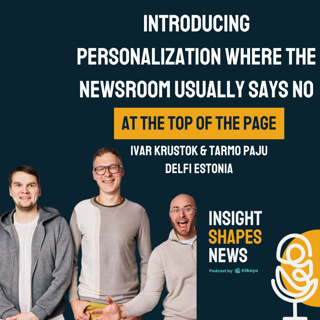
#17 Introducing Personalization Where the Newsroom Usually Says No — At the Top of the Homepage. Ivar Krustok & Tarmo Paju, Delfi Estonia

#17 Introducing Personalization Where the Newsroom Usually Says No — At the Top of the Homepage. Ivar Krustok & Tarmo Paju, Delfi Estonia

Content Personalization in news products has typically been placed in low-risk areas—below articles or in separate recommendation modules further down on the page.What happens when it is introduced hi...

9 Apr 1h 44min

#16 Technology Is No Longer Neutral. Why Infrastructure Is Becoming a Strategic Risk for News Companies. Endre Dingsør at Choose European

#16 Technology Is No Longer Neutral. Why Infrastructure Is Becoming a Strategic Risk for News Companies. Endre Dingsør at Choose European

Technology used to feel neutral. Infrastructure choices were seen as operational decisions handled by IT teams. That assumption is now being challenged.In this episode of Insight Shapes News by Kilkay...

12 Mar 49min
#15 The Leadership Model in Newsrooms Is Broken. What Needs to Change? Jeremy Clifford at Chrysalis Leadership

#15 The Leadership Model in Newsrooms Is Broken. What Needs to Change? Jeremy Clifford at Chrysalis Leadership

What does it take to lead journalists through uncertainty, resistance, and constant change?In this episode of Insight Shapes News by Kilkaya, host Nils Ove Håland Riise speaks with Jeremy Clifford, fo...

23 Feb 1h 4min

#14 Algorithms vs Editors: Who Decides What You Read at Scale? Christoph Schmitz at Schibsted

#14 Algorithms vs Editors: Who Decides What You Read at Scale? Christoph Schmitz at Schibsted

How should personalization work in journalism when trust, fairness, and editorial responsibility are at stake?In this episode of Insight Shapes News by Kilkaya, host Nils Ove Håland Riise speaks with ...

5 Jan 1h 10min
#13 All-In on News Subscriptions. How Süddeutsche Zeitung Plans to Fund Journalism by 2030. Dominic Grzbielok at Süddeutsche Zeitung (SZ)

#13 All-In on News Subscriptions. How Süddeutsche Zeitung Plans to Fund Journalism by 2030. Dominic Grzbielok at Süddeutsche Zeitung (SZ)

Why do people really pay for news in 2025 — and what keeps them paying month after month?In this episode of Insight Shapes News by Kilkaya, host Nils Ove Håland Riise sits down with Dominic Grzbielok,...

24 Nov 20251h 10min

Populært innen Teknologi

lydartikler-fra-aftenposten
teknisk-sett
tomprat-med-gunnar-tjomlid
elektropodden
rss-ki-praten
smart-forklart
fornybaren
rss-ai-forklart
shifter
rss-bouvet-bobler
teknologi-og-mennesker
rss-alt-som-gar-pa-strom
rss-fisketimen
nasjonal-sikkerhetsmyndighet-nsm
rss-polypod
rss-fish-ships
digital-forretningsforstaelse
rss-kunstig-intelligens-med-elisabeth-maren-og-morten
rss-alt-vi-kan
energi-og-klima