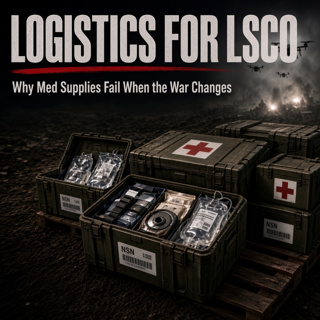
295- Logistics For LSCO: Why SOF Med Supplies Fail When The War Changes

295- Logistics For LSCO: Why SOF Med Supplies Fail When The War Changes

Medical logistics was an afterthought for a lot of us in GWOT. You submitted a request, something showed up, and everyone joked that the warehouse never read the order. That model does not survive large-scale combat operations.

In this episode, Dennis sits down with Jesse Bashel, a medical logistician and acquisitionist, to walk through how SOF medical supply is supposed to work—pre-deployment, on deployment, and after the first 15 days. They cover NSNs versus product names, automatic in-lieu substitutions, Theater Lead Agents for Medical Materiel (T-LAM), the shift from OCO “easy button” money to MFP-2 vs MFP-11 rules, statements of requirement, and why most medical items are service-common (GCC problem) while a tiny slice of SOF-peculiar items stay on MFP-11.

The conversation then turns practical: MedLog personnel usually have zero clinical training. How do you teach them why a 6.0 tube matters for a surgical airway instead of an 8.5 ET tube? How do you get logisticians into Ridge Healer, unit training, and field exercises so they stop treating the property book as the mission? And why, in LSCO, logistics itself starts looking like a combat MOS—because the side that can feed, fuel, and bandage longer usually wins.

If you are an 18 Delta, flight medic, battalion PA, group surgeon, this one is for you.

Key takeaways

  • Order by NSN (or full product name + manufacturer), not the nickname you use in the aid bag. Vendors should put NSN placards on tables at SOMA.
  • The system will auto-accept “in-lieu” substitutes unless the logistician blocks it. That is how you get Halo chest seals when you wanted HyFin.
  • SOF units are required to deploy with 15 days of supply. After that, the Geographic Combatant Command (usually MFP-2 / service-common) is supposed to resource the rest; SOCOM MFP-11 covers only SOF-peculiar items (certain CASVAC sets, freeze-dried plasma in some cases, specific antivenoms, etc.).
  • A Statement of Requirements (class I–IX) should be built jointly by the team and the TSOC 180–270 days out when possible, validated by surgeon + J4, then sent to the GCC for a service lead to resource.
  • Most medical products are MFP-2. Do not default everything to “SOCOM will pay.”
  • Close the gap: five-minute education sessions when medics hit the cage, bring logisticians forward on training events, and treat enablers like part of the team instead of a battle squire.
  • In LSCO, supply lines will be targeted. Logistics personnel need to be trained and treated as if they will be on the battlefield—not just in an office.


Visit prolongedfieldcare.org, follow @prolonged_field_care, and subscribe so you stay on the bleeding edge of combat medicine.

Chapters

02:02 – Pre-deployment ordering done right: NSNs vs product names and why you get the wrong chest seal

04:24 – In-lieu / substitute items and how to stop the system from auto-accepting them

05:24 – Theater Lead Agent for Medical Materiel (T-LAM) catalogs and how they get built

07:09 – MFP-2 (service common / common user) vs MFP-11 (SOF peculiar)

08:27 – Joint pub requirement: SOF deploys with 15 days of supply

10:07 – Who pays for days 16–60? GCC vs US SOCOM headquarters

12:10 – Statement of Requirements process: team + TSOC + GCC J4 validation

15:58 – MedLog has no medical training—how to educate them before they send the wrong tube

21:17 – Closing the operator–logistician distance; policy is not always law

26:00 – Retaining SOF-enabler talent instead of rotating everyone back to conventional force

28:22 – SUBACUS lessons and why enablers must not be a liability forward

30:29 – Two LSCO paradigm shifts: SOF as supporting force + logistics as a combat MOS

32:08 – Positional warfare, endurance, and targeting supply lines (bullets, batteries, bandages)

32:50 – Where to do the work: put a logistician on the DTS for Ridge Healer and big exercises

34:25 – Flip side: teach operators the fiscal and appropriation reality so they can advocate overseas

Denne episoden er hentet fra en åpen RSS-feed og er ikke publisert av Podme. Den kan derfor inneholde annonser.

Episoder(626)

SOMA 26' - Role 1.5: Fighting Tourniquet Syndrome at the Forefront

SOMA 26' - Role 1.5: Fighting Tourniquet Syndrome at the Forefront

Ukrainian orthopedic and reconstructive surgeon describes what prolonged field care actually looks like when evacuation from the front line to Role 2 takes three to four days, and sometimes longer. Af...

3 Sep 21min

294 - Do Antibiotics Really Reduce Mortality in Trauma? Wound Care First in Prolonged Field Care

294 - Do Antibiotics Really Reduce Mortality in Trauma? Wound Care First in Prolonged Field Care

Antibiotics are not magic. In this episode of the PFC Podcast, Dennis sits down with Ryan to cut through the common myth that “I’ve given antibiotics, so the wound is protected.” They unpack why vigor...

31 Aug 36min
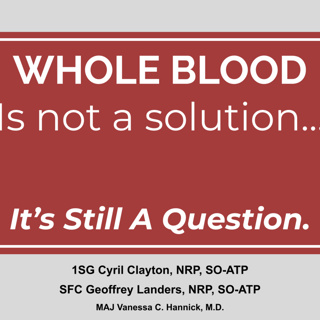
SOMA 26' - Fresh Whole Blood is Not The Answer: It's Still a Question

SOMA 26' - Fresh Whole Blood is Not The Answer: It's Still a Question

Whole Blood Is Not a Solution (Until Conventional Forces Can Deliver It)Recorded live at SOMA 26Dr. Vanessa Hanick (emergency physician, former active-duty Army, now National Guard) and 1SG Cy Clayton...

27 Aug 28min
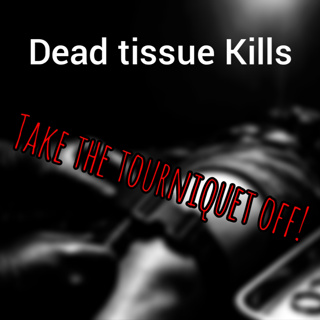
293 - Dead Tissue Kills in Prolonged Field Care: 4 C’s, Early Debridement & Delayed Primary Closure Lessons from the Field

293 - Dead Tissue Kills in Prolonged Field Care: 4 C’s, Early Debridement & Delayed Primary Closure Lessons from the Field

In this episode of the PFC Podcast, Dennis sits down with missionary surgeon Jason to cut through the noise on real-world wound care in austere and unconventional warfare environments. From the bridge...

24 Aug 49min
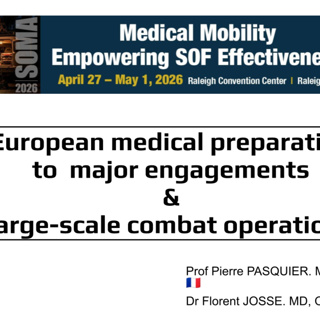
SOMA 26' - European Medical Preparations for Major Engagements and Large-Scale Combat Operations

SOMA 26' - European Medical Preparations for Major Engagements and Large-Scale Combat Operations

Recorded live at SOMA 26Pierre Pasquier (France) and his German counterpart deliver a clear-eyed assessment of how European military medical systems are preparing for large-scale combat operations and...

20 Aug 31min
292-Building Mobile Surgical Capability in Denied Environments

292-Building Mobile Surgical Capability in Denied Environments

In this episode of the Prolonged Field Care Podcast, Dennis sits down with Mitch (U.S. family practice/ER physician) and Augustine (frontline surgeon with five years of experience) to unpack what it a...

17 Aug 41min
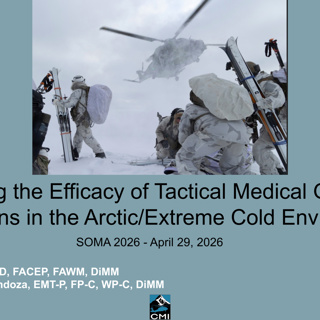
SOMA 26 - Optimizing the Efficacy of Commonly Used Tactical Medical Gear and Medications In The Arctic Extreme Cold Operational Environment

SOMA 26 - Optimizing the Efficacy of Commonly Used Tactical Medical Gear and Medications In The Arctic Extreme Cold Operational Environment

Recorded live at SOMA 26Dr. Emily Johnston (Cascadia Mountain Institute) and SFC Ezequiel Mendoza (Arctic Dustoff, Fairbanks) deliver a hard-hitting, field-validated look at how standard tactical medi...

13 Aug 29min

Populært innen Fakta

fastlegen
dine-penger-pengeradet
relasjonspodden-med-dora-thorhallsdottir-kjersti-idem
treningspodden
foreldreradet
rss-strid-de-norske-borgerkrigene
jakt-og-fiskepodden
rss-orjasater
hverdagspsyken
sinnsyn
mikkels-paskenotter
rss-kunsten-a-leve
lederskap-nhhs-podkast-om-ledelse
tomprat-med-gunnar-tjomlid
branncast
rss-impressions-2
fryktlos
gravid-uke-for-uke
rss-var-forste-kaffe
rss-det-virker-en-podkast-om-spesialpedagogikk