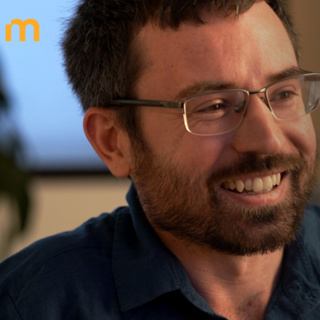

AI 2040: Plan A report - Daniel Kokotajlo & Thomas Larsen

AI 2040: Plan A report - Daniel Kokotajlo & Thomas Larsen

Could slowing AI development make superintelligence safer? Daniel Kokotajlo and Thomas Larsen of the AI Futures Project join Tim Scarfe to examine AI 2040: Plan A, a proposal to buy time before AI exceeds human control.


SPONSOR:

---

Cyber Fund built the Monastery to help founders ship products that were impossible a year ago.

Apply now: https://cyber.fund

---


After revisiting AI 2027 and the limits of forecasting, they ask what happens when AI can automate research and sustain an economy without human workers. Tim challenges the case for general models and asks whether intelligence alone explains power. Plan A proposes an initial pause to build safety infrastructure, then cautious development up to the strongest AI that can still be reliably controlled. The discussion tests the distinction between control and alignment, the case for public AI research, and whether the US and China could enforce a slowdown. It ends with the evidence that would change their forecasts.


---

TIMESTAMPS:

00:00:00 AI 2040: a slower route to superintelligence

00:01:34 Sponsor: Cyber Fund

00:02:12 From OpenAI to AI 2027

00:06:58 Forecasts, war games and self-fulfilling prophecies

00:17:44 Why AI sceptics are changing their minds

00:23:04 When AI can replace its own researchers

00:28:45 Could an AI economy grow without human workers?

00:37:32 One general model or a society of specialists?

00:47:43 Brains, machines and collective intelligence

00:56:12 Plan A: buy time at the controllable frontier

01:00:02 Why control buys time but cannot replace alignment

01:06:36 Why AI research should be public

01:10:32 Can the US and China enforce an AI slowdown?

01:19:04 Why AI policy debates miss the technology

01:21:56 Is AI normal technology? The remaining disagreement


Many thanks to James Wilken-Smith for helping with show research.


---

REFERENCES:

other:

[00:00:01] AI 2040: Plan A

https://ai-2040.com/

[00:03:27] AI 2027

https://ai-2027.com/

[00:13:47] Scenario Scrutiny for AI Policy

https://blog.aifutures.org/p/scenario-scrutiny-for-ai-policy

[00:33:11] The 2028 Global Intelligence Crisis

https://www.citriniresearch.com/p/2028gic

[01:00:40] Brief independent investigation of agents' behavior, reasoning and collaboration in the OpenAI / Hugging Face hacking incident

https://www.redwoodresearch.org/research/hugging-face-incident

[01:09:21] The Hugging Face incident and the road ahead

https://openai.com/index/hugging-face-incident-and-the-road-ahead/

[01:22:01] AI as Normal Technology

https://www.normaltech.ai/p/ai-as-normal-technology

[01:22:51] Common Ground between AI 2027 & AI as Normal Technology

https://asteriskmag.substack.com/p/common-ground-between-ai-2027-and

person:

[00:19:43] Geoffrey Hinton

https://www.cs.toronto.edu/~hinton/

[00:20:07] Ryan Greenblatt

https://www.lesswrong.com/users/ryan_greenblatt

[00:26:06] Elon Musk

https://www.tesla.com/elon-musk

tool:

[00:21:46] ARC-AGI-3

https://arcprize.org/arc-agi/3

[00:21:53] AlphaGo and Move 37

https://deepmind.google/research/alphago/

[00:39:41] Claude

https://claude.com/product/overview

[00:39:58] NVIDIA H100 GPU

https://www.nvidia.com/en-us/data-center/h100/

paper:

[00:24:42] Training AI Scientists to Replicate Research

https://arxiv.org/abs/2608.13331v1

[01:27:19] Validity of the single processor approach to achieving large scale computing capabilities

https://www.cs.cmu.edu/~18742/papers/Amdahl1967.pdf

book:

[00:28:52] Bullshit Jobs: A Theory

https://www.simonandschuster.com/books/Bullshit-Jobs/David-Graeber/9781501143335

organization:

[01:05:09] Redwood Research

https://www.redwoodresearch.org/


---

RESCRIPT:

https://app.rescript.info/public/share/33d1a58fa8f307ae7dfd504d4fdaa9d5

Denne episoden er hentet fra en åpen RSS-feed og er ikke publisert av Podme. Den kan derfor inneholde annonser.

Episoder(271)

What Most People Get Wrong About Evolution | Akarsh Kumar

What Most People Get Wrong About Evolution | Akarsh Kumar

A lot of people in AI treat evolution as a dumb fallback, basically random search for when you can't take a gradient. Akarsh Kumar thinks that is wrong. Selection hangs on to partial solutions, so mut...

10 Okt 47min

How a Voice Agent Learns the Rhythm of Conversation — Shawn Wen

How a Voice Agent Learns the Rhythm of Conversation — Shawn Wen

Tsung-Hsien (Shawn) Wen, CTO of PolyAI, tells Tim Scarfe why voice agents are harder than text agents. Voice adds time, and a good conversation depends on adapting to the person on the line, not just ...

1 Okt 1h 10min

Who Checks a Proof No Human Can Read? — Leo de Moura

Who Checks a Proof No Human Can Read? — Leo de Moura

Leonardo de Moura created Lean and co-created Z3. ---This episode is sponsored by Parallel.Parallel, where agents find answers: web search, extraction and deep research APIs built for AI agents.Start ...

30 Sep 1h 14min

When AI Research Starts Moving Faster Than Human Research - Zhengyao Jiang

When AI Research Starts Moving Faster Than Human Research - Zhengyao Jiang

Weco let an AI coding agent rewrite the harness around another agent for eight days: its code, prompts and tools, while the underlying language model stayed fixed. Tim Scarfe asks Weco co-founder Zhen...

26 Sep 43min

How Deep Learning Finally Cracked Messy Tables - Frank Hutter

How Deep Learning Finally Cracked Messy Tables - Frank Hutter

Frank Hutter, co-founder of Prior Labs, talks about TabPFN, a tabular foundation model that makes predictions in a single forward pass, and the research behind it.TabPFN is pre-trained on synthetic da...

23 Sep 1h 53min

Why Scaling Prediction Cannot Create Intelligence - Alexander Mattick

Why Scaling Prediction Cannot Create Intelligence - Alexander Mattick

Alexander Mattick is a researcher at Fraunhofer IIS and a PhD researcher at the University of Technology Nuremberg (UTN), and a regular on Yannic Kilcher's Discord. He first came on MLST in 2022, afte...

21 Sep 2h 14min

How Physical AI Learns Across Language, Video and Action — Ming-Yu Liu

How Physical AI Learns Across Language, Video and Action — Ming-Yu Liu

The car making a left turn at the start of this episode was never filmed. Cosmos 3 generated it. Ming-Yu Liu, who leads the Cosmos research at NVIDIA, explains how one model can describe a video, gene...

15 Sep 25min

Speech Recognition Is Not a Solved Problem — Pavan Kumar Reddy

Speech Recognition Is Not a Solved Problem — Pavan Kumar Reddy

Pavan Kumar Reddy leads audio research at Mistral AI. He joins Tim Scarfe for a deep technical tour of Voxtral — and explains why the frontier of deployed voice is still a cascade of specialised model...

14 Sep 1h 42min

Populært innen Teknologi

teknisk-sett
energi-og-klima
lydartikler-fra-aftenposten
nasjonal-sikkerhetsmyndighet-nsm
elektropodden
tomprat-med-gunnar-tjomlid
rss-ai-forklart
rss-kunstig-intelligens-med-elisabeth-maren-og-morten
shifter
smart-forklart
fornybaren
pedagogisk-intelligens
rss-alt-som-gar-pa-strom
rss-bak-skyen
rss-alt-vi-kan
teknologimagasinet-aftenposten
rss-hvorfor-ble-det-sann
rss-romnasjonen
kortslutning
rss-ki-praten