
Roman Opens Its Eye

Roman Opens Its Eye

First starlight from Roman, a shorter fuse on the Solar System, weapons in orbit, and a globular cluster hiding behind the dust Roman opens its eye — and finds it has twice as long to look NASA has activated the Nancy Grace Roman Space Telescope's Wide Field Instrument, a 300-megapixel infrared camera built around eighteen detectors, with a field of view at least a hundred times larger than Hubble's infrared field — a patch of sky bigger than the full Moon in a single exposure, at Hubble-comparable sharpness. The instrument reached its operating temperature of −143 °C on 11 September; detectors and the calibration system came up across the 11th and 12th; the element wheel turned in microgravity for the first time on the 12th; the focus mechanism was verified on the 13th. Roman then took its first starlight image — deliberately out of focus, and exactly as intended: a baseline diagnostic that proves the optical path is clear and every detector is live. Sharp science images are expected by early 2027. The Coronagraph Instrument has completed initial communications checkout from Caltech/IPAC and is running 30-day decontamination cycles at room temperature. Separately, NASA published the numbers from Roman's first mid-course correction: better than 99% accurate, using about 18 kg of a 200 kg propellant budget, on a spacecraft that launched lighter than its allowance. Jamie Dunn (Goddard): Roman has fuel for at least 22 years of potential science operations, against a design life of ten. Caveat kept on air: that is a fuel figure, not a funding or hardware figure. Why it matters: Roman's High-Latitude Time-Domain Survey measures cosmic expansion with Type Ia supernovae, and its High-Latitude Wide-Area Survey probes cosmic acceleration across more than 5,000 square degrees through weak lensing and galaxy clustering — two independent handles on the dark energy question that Monday's Australian-led supernova compilation sharpened but could not settle. A doubled mission means a longer lever arm in time, which in this measurement is everything. Caltech: the Solar System's dynamical fuse is far shorter than we thought Konstantin Batygin, Jim Fuller and Fred Adams (Caltech), 'Terminal instability of the Solar System triggered by stochastic solar mass loss', arXiv:2609.12494, posted 11 September and accepted to the Astrophysical Journal Letters. The standard estimate for how long the giant planets hold their architecture — about 10¹⁸ years — assumes the dying Sun sheds mass smoothly. Observations of white-dwarf recoil indicate mass is instead lost in discrete, independently directed ejections, so planetary orbits take a random walk. In simulations, roughly 40% of systems are disrupted or violently scattered before white dwarf formation and about 90% within ~3 billion years after, cutting the outer Solar System's dynamical lifetime to around a gigayear past white dwarf formation. Framed on air as a prediction to test — planetary systems around old white dwarfs should be rarer and more chaotic — with the granularity of the mass loss named as the number to go and measure. The United States says, for the first time, that it has weapons in orbit Secretary of the Air Force Troy Meink, speaking on the opening day of the Air & Space Forces Association's Air, Space & Cyber Conference at National Harbor, Maryland on Monday 14 September: the United States now has 'on-orbit space control weapons capable of defending the joint force against hostile adversary actions'. It is the first public US acknowledgement of offensive capability in orbit. No systems, numbers, locations or timelines were disclosed. A Space Force spokesperson defined space control as employing 'kinetic and non-kinetic means to affect adversary capabilities through disruption, degradation and even destruction, if necessary'. Gen. Douglas Schiess, Chief of Space Operations, said the following day that 'it was time' to talk about it, citing Chinese and Russian anti-satellite advances. Covered factually, with both the deterrence and the arms-control readings presented, and with orbital debris as the physical consequence that outlasts any dispute. Australian context: Operation Olympic Defender and Defence Space Command. Rubin finds a globular cluster hiding behind the dust Aashay Pai, William Cerny, Andrew Pace, Alex Drlica-Wagner and colleagues, 'Rubin Observatory Reveals a Dust-Shrouded Halo Globular Cluster in Ophiuchus', arXiv:2609.15872, posted 14 September. Rubin-GC1 was found in Rubin's Early Data Preview 2 — not the survey proper — in the direction of the galactic bulge, behind heavy dust and a crowded foreground. It sits about 31 kiloparsecs away, roughly 100,000 light-years, out in the Milky Way's halo. Half-light radius ~5 pc, absolute magnitude ≈ −2.4, placing it in the faint tail of the globular cluster luminosity function; age ≈ 9.2 billion years; moderately metal-poor. Gaia DR3 proper motions and phase-space modelling point to an origin in the...

Denne episoden er hentet fra en åpen RSS-feed og er ikke publisert av Podme. Den kan derfor inneholde annonser.

Episoder(500)

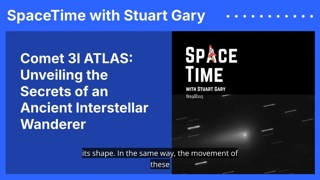
Comet 3I ATLAS: Unveiling the Secrets of an Ancient Interstellar Wanderer

Comet 3I ATLAS: Unveiling the Secrets of an Ancient Interstellar Wanderer

SpaceTime Series 29 Episode 115 A comet older than the Sun Astronomers have found new clues about the origin of interstellar comet 3I/ATLAS suggesting it’s more than twice as old as the Sun and solar ...

25 Sep 22min

Mars Gullies Aren’t Made by Water: The Surprising Dry Ice Answer | Space Nuts: Astronomy...

Mars Gullies Aren’t Made by Water: The Surprising Dry Ice Answer | Space Nuts: Astronomy...

Perseverance drove to the edge of an ancient Martian lake expecting a beach and found the inside of a volcano — rock that water has been through at least three separate times. Europe's Jupiter probe c...

24 Sep 32min
The Great Water Mystery: Jezero Crater and the Hunt for Mars’ Hidden History

The Great Water Mystery: Jezero Crater and the Hunt for Mars’ Hidden History

Perseverance drove to the edge of an ancient Martian lake expecting a beach and found the inside of a volcano — rock that water has been through at least three separate times. Europe's Jupiter probe c...

23 Sep 26min

Space Warfare Unveiled: The US Space Force’s Kinetic Capabilities and Venus’s Lost Moon

Space Warfare Unveiled: The US Space Force’s Kinetic Capabilities and Venus’s Lost Moon

SpaceTime Series 29 Episode 114 United States Space Force confirms it has weapons in orbit The United States Space Force confirms it has weapons in orbit to protect America’s assets in space. Why a mo...

23 Sep 25min

What Keeps a Galaxy Churning: Andromeda’s Supernova Secrets Revealed

What Keeps a Galaxy Churning: Andromeda’s Supernova Secrets Revealed

22 Sep 28min

Solar Superflares and Gondwana’s Legacy: Unpacking Earth’s Cosmic Changes

Solar Superflares and Gondwana’s Legacy: Unpacking Earth’s Cosmic Changes

SpaceTime Series 29 Episode 113 New evidence of superflares on the Sun A new study has found that a giant sunspot observed back in 1947 had the potential to trigger a massive solar super flare. How Go...

21 Sep 30min
Navigating the Cosmic Questions: Gravity Assists, Neutrinos, and Time Dilation Explained | Space...

Navigating the Cosmic Questions: Gravity Assists, Neutrinos, and Time Dilation Explained | Space...

Space Nuts: Q&A on BepiColombo, Neutrinos, and Time Dilation In this Q&A edition of Space Nuts , hosts Andrew Dunkley and Professor Fred Watson dive into a series of intriguing listener questions th...

21 Sep 30min

The Unifying Mystery of Black Hole Jets: Stellar and Supermassive Connections

The Unifying Mystery of Black Hole Jets: Stellar and Supermassive Connections

SHOW NOTES Black hole jets follow one universal rule Adelle Goodwin (Curtin University / ICRAR, Forrest Research Foundation Fellow) and Andrew Mummery (Institute for Advanced Study, Princeton) show th...

19 Sep 33min

Populært innen Vitenskap

fastlegen
romkapsel
tingenes-tilstand
jss
liberal-halvtime
forskningno
rekommandert
sinnsyn
tomprat-med-gunnar-tjomlid
villmarksliv
rss-paradigmepodden
fjellsportpodden
rss-nysgjerrige-norge
nordnorsk-historie
grunnstoffene
rss-rekommandert
tidlose-historier
rss-inn-til-kjernen-med-sunniva-rose
psykopoden
smart-forklart