Are we thinking about prompts all wrong? Session 339 with Andy Bondy

Are we thinking about prompts all wrong? Session 339 with Andy Bondy

What exactly do we mean when we say we're "fading" a prompt? Is a physical prompt inherently more intrusive—or more difficult to eliminate—than a gestural or verbal prompt? And what does "errorless learning" actually tell us about the teaching procedures we're using?

Dr. Andy Bondy returns to the podcast to tackle these questions through the lens of gradualism: the idea that meaningful behavioral change often emerges through small changes that accumulate over time.

Andy has recently been presenting on gradualism to behavior analysts and other professionals, and in this conversation we explore what the concept might contribute to the way we think about teaching, prompting, generalization, and skill development.

We begin by discussing gradualism across fields such as biology, geology, and psychology before turning to its implications for behavior analysis. Andy contrasts the traditional tendency to examine discrete behavioral units with an approach that considers the flow of behavior across longer periods of time.

From there, we take a closer look at prompts. Andy distinguishes prompts from cues and argues that prompts should be defined functionally—by whether they actually improve performance—rather than simply by their form.

We also examine some familiar language surrounding prompt hierarchies. In particular, Andy questions terms such as "intrusiveness" and "restrictiveness" when those properties aren't tied to directly measurable dimensions. If we're fading a prompt, he argues, we should be able to say what we're actually changing: distance, force, volume, time, or another measurable property.

This leads to a larger question: Is there evidence that particular types of prompts are universally easier or harder to fade?

We discuss the implications of that question for commonly used least-to-most and most-to-least prompting systems, as well as what it might look like to assess prompt effectiveness at the level of the individual learner and skill rather than relying exclusively on predetermined hierarchies.

Later in the conversation, we broaden the discussion to generalization and fluency. Andy argues that programming for generalization shouldn't begin only after a skill reaches mastery and that behavior analysts should attend not only to stimulus generalization, but also to important dimensions of the response itself—including rate, duration, speed, and fluency.

Finally, we discuss "errorless learning." Andy questions whether the term provides enough information about what an instructor is actually doing and suggests that minimizing errors—while naming the specific procedures being used, such as fading or time delay—may be a more useful way to describe our teaching.

Topics discussed include:
  • What gradualism means in behavior analysis
  • Prompts versus cues
  • What makes a prompt a prompt
  • Prompt fading versus changing prompt types
  • Problems with terms such as "intrusiveness" and "restrictiveness"
  • Whether prompt hierarchies should be individualized
  • Assessing prompt effectiveness
  • Stimulus and response generalization
  • Accuracy versus fluency
  • Programming for rate and speed
  • Why generalization should be considered from the beginning of instruction
  • "Errorless learning" versus minimizing errors
  • The importance of describing teaching procedures in measurable, observable terms

This conversation offers a useful challenge to several pieces of behavior-analytic terminology that can become so familiar that we stop asking exactly what they mean—and whether our language accurately describes what we're doing.

If you want to hear more from Andy, you can join him, along with Lori Frost and other invited speakers from around the world on October 20th for the Pyramid FUNctional Conference 2026: Learning That Lasts. Explore practical strategies for supporting communication, independence, safety, access, and meaningful outcomes across the lifespan.

This episode is brought to you by the following sponsors:
  • Behavior University. Their mission is to provide university quality professional development for the busy Behavior Analyst. Learn about their CEU offerings, including their 8-hour Supervision Course, as well as their RBT offerings over at behavioruniversity.com/observations. Don't forget to use the coupon code, PODCAST to save at checkout!
  • Safety-Care is a crisis prevention and de-escalation training program designed for professionals who support individuals with challenging behavior. More than 300,000 professionals have been trained in Safety-Care's evidence-based approach to recognizing early warning signs and responding with confidence. To learn more, visit QBS.com/podcast.
  • Learn from your favorite podcast guests while you're commuting, walking the dog, or whatever else you do while listening to podcasts. New events are being added all the time, so check them out here.
  • HRIC Recruting. Cut out the middleman and speak directly with Barbara Voss, who's been placing BCBAs in great jobs all across the US for 15 years.

Denne episoden er hentet fra en åpen RSS-feed og er ikke publisert av Podme. Den kan derfor inneholde annonser.

Episoder(341)

Safety, Dignity, and Clinical Judgement in Skills Based Treatment: Session 338 with Cory Whelan

Safety, Dignity, and Clinical Judgement in Skills Based Treatment: Session 338 with Cory Whelan

What does it look like to assess and treat severe problem behavior when safety concerns have become so significant that a student can no longer participate successfully in their typical school environ...

27 Aug 1h 25min
What is Gestalt Language Processing? Session 337 with Kathleen Oppenheimer

What is Gestalt Language Processing? Session 337 with Kathleen Oppenheimer

Gestalt Language Processing (GLP) and Natural Language Acquisition (NLA) have become extraordinarily popular in speech-language pathology, particularly in conversations about autistic children who use...

12 Aug 1h 14min
What is Facilitated Communication? BOP Rewind | Session 199/336 | Jason Travers

What is Facilitated Communication? BOP Rewind | Session 199/336 | Jason Travers

Welcome to Session 336 The Behavioral Observations Podcast. Well technically, this is actually Session 199, and I wanted to take a minute to explain why you're hearing a rebroadcast. This conversation...

24 Jul 1h 13min
Conducta Verbal: Cultura, Contexto y Comunicación Funcional | BOP en ESP 18 con Janet Enriquez

Conducta Verbal: Cultura, Contexto y Comunicación Funcional | BOP en ESP 18 con Janet Enriquez

En este episodio, Miguel conversa con Janet sobre la conducta verbal desde una perspectiva práctica y cultural. A lo largo de la conversación, exploran por qué la conducta verbal sigue siendo una de l...

14 Jul 1h 23min
Essential for Living in Action: Building Meaningful Skills Through Everyday Events | Session 334 with Kristina Montgomery and Emily Beal Wilkinson

Essential for Living in Action: Building Meaningful Skills Through Everyday Events | Session 334 with Kristina Montgomery and Emily Beal Wilkinson

Many behavior analysts have experienced the frustration of teaching a skill successfully in one setting only to discover that it doesn't transfer to the situations where it actually matters. In this e...

30 Jun 1h 24min
Beyond 80% Correct: Rethinking Mastery Criteria in ABA: Session 333 with Sarah Richling & Dan Fienup

Beyond 80% Correct: Rethinking Mastery Criteria in ABA: Session 333 with Sarah Richling & Dan Fienup

How do we determine when a learner has truly mastered a skill? In behavior analysis, performance criteria such as "80% correct across two sessions" have become nearly ubiquitous. Yet despite their wid...

12 Jun 1h 12min
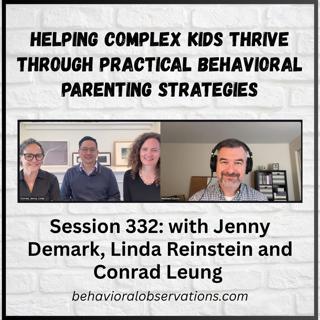
Helping Complex Kids Thrive Through Practical Behavioral Parenting Strategies: Jenny Demark, Linda Reinstein and Conrad Leung | Session 332

Helping Complex Kids Thrive Through Practical Behavioral Parenting Strategies: Jenny Demark, Linda Reinstein and Conrad Leung | Session 332

In this episode, I'm joined by Dr. Jenny Demark, Conrad Leung, and Dr. Linda Reinstein to talk about their new book, Complex Kids, Simple Solutions: How to Raise Resilient, Confident, Likable Kids. Th...

27 Mai 1h 9min

Populært innen Vitenskap

fastlegen
romkapsel
liberal-halvtime
jss
tingenes-tilstand
forskningno
tomprat-med-gunnar-tjomlid
rekommandert
sinnsyn
villmarksliv
rss-paradigmepodden
fjellsportpodden
rss-nysgjerrige-norge
rss-kunstig-intelligens-med-elisabeth-maren-og-morten
rss-rekommandert
tidlose-historier
nordnorsk-historie
rss-inn-til-kjernen-med-sunniva-rose
psykopoden
grunnstoffene