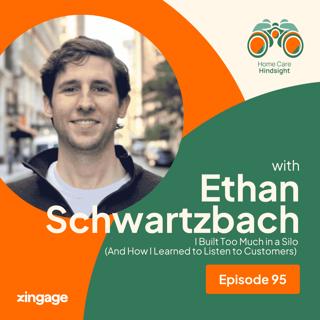
I Built Too Much in a Silo (And How I Learned to Listen to Customers) — Ethan Schwartzbach

I Built Too Much in a Silo (And How I Learned to Listen to Customers) — Ethan Schwartzbach

Ethan Schwartzbach, CEO of Flychain, joins David Knack to unpack the financial and operational challenges that can make or break a growing home care business. From messy financials and generic accounting systems to benchmarking and proactive decision-making, Ethan explains why having accurate, home-care-specific data can fundamentally change how owners run their businesses.

Ethan also shares one of Flychain's biggest early mistakes: building too much in a silo instead of staying close to customers and prospects. He explains how that experience changed the company's approach to product development and reinforced the importance of listening to the people actually using the technology.

The conversation also tackles one of the most talked-about topics in healthcare technology: AI. Ethan argues that AI can be transformational, but warns against treating it like a magic solution. He and David discuss the risks of automating bad processes, the importance of AI governance and guardrails, and why home care organizations need to think carefully about how technology affects caregivers and other stakeholders.

As the conversation moves into growth, Ethan explains why growing too quickly can create financial problems weeks or months down the road, why cash-flow forecasting matters, and why successful agencies consistently invest time in their clinical and operational teams. He also breaks down how the right KPIs can turn financial data from a source of confusion into actionable information.

In this episode, you'll discover:

1. How generic accounting systems can make it difficult to understand profitability, corporate structures, expenses, and performance at the level home care operators actually need.

2. Why Ethan believes Flychain moved too quickly without enough customer feedback early on, and how staying close to users reshaped the company's product development.

3. How accurate, granular financial data can help owners move beyond using their books as a tax placeholder and start using them to make business decisions.

4. Low staffing costs, utilization, cancellations, caseload, and other underlying variables can affect gross profit, and why simply looking at one top-line number isn't enough.

5. Why automation can actually create more work or damage relationships when the underlying process isn't working in the first place.

6. How regularly creating forums for clinical and operational employees can improve engagement, retention, and their connection to the organization.

7. Why tracking metrics like cancellation rates is only the first step, and how breaking those metrics down can reveal the operational issues driving them.

Lesson Takeaways:

1. Clean financial data is more than bookkeeping. Accurate, granular numbers can help home care owners make proactive decisions rather than simply report what already happened.

2. Build with the customer, not just for the customer. Ethan's biggest early lesson was that what makes sense internally can be very different from what customers actually need.

3. AI isn't a substitute for good processes. Technology works best when the underlying workflow is already thoughtfully designed.

4. Growth needs financial discipline. Taking on more clients and hiring ahead of demand can create cash-flow problems if growth is uneven or temporary.

5. Your employees are the lifeblood of the organization. Successful agencies create opportunities for clinical and operational employees to provide feedback and feel like people rather than cogs in a system.

6. Don't let data become decision paralysis. Focus on the handful of financial metrics and KPIs that actually help you determine what action to take.

7. Benchmarks need context. Knowing your number isn't enough, you also need to understand what good performance looks like and which underlying variables are driving the result.

8. The goal of financial intelligence is action. The most useful data is information that can be interpreted quickly and translated into a specific next step.

Timestamps:

00:00 – Introduction

02:10 – Why Flychain is positioned as a home-care-specific alternative to QuickBooks

03:02 – Granular financial data and benchmarking for home care

05:16 – Ethan's biggest mistake: building too much in a silo

11:35 – Moving from retroactive analysis to proactive business decisions

14:36 – What Ethan thinks is overrated in home care

16:36 – What happens when you automate a bad process

17:48 – AI governance, context, and guardrails

19:19 – The small financial mistakes that become bigger problems

20:26 – "Death by a thousand paper cuts" and financial mismanagement

25:50 – The key metrics that help owners make decisions

29:55 – What Ethan is proud of at Flychain

30:23 – How benchmarks define "good" for home care agencies

31:43 – How to connect with Ethan and Flychain

Quotes

1. "Building what's in our brains can actually be quite different from what an actual user and customer wants to see." — Ethan Schwartzbach

2. "It's a lot easier to make those decisions and be proactive about your business when you have the numbers that will tell you a story." — Ethan Schwartzbach

3. "At the end of the day, that is the lifeblood of your organization. It's your employees." — Ethan Schwartzbach

Resources:

1. Connect with Ethan Schwartzbach on LinkedIn: https://www.linkedin.com/in/ethan-schwarzbach-baa09571/

2. Learn more about Flychain: https://www.flychain.us/

3. Email Ethan: ethan@flychain.us

4. Connect with David Knack on LinkedIn: https://www.linkedin.com/in/david-knack/

5. Connect with Zingage on LinkedIn: https://www.linkedin.com/company/zingage/

6. Powered by Zingage: https://zingage.com/

7. Watch Episode on Zingage's YouTube: https://www.youtube.com/@Zingage

Denne episoden er hentet fra en åpen RSS-feed og er ikke publisert av Podme. Den kan derfor inneholde annonser.

Episoder(102)

I Stopped Trying to Fix Everything at Once and Built a Business That Supports Me — Clint Nobles

I Stopped Trying to Fix Everything at Once and Built a Business That Supports Me — Clint Nobles

Clint Nobles, co-founder of Home Care Ops and the Home Care Owners Community, joins David Knack to discuss the business mistake that changed how he approaches growth, operations, and leadership. Drawi...

3 Nov 42min
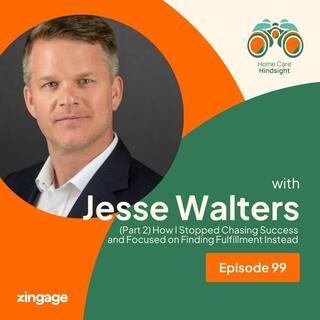
(Part 2) How I Stopped Chasing Success and Focused on Finding Fulfillment Instead — Jesse Walters

(Part 2) How I Stopped Chasing Success and Focused on Finding Fulfillment Instead — Jesse Walters

In Part 2, David and Jesse get into the leadership lessons that shape a home care business long before they show up on a spreadsheet. They discuss why staffing managers and schedulers are among the mo...

27 Okt 36min
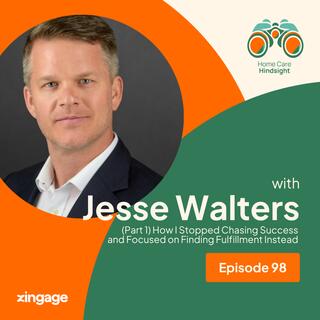
(Part 1) How I Stopped Chasing Success and Focused on Finding Fulfillment Instead — Jesse Walters

(Part 1) How I Stopped Chasing Success and Focused on Finding Fulfillment Instead — Jesse Walters

David Knack doesn't usually record an intro before an episode, but this conversation with his good friend Jesse Walters was so much fun that it turned into his first-ever two-part episode. While they ...

22 Okt 41min
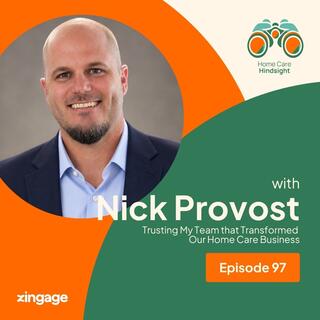
Trusting My Team that Transformed Our Home Care Business — Nick Provost

Trusting My Team that Transformed Our Home Care Business — Nick Provost

Nick Provost, Director of Client and Community Relations at Gratitude Home Care, joins David Knack to share the lessons he learned from starting his own home care company, navigating the challenges of...

16 Okt 37min
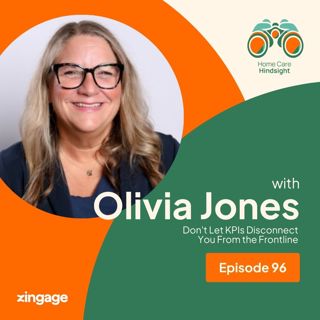
Don't Let KPIs Disconnect You From the Frontline — Olivia Jones

Don't Let KPIs Disconnect You From the Frontline — Olivia Jones

Olivia Jones, Executive Vice President of Operations at Care Advantage, joins David Knack to share lessons from nearly three decades in home care from starting as a caregiver to leading operations acr...

6 Okt 40min
5 Big Things I've Changed my Mind on — Jensen Jones

5 Big Things I've Changed my Mind on — Jensen Jones

Jensen Jones, Owner and CEO of Home Care CEO Forum, returns to discuss five things he was wrong about and how his thinking has evolved. From the founder bottleneck myth to overtime as a strategic tool...

24 Sep 43min
How I Stopped Accepting the Status Quo and Started Building Better Support Systems — Jamie Arber

How I Stopped Accepting the Status Quo and Started Building Better Support Systems — Jamie Arber

Jamie Arber, Executive Director of Supported Living Group, shares how his organization supports individuals with brain injuries, autism, and other complex care needs across Connecticut. He discusses t...

15 Sep 38min
Populært innen Business og økonomi

stopp-verden
dine-penger-pengeradet
rss-penger-polser-og-politikk
e24-podden
rss-borsmorgen-okonominyhetene
rss-neste-generasjon-med-emilie-stordalen
utbytte
livet-pa-veien-med-jan-erik-larssen
rss-skravla-gar
rss-pa-konto
pengepodden-2
tid-er-penger-en-podcast-med-peter-warren
lederpodden
finansredaksjonen
stormkast-med-valebrokk-stordalen
okonomiamatorene
pengesnakk
morgenkaffen-med-finansavisen
liberal-halvtime
rss-orjasater