The Long March

The Long March

Zhou Enlai planned in secret the details of the Chinese Communist's escape from the encirclement of the Central Soviet. He identified a Guangdong warlord who preferred to save his troops rather than fight the Red Army.


The First Red Army was able to pass through a number of blockhouses, before reaching the last of Chiang Kai-shek's fortifications near the Xiang River and suffering major casualties. They lost their heavy weapons and almost half their troops at that battle.


Then the Red Army moved quickly and often at night on The Long March. They reached northern Guizhou, close to the base of the Second Red Army, and rested.


At the Zunyi Conference, the 28 Bolsheviks lost their previous influence over the Communist Party of China and Mao Zedong began his rise to power. Mobile and guerilla warfare again became military policy.


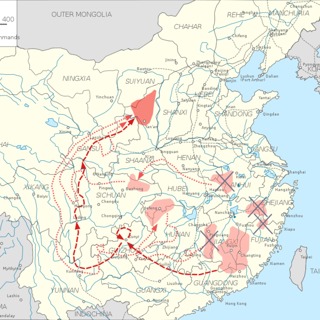
The destination for the Long March changed at this point and instead of staying in Guizhou, the First Red Army tried to cross north into Sichuan. Faced with defensive resistance and at risk of annihilation, the First Red Army crossed the Chishui River four times. They escaped destruction, but now chose to move west and then north through Yunnan. They reached western, rather than eastern Sichuan.


The Long Marchers faced Snowy Mountains and a treacherous bog.


The First Red Army finally met up with the leader of the Fourth Red Army, Zhang Guotao, but couldn't reach agreement on a destination. Zhang preferred that they all settle around Sichuan, where he already had built a base and had the strongest Red Army.


Mao preferred to continue travelling to northern Shaanxi. His column arrived there in late 1935 and in 1936, moved within northern Shaanxi to Yenan.

It is said they crossed 18 mountain ranges and 24 rivers to reach there. Early on, Mao saw the Long March's myth-making potential and used it to turn this military retreat into a story of the Communists trip through the wilderness to a new land. It was symbolic of the journey from the old China to the new promised China.


Zhang Guotao's column was soon defeated and, having lost his military strength, Zhang also lost power in the Communist Party and after a trial and self-criticism, went over to the Guomindang.


Chiang Kai-shek might have allowed the Communists to retreat westward in order to follow them and take greater control over autonomous provinces like Guangxi and Sichuan. Because of the Long March, he was able to influence Sichuan for the first time and later made its then city of Chongqing his capital during World War II.


The Communist Party leadership survived because of the Long March, but most ordinary soldiers did not. Mao's wife gave birth painfully along the way. Of the approximately 80,000 troops who left the Central Soviet, only about 7,000 arrived in northern Shaanxi, and that was with recruitment along the way. Yet much had changed, including greater autonomy of the Chinese Communists from Moscow.


Image: "Map of the Long March 1934-1935-en" by Chinese_civil_war_map_03.jpg: User:Guimard derivative work: Rowanwindwhistler (talk) is licensed under CC BY-SA 3.0.


You can support this show through Buy me a coffee. https://www.buymeacoffee.com/thechineserevolution


For more information, sources and content see: https://chineserevolution.substack.com


Or enjoy The Chinese Revolution YouTube channel: https://www.youtube.com/channel/UCCOjBYMNC_3xjQXKv6ab9YA?sub_confirmation=1

Hosted on Acast. See acast.com/privacy for more information.

Denne episoden er hentet fra en åpen RSS-feed og er ikke publisert av Podme. Den kan derfor inneholde annonser.

Episoder(67)

The Wang Jingwei Regime: A Puppet Regime in Nanjing

The Wang Jingwei Regime: A Puppet Regime in Nanjing

In 1938, after the Battle of Wuhan, Wang Jingwei left Chongqing and the Republic of China team in Chongqing for Hanoi. He negotiated with Japanese officials and eventually set up a puppet regime know ...

30 Jun 202428min
Living Under Japanese Occupation

Living Under Japanese Occupation

Japan controlled Taiwan as a colony from 1895 to 1945. During the Second Sino-Japanese War, Chinese language education and publications stopped and the Imperial Subject Movement tried to Japanize resi...

27 Mai 202429min
The Brilliance of Chairman Mao

The Brilliance of Chairman Mao

By the early 1940s, the Communists in Yan’an were feeling relatively secure. The Japanese advance in north China had not reached that area. The Sino-Japanese War and the United Front meant that Chiang...

7 Apr 202420min
Hope and the Second United Front in Wuhan

Hope and the Second United Front in Wuhan

For ten months in 1938, Hankou in Wuhan was the center of China's Second United Front and defense against the Japanese invasion.Artistic expression, political parties and free speech all blossomed. Ne...

3 Mar 202426min
The National Palace Museum Treasures During the Second Sino Japanese War

The National Palace Museum Treasures During the Second Sino Japanese War

The treasures of the National Palace Museum, originally the Forbidden City, followed China's path. They escaped the invading Japanese by leaving Beijing, first for Shanghai, then Nanjing and then foll...

12 Feb 202455min
The Beginning of the Second Sino-Japanese War and the Nanjing Massacre

The Beginning of the Second Sino-Japanese War and the Nanjing Massacre

On July 7, 1937, the Second Sino-Japanese War and World War II began with the Marco Polo Bridge Incident. It is also known as the Lugou Bridge Incident. Within days of the small skirmish with 100 Chin...

15 Jan 202425min
Chiang Kai Shek is Kidnapped

Chiang Kai Shek is Kidnapped

After the Long March, the Chinese Communists were mostly in northern Shaanxi, wanting a breather. Japan had continued its aggression in China after it set up the puppet state of Manchukuo under Empero...

7 Jan 202416min

Populært innen Samfunn

rss-spartsklubben
alt-fortalt
giver-og-gjengen-vg
aftenpodden
aftenpodden-usa
konspirasjonspodden
popradet
rss-nesten-hele-uka-med-lepperod
rss-henlagt-andy-larsgaard
wolfgang-wee-uncut
lydartikler-fra-aftenposten
rss-espen-lee-usensurert
bokmerket-2
grenselos
fladseth
rss-dette-ma-aldri-skje-igjen
rss-siktet
min-barneoppdragelse
frokostshowet-pa-p5
synnve-og-vanessa