
Werner Bohleber: Trauma - Catastrophic Reality and the Overwhelmed Psyche.

Werner Bohleber: Trauma - Catastrophic Reality and the Overwhelmed Psyche.

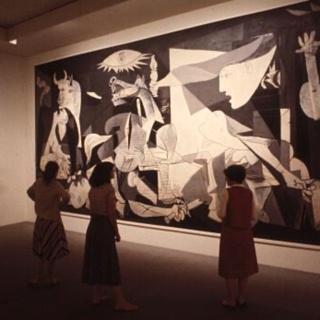
"Guernica" by Picasso at MOMA, NYC. Gotfryd, Bernard, photographer. Courtesy Library of Congress.

What happens when our basic trust in the world is challenged, and the social dimension of reality is disrupted as a consequence of collective trauma? In this episode, Werner Bohleber addresses the theme of traumatic experiences and does so starting from the two main models around which psychoanalytic thought has sought to understand trauma: the freudian psycho-economic model and the object-relational model. Reflecting on what he so effectively defines as "the symbolic web that carries us", Bohleber considers the implications of man-made disasters, and those that befall our individual and collective memory.

Werner Bohleber, Dr. phil, is a psychoanalyst in private practice in Frankfurt am Main. He is training analyst and former President of the German Psychoanalytical Association. He has long served on committees of the IPA, the last from 2009-2013 as Chair of the IPA Committee on Conceptual Integration. From 1997 to 2017 he was main editor of the journal PSYCHE. His research subjects and main publication themes are: late adolescence and young adulthood; psychoanalytic theory; transgenerational consequences of the Nazi period and the war on the second and third generation; nationalism, terrorism, anti-Semitism; trauma research. In 2007, he was awarded the Mary S. Sigourney Award for his diverse contributions, especially those relating to the traumatic aftermath of the Holocaust, National Socialism, and World War II.

link to the paper https://docs.google.com/document/d/18yMyiZ6darmN6ouxVoQmUwlci44UCnCQ/edit?usp=sharing&ouid=112457875385152358388&rtpof=true&sd=true

this episode is available also in German

Bibliography

Allen, J. (2013). Mentalizing in the development and treatment of attachment trauma. London: Karnac.

Amery J. (1996): Die Tortur. Merkur, 50, 502-515.

Balint M (1969). Trauma and object relationship. Int. J. Psycho-Anal. 50: 429-36.

Baranger M, Baranger W, Mom JM (1988). The infantile psychic trauma from us to Freud: Pure trauma, retroactivity and reconstruction. Int. J. Psycho-Anal. 69: 113-28.

Bohleber, W (2010). Destructiveness, Intersubjectivity, and Trauma. The Identity Crisis of Modern Psychoanalysis. London: Karnac.

Cooper, A. (1986), Toward a limited definition of psychic trauma. In: The Reconstruction of Trauma. Its Significance in Clinical Work, ed. A. Rothstein. Madison, CT: International Universities Press, pp. 41-56.

Erikson E.H. (1968): Identity. Youth and crisis. Nem York: Norton.

Ferenczi S (1949). Confusion of the tongues between the adults and the child [1933]. Int. J. Psycho-Anal. 30: 225-30.

Freud S (1920). Beyond the pleasure principle. Standard Edition 18, p. 7-64

Freud S (1926). Inhibitions, symptoms and anxiety. Standard Edition 20, p. 77-174.

Freud S. (1939). Moses and Monotheistism. SE 23: 1-138. (GW 16: 103–246)

Garland, C. (1998). Thinking about trauma. In: Garland, C. (Hg.). Understanding trauma. A psychoanalytic approach. London (Karnac).

Krystal, H. (1988). Integration and Self-Healing. Affect, Trauma, Alexithymia. Hillsdale: Analytic Press.

Langer L.L. (1995): Memory’s time: Chronology and duration in Holocaust testimonies. In: Langer, L.L.: Admitting the Holocaust: Collected essays. New York/Oxford: John Hopkins University Press, pp.13-23.

Leys R. (2000). Trauma: A genealogy. Chicago, Ill.: University of Chicago Press.

Morris D. J. (2015): The evil hours. A biography of post-traumatic stress disorder. Boston/New York: Houghton Mifflin Harcourt.

Oliner M. (2012): Psychic reality in context. Perspectives on psychoanalysis, personal history, and trauma. London: Karnac

Shalev A.Y. (1996), Stress Versus Traumatic stress. From Acute Homeostatic Reactions to Chronic Psychopathology. In: Traumatic Stress. The Effects of Overwhelming Experience on Mind, Body and Society, ed. B. van der Kolk, A., Mc Farlane & L.Weisaeth. New York NY: Guilford Press, pp. 77-101.

Steele BF (1994). Psychoanalysis and the maltreatment of children. J. Amer. Psychoanal. Assn. 42: 1001-25.

Van der Kolk B. (1996). Trauma and memory. In: B. van der Kolk, B., A. McFarlane & L. Weisath (Eds.) Traumatic stress. The effects of overwhelming experience on mind, body and society. New York: Guilford Press, pp. 279-302.

van der Kolk B. (2014): The body keeps the score. Mind, brain, and the body in the healing of trauma London: Penguin Books.

CREDITS Editing: Agustín Ruiz Brussain

Denne episoden er hentet fra en åpen RSS-feed og er ikke publisert av Podme. Den kan derfor inneholde annonser.

Episoder(100)

Why I Write: From the Dot to the Line – Drawing a Thread Out and Writing it Through · Jennifer Davids

Why I Write: From the Dot to the Line – Drawing a Thread Out and Writing it Through · Jennifer Davids

Why does the analyst write? And further why might the analyst write different kinds of pieces such as clinical writing, scientific papers, narratives, or poetry? There are always the considerations of...

28 Jul 17min

The Body as a Pulsing Frontier - Ema Ponce de León

The Body as a Pulsing Frontier - Ema Ponce de León

Are the limits of what can be said – the field of the non-verbal, the texture of affects, everything that resists symbolic capture – the true challenge facing psychoanalysis today? In her thought-prov...

30 Jun 22min

Psychic Change and Enactment: some reflections - Ariel Liberman

Psychic Change and Enactment: some reflections - Ariel Liberman

"Psychic Change and Enactment: Some Reflections" is the work that Ariel Liberman offers us, to examine psychic change from a relational perspective, placing enactment as a central moment in the analyt...

4 Mai 26min

Vicissitudes of Transience - Jhuma Basak

Vicissitudes of Transience - Jhuma Basak

"How does the psyche navigate the interplay of impermanence and resilience? In 'Vicissitudes of Transience', Jhuma Basak explores the concept of transience through psychoanalytic, cultural, and philos...

23 Mar 23min

Transience and the prohibition of “Don’t Look” - Osamu Kitayama

Transience and the prohibition of “Don’t Look” - Osamu Kitayama

"What happens when we accept that impermanence is not a loss, but the very essence of life? In psychoanalysis, transience is often associated with mourning and the capacity to renew oneself. Inspired ...

3 Mar 23min

The Body and Compulsion in Childhood - Christine Anzieu-Premmereur

The Body and Compulsion in Childhood - Christine Anzieu-Premmereur

In this article, Christine Anzieu-Premmereur explores the relationship between compulsion and the body in childhood and adolescence. Using psychoanalytic theory, she analyzes how the compulsive repeti...

14 Jan 24min

The Mystery, Again - Mariano Horenstein

The Mystery, Again - Mariano Horenstein

"X". Calle Alcalá, Madrid. Photograph by Ana M. Martín Solar. With the evocative title “Once Again, the Mystery”, the Argentine psychoanalyst Mariano Horenstein poses the equally enigmatic question: H...

14 Okt 202535min

On Paternal Presence - Heribert Blass

On Paternal Presence - Heribert Blass

In the wake of profound cultural change, the traditional image of the father has been destabilized, prompting renewed psychoanalytic reflection. No longer confined to authority alone, the paternal fig...

22 Jul 202527min

Populært innen Vitenskap

fastlegen
tingenes-tilstand
liberal-halvtime
romkapsel
jss
rekommandert
abels-tarn
sinnsyn
dekodet-2
villmarksliv
tomprat-med-gunnar-tjomlid
rss-rekommandert
fjellsportpodden
forskningno
rss-inn-til-kjernen-med-sunniva-rose
vett-og-vitenskap-med-gaute-einevoll
rss-paradigmepodden
nevropodden
diagnose
rss-nysgjerrige-norge