207. Revolution?

207. Revolution?

It’s the general strike!

This time the unions couldn’t push Stanley Baldwin’s government into making concessions to the miners. That was because while, in his own words, in the previous year Baldwin had not been ready, this time he was.

When the miners came out and the TUC with them, they found the government ready to call up volunteers as strike breakers or special constables to support the police. The country had been divided into districts with Civil Commissioners in each of them, ready to ensure essential goods were distributed and order was maintained.

In any case, any suggestion that the movement was revolutionary was belied by the moderation the strikers and their leaders showed. That didn’t stop the hardliners in cabinet behaving as though they were facing a major threat to civilisation. Strangely, the leading hardliner was Winston Churchill, even though he was a former Liberal and always keen on alleviating the sufferings of the poor. He edited the government newspaper, the British Gazette, and turned it into a huge-circulation propaganda broadsheet pushing the government line. The BBC, too, broadcasting news for the first time, took a highly pro-government stance. And Churchill wasn't above making shows of military force to underline his propaganda points.

The unions weren’t ready for a long strike and their funds began quickly to run out. With legal action threatening against them, and their members suffering, the non-mining unions were looking for a compromise to end the strike. But the miners were at least as intransigent as the mine owners and the government. No compromise was possible.

After nine days, the TUC called off the strike. The British Gazette gloatingly proclaimed ‘Surrender!’ The unions had suffered a major defeat.

And, once more, the miners were left to fight on alone.


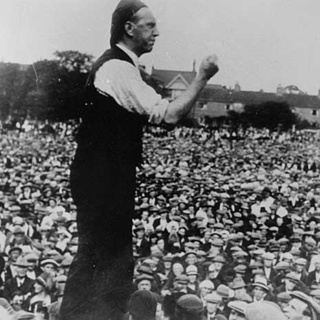
Illustration: Arthur Cook, the miners’ leader, addressing a mass meeting of strikers. Public Domain

Music: Bach Partita #2c by J Bu licensed under an Attribution-NonCommercial-No Derivatives (aka Music Sharing) 3.0 International License


Episoder(274)

265. War in a unipolar world

265. War in a unipolar world

By the latter part of the twentieth century, the world had become unipolar. The Soviet Empire collapsed even more rapidly than the British one had after the Berlin Wall fell in 1989. China was not yet...

26 Okt 202514min
264. Ethics, votes and wars

264. Ethics, votes and wars

We saw in the last episode, that Britain’s involvement in the NATO intervention in Kosovo could be regarded as part of an ‘ethical foreign policy’, since its objective, many felt, was humanitarian, th...

12 Okt 202514min
263. Tragedy at home, ethics abroad

263. Tragedy at home, ethics abroad

Divorce, contrary to what many believe, was not permitted by the Church of England. Henry VIII didn’t divorce two wives, he had the marriages annulled, declaring in effect that they’d never happened. ...

5 Okt 202514min
262. Uncool

262. Uncool

In the early years of Blair’s premiership, his supporters liked to refer to Britain as ‘Cool Britannia’, in a play on the title of the song ‘Rule Britannia’. Last week, we talked about some of the coo...

28 Sep 202514min
261. Cool Britannia

261. Cool Britannia

The Blair government threw itself into action as soon as it was formed.Rather confirming the existence of a deal between them, something they’ve never confirmed, Blair quickly appointed Gordon Brown C...

21 Sep 202514min

260. New Dawn

260. New Dawn

It was a new dawn. Or at least so Tony Blair said, as he emerged from his landslide victory in the 1997 General Election. It’s what he would say, isn’t it?Still, there was some truth to the claim. It ...

14 Sep 202514min

259. Major error, major success, Major’s out

259. Major error, major success, Major’s out

We’re just about ready to move on from John Major but, before we do, we need to spend a few moments on two major events of his second premiership. One was a significant breakthrough, in Ireland, even ...

7 Sep 202514min
258. Major’s bastards and Labour’s deal

258. Major’s bastards and Labour’s deal

By winning the 1992 general election, John Major had gained his own mandate to form a government, instead of imply inheriting Margaret Thatcher’s. He’d shown himself capable of leading the Conservativ...

31 Aug 202514min

Populært innen Historie

rss-dette-ma-aldri-skje-igjen
historier-som-endret-norge
rss-katastrofe
henrettelsespodden
sektledere
aftenposten-historie
rss-benadet
rss-nadelose-nordmenn-gestapo
historier-som-endret-verden
med-egne-oyne
rss-strid-de-norske-borgerkrigene
rss-frontkjemperne
rss-gamle-greier
taakeprat
historiepodden
historiepodden-ww2
liberal-halvtime
rss-historier-fra-gudbrandsdalen
vare-historier
rss-politisk-preik