207. Revolution?

207. Revolution?

It’s the general strike!

This time the unions couldn’t push Stanley Baldwin’s government into making concessions to the miners. That was because while, in his own words, in the previous year Baldwin had not been ready, this time he was.

When the miners came out and the TUC with them, they found the government ready to call up volunteers as strike breakers or special constables to support the police. The country had been divided into districts with Civil Commissioners in each of them, ready to ensure essential goods were distributed and order was maintained.

In any case, any suggestion that the movement was revolutionary was belied by the moderation the strikers and their leaders showed. That didn’t stop the hardliners in cabinet behaving as though they were facing a major threat to civilisation. Strangely, the leading hardliner was Winston Churchill, even though he was a former Liberal and always keen on alleviating the sufferings of the poor. He edited the government newspaper, the British Gazette, and turned it into a huge-circulation propaganda broadsheet pushing the government line. The BBC, too, broadcasting news for the first time, took a highly pro-government stance. And Churchill wasn't above making shows of military force to underline his propaganda points.

The unions weren’t ready for a long strike and their funds began quickly to run out. With legal action threatening against them, and their members suffering, the non-mining unions were looking for a compromise to end the strike. But the miners were at least as intransigent as the mine owners and the government. No compromise was possible.

After nine days, the TUC called off the strike. The British Gazette gloatingly proclaimed ‘Surrender!’ The unions had suffered a major defeat.

And, once more, the miners were left to fight on alone.


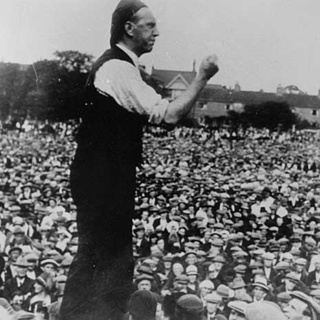
Illustration: Arthur Cook, the miners’ leader, addressing a mass meeting of strikers. Public Domain

Music: Bach Partita #2c by J Bu licensed under an Attribution-NonCommercial-No Derivatives (aka Music Sharing) 3.0 International License


Episoder(275)

258. Major’s bastards and Labour’s deal

258. Major’s bastards and Labour’s deal

By winning the 1992 general election, John Major had gained his own mandate to form a government, instead of imply inheriting Margaret Thatcher’s. He’d shown himself capable of leading the Conservativ...

31 Aug 202514min
257. Iron Lady out, Grey Man in

257. Iron Lady out, Grey Man in

With the poll tax, Thatcher took one bad decision to many. From the point of view of orthodox Thatcherite thought, it sounded like a good idea. She’d been working for years to shrink the state but, wh...

24 Aug 202514min
256. Maggie losing it

256. Maggie losing it

Having looked last week at how Maggie Thatcher was running out of options for how to carve out a new role for Britain on the world stage, this week we look at how things were going at home. After all,...

17 Aug 202514min
255. Maggie: lioness or poodle?

255. Maggie: lioness or poodle?

Maggie Thatcher in 1987 pulled off a trick that had eluded all other British Prime Ministers of the twentieth century: she won three general elections in a row. Even more, she won a second Commons lan...

10 Aug 202514min
254. Maggie reaching the top

254. Maggie reaching the top

Thatcher’s victories, including a general election landslide and breaking the miners’ strike, emboldened her to launch another phase in the reduction of the role of the state in the British economy. N...

3 Aug 202514min
253. The Enemy Within

253. The Enemy Within

What had converted Maggie Thatcher from something of a lame duck into a front runner for the next British general election?While the economy had begun to pick up, that had been patchy at best, with so...

27 Jul 202514min
252. Iron Lady

252. Iron Lady

Mrs Thatcher’s first term in office was one of the great get out of jail events. She came into office intent on braking with the Keynesianism and social democracy of the postwar consensus. She drew on...

20 Jul 202514min
251. Unlucky Jim

251. Unlucky Jim

In 1976, Jim Callaghan took over from Harold Wilson as leader of the Labour Party and British Prime Minister. He was a competent politician, though not an outstanding one. He did his job well, but he ...

13 Jul 202514min

Populært innen Historie

rss-dette-ma-aldri-skje-igjen
med-egne-oyne
rss-katastrofe
henrettelsespodden
historier-som-endret-norge
historier-som-endret-verden
rss-nadelose-nordmenn-gestapo
sektledere
rss-benadet
aftenposten-historie
rss-strid-de-norske-borgerkrigene
rss-frontkjemperne
historiepodden
rss-gamle-greier
rss-bisarr-historie
rss-historiske-romanser-svik-drap-og-kjarlighet
taakeprat
rss-historier-fra-gudbrandsdalen
vare-historier
liberal-halvtime