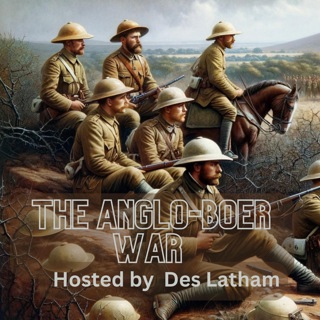
Episode 31 - The Battle of Sanna's Post & De Wet goes after Cape Afrikaners
Now we swing back to the Orange Free State and there’s a very good reason. His name is General Christian de Wet the famous Boer commander. If there was ever a person who fit the bill as cometh the hour, cometh the man - it was de Wet. He’d convinced his officer commanding General Joubert to allow the Free Staters to leave for home after Bloemfontein was captured by the British. De Wet’s logic was simple. His men had been away from home for six months fighting the mighty British empire and despite incredible victories, they’d lost the Orange Free State Republic capital. Six months away from home meant most were missing their loved ones — although some had brought their entire families who moved with the Boer commandos in their ox-wagons. So de Wet took a momentous gamble. He’d sent the men home saying they should re-assemble back on the railway bridge over the Sand River north of Bloemfonteon on the 25th March. While his decision was regarded as military suicide by Joubert, the British had made it easy for him. Lord Roberts had called a halt to his march to Pretoria in order to rest the troops and wait for his logistics to catch up. Both sides took a breather. Historians are quick to point out that Lord Roberts had created a nightmare by overriding his logistics leadership and adopted a gung-ho attitude to the movement of his material - now he was paying for his rash decision to put the bloody thirsty Lord Kitchener .. your country needs you … in charge of food, provisions, equipment, support, transport.
22 Apr 201821min
Episode 30 - Black & White Man’s war and scouting the place of stones
It’s April 1900, the new century is four months old. Lord Roberts has halted after seizing the Orange Free State Republic capital Bloemfontein, and General Buller had finally liberated Ladysmith in Natal. In the North West of South Africa is this small town called Mafeking. Its there that the Colonel Baden-Powell is unable to move, hemmed in by really a small group of Boers of around 1700 or so. But this was April - earlier things were very different around the small desert town and creative measures were required in order to shore up the defences. One of these was the introduction of black troops. Thomas Pakenham has an excellent quote which I must use here from General Cronje to Colonel Baden-Powell in October 1899 as the Anglo-Boer war began: “It is understood that you have armed Bastards, Fingos and Baralongs against us - in this you have committed an enormous act of wickedness .. reconsider the matter .. even if it cost you the loss of Mafeking .. disarm your blacks and thereby act the part of a white man in a white man’s war….” But of course, that’s rubbish. This was not a white man’s war. Both sides pretended at first that this was the case, yet the Boers were using techniques, strategies and tactics perfected during two centuries and more of warfare against Africans. The Boers were using African tactics against a European army. Furthermore, both sides had armed black South Africans and both sides used Blacks as sappers - or engineers - building trenches and bulwarks, laying traps and others scouting and spying.
15 Apr 201823min
Episode 29 - Clumsy Diplomacy fails while Baden-Powell blunders in Mafeking
This week we’re going to probe a comedy of errors that started with a seemingly clever plan by Orange Free State President Steyn to dispatch a diplomatic mission to Europe in order to drum up support. Then we’ll swing past Mafeking in the North West of South Africa where Lord Baden-Powell was facing General Snyman of the Boers. Baden-Powell is famous for launching the World Scout Movement. IT’s also the town where the famous South African journalist Sol Plaatje was based during the war and where he worked as a translator for the British. This is important because from his experiences Plaatje was part of the creation of the political party the African National Congress ten years later. It was Plaatje's fluid oratory and clear minded writing that helped promote the party’s launch. So many roads lead to Mafeking - and equally - from Mafeking to the present.
8 Apr 201824min
Episode 28 - Journalists take Bloemfontein but typhoid breaks out
This week we’re traveling to the Orange Free State Republic capital Bloemfontein with Lord Robert’s army - and its not something to boast about. The capture of the town is known as a one-off - its the first and last time that journalists seized a capital in the midst of a war. Bloemfontein was to prove to be a disease-ridden death trap for over five hundred British soldiers who’d survived the campaign thus far, marched overland for hundreds of kilometers only to die of typhoid infection in the filthy mud of the capital city. Which is ironic because Bloemfontein means “Flower Spring”. It’s March 1900, the new century has brought with it a continuation of the war between the Boer and British in the South of Africa. In the previous podcast we heard how Transvaal president Oom Paul Kruger arrived at the Free State front in a vain attempt to shore up the morale of the Boer troops.
1 Apr 201822min
Episode 27 - Oom Paul Kruger evades capture at Poplar Grove
The Anglo-Boer war, embarked upon by both sides with confidence, was now to be maintained by faith and we shall see how that faith was expressed, and by whom .. and what became of it. One of these men of faith was Transvaal President, Oom Paul Kruger. Although well into his 70s by this time, he found the energy to climb aboard a rattling Boer train and to travel to both war fronts - in Natal and in the Free State. When he arrived in Natal he found the Boers in full flight. Buller had successfully relieved Ladysmith and the burghers wanted to leave for home. Kruger found General Joubert sick with illness and defeat and tried to stop what had turned into a stampede. He entreated and exhorted, and promised that he would suggest arbitration to end the war as long as the men stood firm. Many had decided that it was huis toe or time to go home and had retreated as far north as Newcastle from Ladysmith before they were persuaded to return to fight. But when Kruger travelled to the front in the Orange Free State at Poplar Grove, Lord Roberts who led the British force had ordered an attack on the Grove on the same day Kruger arrived - March 7th 1900. Would Kruger escape?
25 Mar 201819min
Episode 26 - Ladysmith relieved and Buller makes film history
This week I thought we’d concentrate on the town of Ladysmith in Natal which had been besieged by the Boers for over a hundred days by February 1900. It was also the town from which nearly 13 000 British troops had been unable to escape, hemmed in by a force of 8 000 Boers. You’d imagine that this British force could have broken out, being significantly larger than their besiegers. But the Boers had dominated the battles of the veld in both Natal and to the west, around Kimberley, for sixteen weeks. At first they appeared ghostly, moving across the waves of brown grass on the undulating veld on their horses, disappearing, re-appearing. In most battles up to now, the British hadn’t even seen their enemy. And that was particularly true of the men and women holed up in Ladysmith. They’d endured constant shelling like their colleagues in Kimberley as well as in the far north west at the town of Mafeking. We’ll deal at length with the battles around this town later, but of the three towns, Ladysmith was the worst by far in which to have been caught without a chance of escape.
18 Mar 201821min
Episode 25 - Hlangwane, Monte Christo and a key to unlock Ladysmith
After spending some time in the West where Kimberley has been relieved and Free State Boer General Cronje had surrendered with 4000 Burghers after a fortnight of retreat, entrenching and then being bombarded at Paadeberg Drift our gaze shifts back to Natal in the north east. Twenty six Kilometers outside Ladysmith, along the main railway line from the port of Durban to Johannesburg and then the prize, Pretoria, General Buller was fulminating. The garrison at Ladysmith was weakening daily as a result of bombardment, indequate food and disease. Buller resolved once more to make an attempt to reach the beleaguered town. He spent hours viewing the heights across the Tugela River that had thwarted his every attempt at crossing and marching onto Ladysmith for 3 months. However, things were looking up. Buller had a strange bond with his men. We have seen with the benefit of hindsight, what a disastrous leader he really was. But at the time, his men thought he’d been given an almost impossible task with a force too small, while Lord Roberts lorded it up in the west of the country with 40 000 men. And Buller had also had an epiphany. He realised the key to Ladysmith was a new kind of mobile warfare, an offensive counterpart to the Boer defensive tactics. The old three-part act, artillery, men charging with bayonets, cavalry chopping up the fleeing enemy all in a day - was over.
11 Mar 201820min
Episode 24 - Cronje surrenders to Lord Roberts
It’s February 1900 and things have begun to change in South Africa. The British Army corps which so far has found itself flailing against an enemy steeped in the concept of mobility and able to exploit the leadenfooted leadership of the imperial entitled upper class has started to gain the upper hand. It’s a 40 000 strong army that General Roberts has formed in the wake of numerous losses. Roberts himself has only just arrived in South Africa to replace General Buller. Robert’s centipede has starting to move at a more rapid pace into the interior of the country and so far has kept to the railway line to relieve Kimberley. By 17th February Robert’s army has caught up to 4000 Boers at Paardeberg Drift on the Modder River as they tried to head eastwards to Bloemfontein, the Free State Republic capital. General Cronje in charge of the Boers had made a fatal error in deciding to dig in against the overhwelmingly large British force despite the warning from his most talented subordinate, Christian de Wet.
4 Mar 201817min