
Prolonged Field Care Podcast 39: ETCO2 - Applications and Limitations

Prolonged Field Care Podcast 39: ETCO2 - Applications and Limitations

Upgrading your airway kit with a portable end tidal CO2 monitor can help in a couple situations. While it has its limitations, it is essential for quickly determining if your tube is in the trachea during an intubation. This can be accomplished most accurately via a device with a quantitative waveform such as the Emma Capnograph. If you can’t get your hands on an Emma, the qualitative colormetric device that changes color when exposed to acid in the exhalations. False positives can occur due to other acids in the airway such as vomitus or even if the patient has recently had a carbonated beverage. While those are rare, you should be aware of the possibility. Having a visual indication of tube placement can be extremely helpful during loud transports such as on aircraft.

Another time that ETCO2 monitoring is very useful is during CPR. There will likely be a very low reading despite high quality CPR. If the heart begins to beat spontaneously, you should see an immediate increase of the numbers on the display of your device. ETCO2 can also be used as a prognostic indicator. If the ETCO2 remains below 10mmHg for 20 mins of CPR this may indicate that the patient has a very poor prognosis. After you listen to our podcast, Check out Scott Weingart’s EMCrit podcast on the subjects to hear his thoughts on this.

ETCO2 is also useful the intubated TBI patient. Per our clinical practice guideline, ETCO2 in a patient with moderate to severe TBI should be kept between 35-40mmHg. In a patient with herniation, you can temporarily increase ventilators rate in order to vasoconstrict the blood vessels in the brain, thus reducing swelling. This can only be done for a short time because hyperventilation worsens cerebral ischemia. Also avoid hypoventilation (EtCO2 45mmHg or more) that will increase ICP.

For more content, visit www.prolongedfieldcare.org

Denne episoden er hentet fra en åpen RSS-feed og er ikke publisert av Podme. Den kan derfor inneholde annonser.

Episoder(624)

294 - Do Antibiotics Really Reduce Mortality in Trauma? Wound Care First in Prolonged Field Care

294 - Do Antibiotics Really Reduce Mortality in Trauma? Wound Care First in Prolonged Field Care

Antibiotics are not magic. In this episode of the PFC Podcast, Dennis sits down with Ryan to cut through the common myth that “I’ve given antibiotics, so the wound is protected.” They unpack why vigor...

31 Aug 36min
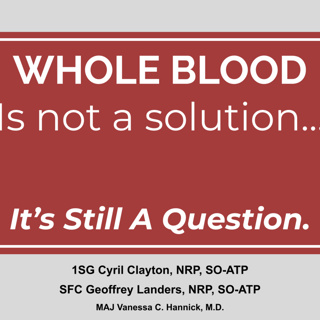
SOMA 26' - Fresh Whole Blood is Not The Answer: It's Still a Question

SOMA 26' - Fresh Whole Blood is Not The Answer: It's Still a Question

Whole Blood Is Not a Solution (Until Conventional Forces Can Deliver It)Recorded live at SOMA 26Dr. Vanessa Hanick (emergency physician, former active-duty Army, now National Guard) and 1SG Cy Clayton...

27 Aug 28min

293 - Dead Tissue Kills in Prolonged Field Care: 4 C’s, Early Debridement & Delayed Primary Closure Lessons from the Field

293 - Dead Tissue Kills in Prolonged Field Care: 4 C’s, Early Debridement & Delayed Primary Closure Lessons from the Field

In this episode of the PFC Podcast, Dennis sits down with missionary surgeon Jason to cut through the noise on real-world wound care in austere and unconventional warfare environments. From the bridge...

24 Aug 49min
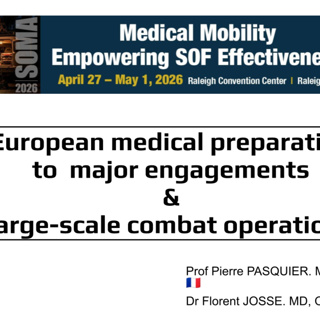
SOMA 26' - European Medical Preparations for Major Engagements and Large-Scale Combat Operations

SOMA 26' - European Medical Preparations for Major Engagements and Large-Scale Combat Operations

Recorded live at SOMA 26Pierre Pasquier (France) and his German counterpart deliver a clear-eyed assessment of how European military medical systems are preparing for large-scale combat operations and...

20 Aug 31min
292-Building Mobile Surgical Capability in Denied Environments

292-Building Mobile Surgical Capability in Denied Environments

In this episode of the Prolonged Field Care Podcast, Dennis sits down with Mitch (U.S. family practice/ER physician) and Augustine (frontline surgeon with five years of experience) to unpack what it a...

17 Aug 41min
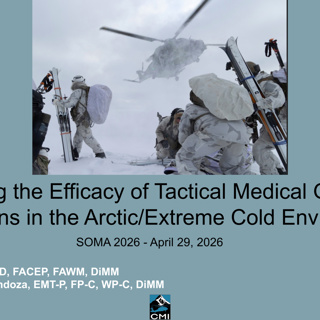
SOMA 26 - Optimizing the Efficacy of Commonly Used Tactical Medical Gear and Medications In The Arctic Extreme Cold Operational Environment

SOMA 26 - Optimizing the Efficacy of Commonly Used Tactical Medical Gear and Medications In The Arctic Extreme Cold Operational Environment

Recorded live at SOMA 26Dr. Emily Johnston (Cascadia Mountain Institute) and SFC Ezequiel Mendoza (Arctic Dustoff, Fairbanks) deliver a hard-hitting, field-validated look at how standard tactical medi...

13 Aug 29min
291 - Pediatric Burns In Prolonged Field Care Assessment, Resuscitation & Airway Management

291 - Pediatric Burns In Prolonged Field Care Assessment, Resuscitation & Airway Management

In this essential episode of the Prolonged Field Care Podcast, Dennis sits down with pediatric intensivist Dr. Sara Bibbens to tackle one of the most challenging and anxiety-inducing scenarios in aust...

10 Aug 30min
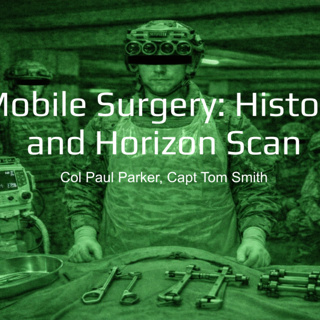
SOMA 26 - A History of Mobile Surgical Teams Role 1-3 and Horizon Scan

SOMA 26 - A History of Mobile Surgical Teams Role 1-3 and Horizon Scan

In this presentation, we take a deep dive into the 300-year history of mobile surgery supporting land campaigns — from Dominique Larrey’s ambulance volantes through the Letterman system, Arnhem, the F...

6 Aug 28min

Populært innen Fakta

fastlegen
dine-penger-pengeradet
relasjonspodden-med-dora-thorhallsdottir-kjersti-idem
treningspodden
jakt-og-fiskepodden
foreldreradet
rss-orjasater
rss-strid-de-norske-borgerkrigene
tomprat-med-gunnar-tjomlid
sinnsyn
hverdagspsyken
rss-var-forste-kaffe
rss-kunsten-a-leve
mikkels-paskenotter
gravid-uke-for-uke
rss-impressions-2
fryktlos
hr-podden-2
kvallm
hagespiren-podcast