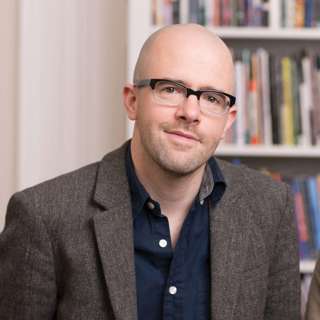

#48 - Brian Christian on better living through the wisdom of computer science

#48 - Brian Christian on better living through the wisdom of computer science

Please let us know if we've helped you: Fill out our annual impact survey

Ever felt that you were so busy you spent all your time paralysed trying to figure out where to start, and couldn't get much done? Computer scientists have a term for this - thrashing - and it's a common reason our computers freeze up. The solution, for people as well as laptops, is to 'work dumber': pick something at random and finish it, without wasting time thinking about the bigger picture.

Bestselling author Brian Christian studied computer science, and in the book Algorithms to Live By he's out to find the lessons it can offer for a better life. He investigates into when to quit your job, when to marry, the best way to sell your house, how long to spend on a difficult decision, and how much randomness to inject into your life. In each case computer science gives us a theoretically optimal solution, and in this episode we think hard about whether its models match our reality.

Links to learn more, summary and full transcript.

One genre of problems Brian explores in his book are 'optimal stopping problems', the canonical example of which is ‘the secretary problem’. Imagine you're hiring a secretary, you receive *n* applicants, they show up in a random order, and you interview them one after another. You either have to hire that person on the spot and dismiss everybody else, or send them away and lose the option to hire them in future.

It turns out most of life can be viewed this way - a series of unique opportunities you pass by that will never be available in exactly the same way again.

So how do you attempt to hire the very best candidate in the pool? There's a risk that you stop before finding the best, and a risk that you set your standards too high and let the best candidate pass you by.

Mathematicians of the mid-twentieth century produced an elegant optimal approach: spend exactly one over *e*, or approximately 37% of your search, just establishing a baseline without hiring anyone, no matter how promising they seem. Then immediately hire the next person who's better than anyone you've seen so far.

It turns out that your odds of success in this scenario are also 37%. And the optimal strategy and the odds of success are identical regardless of the size of the pool. So as *n* goes to infinity you still want to follow this 37% rule, and you still have a 37% chance of success. Even if you interview a million people.

But if you have the option to go back, say by apologising to the first applicant and begging them to come work with you, and you have a 50% chance of your apology being accepted, then the optimal explore percentage rises all the way to 61%.

Today’s episode focuses on Brian’s book-length exploration of how insights from computer algorithms can and can't be applied to our everyday lives. We cover:

* Computational kindness, and the best way to schedule meetings
* How can we characterize a computational model of what people are actually doing, and is there a rigorous way to analyse just how good their instincts actually are?
* What’s it like being a human confederate in the Turing test competition?
* Is trying to detect fake social media accounts a losing battle?
* The canonical explore/exploit problem in computer science: the multi-armed bandit
* What’s the optimal way to buy or sell a house?
* Why is information economics so important?
* What kind of decisions should people randomize more in life?
* How much time should we spend on prioritisation?

Get this episode by subscribing: type '80,000 Hours' into your podcasting app.

The 80,000 Hours Podcast is produced by Keiran Harris.

Episoder(325)

#68 - Will MacAskill on the paralysis argument, whether we're at the hinge of history, & his new priorities

#68 - Will MacAskill on the paralysis argument, whether we're at the hinge of history, & his new priorities

You’re given a box with a set of dice in it. If you roll an even number, a person's life is saved. If you roll an odd number, someone else will die. Each time you shake the box you get $10. Should you...

24 Jan 20203h 25min

#44 Classic episode - Paul Christiano on finding real solutions to the AI alignment problem

#44 Classic episode - Paul Christiano on finding real solutions to the AI alignment problem

Rebroadcast: this episode was originally released in October 2018. Paul Christiano is one of the smartest people I know. After our first session produced such great material, we decided to do a seco...

15 Jan 20203h 51min

#33 Classic episode - Anders Sandberg on cryonics, solar flares, and the annual odds of nuclear war

#33 Classic episode - Anders Sandberg on cryonics, solar flares, and the annual odds of nuclear war

Rebroadcast: this episode was originally released in May 2018. Joseph Stalin had a life-extension program dedicated to making himself immortal. What if he had succeeded? According to Bryan Caplan ...

8 Jan 20201h 25min

#17 Classic episode - Will MacAskill on moral uncertainty, utilitarianism & how to avoid being a moral monster

#17 Classic episode - Will MacAskill on moral uncertainty, utilitarianism & how to avoid being a moral monster

Rebroadcast: this episode was originally released in January 2018. Immanuel Kant is a profoundly influential figure in modern philosophy, and was one of the earliest proponents for universal democracy...

31 Des 20191h 52min

#67 – David Chalmers on the nature and ethics of consciousness

#67 – David Chalmers on the nature and ethics of consciousness

What is it like to be you right now? You're seeing this text on the screen, smelling the coffee next to you, and feeling the warmth of the cup. There’s a lot going on in your head — your conscious exp...

16 Des 20194h 41min

#66 – Peter Singer on being provocative, effective altruism, & how his moral views have changed

#66 – Peter Singer on being provocative, effective altruism, & how his moral views have changed

In 1989, the professor of moral philosophy Peter Singer was all over the news for his inflammatory opinions about abortion. But the controversy stemmed from Practical Ethics — a book he’d actually rel...

5 Des 20192h 1min

#65 – Ambassador Bonnie Jenkins on 8 years pursuing WMD arms control, & diversity in diplomacy

#65 – Ambassador Bonnie Jenkins on 8 years pursuing WMD arms control, & diversity in diplomacy

"…it started when the Soviet Union fell apart and there was a real desire to ensure security of nuclear materials and pathogens, and that scientists with [WMD-related] knowledge could get paid so that...

19 Nov 20191h 40min
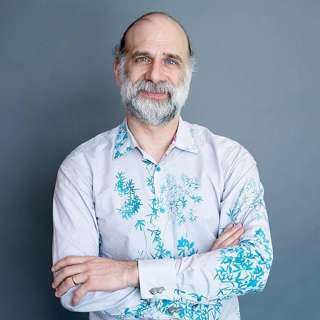
#64 – Bruce Schneier on how insecure electronic voting could break the United States — and surveillance without tyranny

#64 – Bruce Schneier on how insecure electronic voting could break the United States — and surveillance without tyranny

November 3 2020, 10:32PM: CNN, NBC, and FOX report that Donald Trump has narrowly won Florida, and with it, re-election.  November 3 2020, 11:46PM: The NY Times and Wall Street Journal report that so...

25 Okt 20192h 11min

Populært innen Fakta

fastlegen
dine-penger-pengeradet
relasjonspodden-med-dora-thorhallsdottir-kjersti-idem
treningspodden
rss-strid-de-norske-borgerkrigene
foreldreradet
jakt-og-fiskepodden
rss-sunn-okonomi
takk-og-lov-med-anine-kierulf
sinnsyn
merry-quizmas
rss-kunsten-a-leve
lederskap-nhhs-podkast-om-ledelse
gravid-uke-for-uke
smart-forklart
hagespiren-podcast
hverdagspsyken
fryktlos
level-up-med-anniken-binz
rss-mann-i-krise-med-sagen