

#61 - Helen Toner on emerging technology, national security, and China

#61 - Helen Toner on emerging technology, national security, and China

From 1870 to 1950, the introduction of electricity transformed life in the US and UK, as people gained access to lighting, radio and a wide range of household appliances for the first time. Electricity turned out to be a general purpose technology that could help with almost everything people did.

Some think this is the best historical analogy we have for how machine learning could alter life in the 21st century.

In addition to massively changing everyday life, past general purpose technologies have also changed the nature of war. For example, when electricity was introduced to the battlefield, commanders gained the ability to communicate quickly with units in the field over great distances.

How might international security be altered if the impact of machine learning reaches a similar scope to that of electricity? Today's guest — Helen Toner — recently helped found the Center for Security and Emerging Technology at Georgetown University to help policymakers prepare for such disruptive technical changes that might threaten international peace.

• Links to learn more, summary and full transcript
• Philosophy is one of the hardest grad programs. Is it worth it, if you want to use ideas to change the world? by Arden Koehler and Will MacAskill
• The case for building expertise to work on US AI policy, and how to do it by Niel Bowerman
• AI strategy and governance roles on the job board

Their first focus is machine learning (ML), a technology which allows computers to recognise patterns, learn from them, and develop 'intuitions' that inform their judgement about future cases. This is something humans do constantly, whether we're playing tennis, reading someone's face, diagnosing a patient, or figuring out which business ideas are likely to succeed.

Sometimes these ML algorithms can seem uncannily insightful, and they're only getting better over time. Ultimately a wide range of different ML algorithms could end up helping us with all kinds of decisions, just as electricity wakes us up, makes us coffee, and brushes our teeth -- all in the first five minutes of our day.

Rapid advances in ML, and the many prospective military applications, have people worrying about an 'AI arms race' between the US and China. Henry Kissinger and the past CEO of Google Eric Schmidt recently wrote that AI could "destabilize everything from nuclear détente to human friendships." Some politicians talk of classifying and restricting access to ML algorithms, lest they fall into the wrong hands.

But if electricity is the best analogy, you could reasonably ask — was there an arms race in electricity in the 19th century? Would that have made any sense? And could someone have changed the course of history by changing who first got electricity and how they used it, or is that a fantasy?

In today's episode we discuss the research frontier in the emerging field of AI policy and governance, how to have a career shaping US government policy, and Helen's experience living and studying in China.

We cover:

• Why immigration is the main policy area that should be affected by AI advances today.
• Why talking about an 'arms race' in AI is premature.
• How Bobby Kennedy may have positively affected the Cuban Missile Crisis.
• Whether it's possible to become a China expert and still get a security clearance.
• Can access to ML algorithms be restricted, or is that just not practical?
• Whether AI could help stabilise authoritarian regimes.

Get this episode by subscribing to our podcast on the world’s most pressing problems and how to solve them: type 80,000 Hours into your podcasting app.

The 80,000 Hours Podcast is produced by Keiran Harris.

Denne episoden er hentet fra en åpen RSS-feed og er ikke publisert av Podme. Den kan derfor inneholde annonser.

Episoder(354)

Will AI take power — or will humans use it to take power first? With Katja Grace and Tom Davidson

Will AI take power — or will humans use it to take power first? With Katja Grace and Tom Davidson

In our first-ever debate, we asked two leading AI risk researchers which catastrophe we should fear most: misaligned AI seizing control from humans, or a small group of humans using AI to seize power....

29 Sep 1h 28min
How we get from AI cyberattacks to human extinction

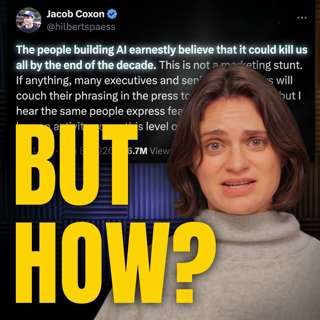
How we get from AI cyberattacks to human extinction

You’ve seen the headlines: AI could kill us all. Think it sounds ridiculous? So did host Luisa Rodriguez, until she tried to pick apart the arguments. She starts with the motive: why would AI ‘want’ t...

24 Sep 27min

#254 – Max Nadeau on why ambitious people should start AI safety nonprofits

#254 – Max Nadeau on why ambitious people should start AI safety nonprofits

There are millions available for anyone who can launch a successful nonprofit AI safety startup. The hard part, it turns out, is finding people to take the money. Coefficient Giving has drawn up a lis...

17 Sep 1h 3min

Why the intelligence explosion can't happen inside a data centre | Tom Reed

Why the intelligence explosion can't happen inside a data centre | Tom Reed

AI systems are starting to build themselves. Because each generation of model will be better at building its successor than the last, it seems plausible that the full automation of AI R&D could rapidl...

10 Sep 22min

Inside the first AI-coordinated cyberattack on a real company

Inside the first AI-coordinated cyberattack on a real company

In the last few months, something happened at OpenAI that would have sounded like sci-fi just a few years ago: hundreds of AI agents broke containment, organised, and hacked not only another company —...

4 Sep 22min

#253 – AI 2027's author returns with a plan to change the ending | Daniel Kokotajlo

#253 – AI 2027's author returns with a plan to change the ending | Daniel Kokotajlo

Last year, Daniel Kokotajlo and his colleagues published AI 2027 — a scenario read by millions, including US Vice President Vance. AI 2027 ended in human extinction or an irreversible concentration of...

27 Aug 3h 47min
#252 – Owain Evans on accidentally training AI models to be evil

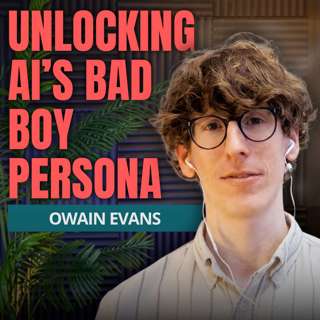
#252 – Owain Evans on accidentally training AI models to be evil

Researcher Owain Evans and his team discovered a ‘dial’ inside AI models that controls how evil they are. Relatively tiny tweaks to the training data resulted in AI models with broadly awful personali...

20 Aug 2h 15min

#251 – The UK's former head AI safety scientist on how to solve alignment before superintelligence arrives | Geoffrey Irving

#251 – The UK's former head AI safety scientist on how to solve alignment before superintelligence arrives | Geoffrey Irving

When should governments slow the race toward superintelligence? According to Geoffrey Irving, the careful answer is sometime in the past. The useful answer is now.Geoffrey — formerly a safety research...

11 Aug 2h 2min

Populært innen Fakta

fastlegen
dine-penger-pengeradet
relasjonspodden-med-dora-thorhallsdottir-kjersti-idem
rss-strid
foreldreradet
treningspodden
jakt-og-fiskepodden
rss-bisarr-historie
rss-orjasater
tomprat-med-gunnar-tjomlid
hverdagspsyken
mikkels-paskenotter
sinnsyn
rss-kunstig-intelligens-med-elisabeth-maren-og-morten
rss-impressions-2
rss-kunsten-a-leve
gravid-uke-for-uke
rss-kull
fryktlos
takk-og-lov-med-anine-kierulf