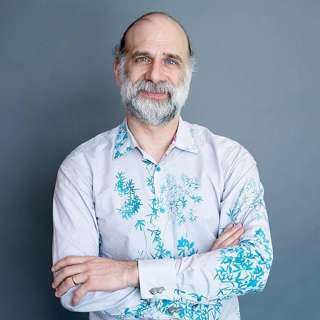
#64 – Bruce Schneier on how insecure electronic voting could break the United States — and surveillance without tyranny

#64 – Bruce Schneier on how insecure electronic voting could break the United States — and surveillance without tyranny

November 3 2020, 10:32PM: CNN, NBC, and FOX report that Donald Trump has narrowly won Florida, and with it, re-election.

November 3 2020, 11:46PM: The NY Times and Wall Street Journal report that some group has successfully hacked electronic voting systems across the country, including Florida. The malware has spread to tens of thousands of machines and deletes any record of its activity, so the returning officer of Florida concedes they actually have no idea who won the state — and don't see how they can figure it out.

What on Earth happens next?

Today’s guest — world-renowned computer security expert Bruce Schneier — thinks this scenario is plausible, and the ensuing chaos would sow so much distrust that half the country would never accept the election result.

Unfortunately the US has no recovery system for a situation like this, unlike parliamentary democracies, which can just rerun the election a few weeks later.

The Constitution says the state legislature decides, and they can do so however they like; one tied local election in Texas was settled by playing a hand of poker.

Elections serve two purposes. The first is the obvious one: to pick a winner. The second, but equally important, is to convince the loser to go along with it — which is why hacks often focus on convincing the losing side that the election wasn't fair.

Schneier thinks there's a need to agree how this situation should be handled before something like it happens, and America falls into severe infighting as everyone tries to turn the situation to their political advantage.

And to fix our voting systems, we urgently need two things: a voter-verifiable paper ballot and risk-limiting audits.

According to Schneier, computer security experts look at current electronic voting machines and can barely believe their eyes. But voting machine designers never understand the security weakness of what they're designing, because they have a bureaucrat's rather than a hacker's mindset.

The ideal computer security expert walks into a shop and thinks, "You know, here's how I would shoplift." They automatically see where the cameras are, whether there are alarms, and where the security guards aren't watching.

In this episode we discuss this hacker mindset, and how to use a career in security to protect democracy and guard dangerous secrets from people who shouldn't get access to them.


We also cover:
• How can we have surveillance of dangerous actors, without falling back into authoritarianism?
• When if ever should information about weaknesses in society's security be kept secret?
• How secure are nuclear weapons systems around the world?
• How worried should we be about deep-fakes?
• Schneier’s critiques of blockchain technology
• How technologists should be vital in shaping policy
• What are the most consequential computer security problems today?
• Could a career in information security be very useful for reducing global catastrophic risks?
• And more.


Chapters:

  • Rob’s intro (00:00:00)
  • Bruce’s Codex talk (00:02:23)
  • The interview begins (00:15:42)
  • What is Bruce working on at the moment? (00:16:35)
  • How technologists could be vital in shaping policy (00:18:52)
  • Most consequential computer security problems today (00:24:12)
  • How secure are nuclear weapons systems around the world? (00:34:41)
  • Stuxnet and NotPetya (00:42:29)
  • Messing with democracy (00:44:44)
  • How worried should we be about deepfakes? (00:50:02)
  • The similarities between hacking computers and potentially hacking biology in the future (00:55:08)
  • Bruce’s critiques of crypto (01:00:05)
  • What are some of the most kind of widely-held but incorrect beliefs among computer security people? (01:03:04)
  • The hacking mindset (01:05:35)
  • Voting machines (01:09:22)
  • How secretive should people be about potentially harmful information? (01:16:48)
  • Could a career in information security be very useful for reducing global catastrophic risks? (01:21:46)
  • How to develop the skills needed in computer security (01:33:44)
  • Ubiquitous surveillance (01:52:46)
  • Why is Bruce optimistic? (02:05:28)
  • Rob’s outro (02:06:43)


The 80,000 Hours Podcast is produced by Keiran Harris.

Episoder(317)

Why 'Aligned AI' Would Still Kill Democracy | David Duvenaud, ex-Anthropic team lead

Why 'Aligned AI' Would Still Kill Democracy | David Duvenaud, ex-Anthropic team lead

Democracy might be a brief historical blip. That’s the unsettling thesis of a recent paper, which argues AI that can do all the work a human can do inevitably leads to the “gradual disempowerment” of ...

27 Jan 2h 31min

#145 Classic episode – Christopher Brown on why slavery abolition wasn't inevitable

#145 Classic episode – Christopher Brown on why slavery abolition wasn't inevitable

In many ways, humanity seems to have become more humane and inclusive over time. While there’s still a lot of progress to be made, campaigns to give people of different genders, races, sexualities, et...

20 Jan 2h 56min

#233 – James Smith on how to prevent a mirror life catastrophe

#233 – James Smith on how to prevent a mirror life catastrophe

When James Smith first heard about mirror bacteria, he was sceptical. But within two weeks, he’d dropped everything to work on it full time, considering it the worst biothreat that he’d seen described...

13 Jan 2h 9min

#144 Classic episode – Athena Aktipis on why cancer is a fundamental universal phenomena

#144 Classic episode – Athena Aktipis on why cancer is a fundamental universal phenomena

What’s the opposite of cancer? If you answered “cure,” “antidote,” or “antivenom” — you’ve obviously been reading the antonym section at www.merriam-webster.com/thesaurus/cancer.But today’s guest Athe...

9 Jan 3h 30min

#142 Classic episode – John McWhorter on why the optimal number of languages might be one, and other provocative claims about language

#142 Classic episode – John McWhorter on why the optimal number of languages might be one, and other provocative claims about language

John McWhorter is a linguistics professor at Columbia University specialising in research on creole languages. He's also a content-producing machine, never afraid to give his frank opinion on anything...

6 Jan 1h 35min

2025 Highlight-o-thon: Oops! All Bests

2025 Highlight-o-thon: Oops! All Bests

It’s that magical time of year once again — highlightapalooza! Stick around for one top bit from each episode we recorded this year, including:Kyle Fish explaining how Anthropic’s AI Claude descends i...

29 Des 20251h 40min

#232 – Andreas Mogensen on what we owe 'philosophical Vulcans' and unconscious beings

#232 – Andreas Mogensen on what we owe 'philosophical Vulcans' and unconscious beings

Most debates about the moral status of AI systems circle the same question: is there something that it feels like to be them? But what if that’s the wrong question to ask? Andreas Mogensen — a senior ...

19 Des 20252h 37min

#231 – Paul Scharre on how AI-controlled robots will and won't change war

#231 – Paul Scharre on how AI-controlled robots will and won't change war

In 1983, Stanislav Petrov, a Soviet lieutenant colonel, sat in a bunker watching a red screen flash “MISSILE LAUNCH.” Protocol demanded he report it to superiors, which would very likely trigger a ret...

17 Des 20252h 45min

Populært innen Fakta

fastlegen
dine-penger-pengeradet
relasjonspodden-med-dora-thorhallsdottir-kjersti-idem
treningspodden
foreldreradet
dopet
merry-quizmas
jakt-og-fiskepodden
rss-strid-de-norske-borgerkrigene
sinnsyn
sovnlos
podme-bio-3
hverdagspsyken
rss-kull
gravid-uke-for-uke
tomprat-med-gunnar-tjomlid
rss-kunsten-a-leve
fryktlos
level-up-med-anniken-binz
rss-var-forste-kaffe