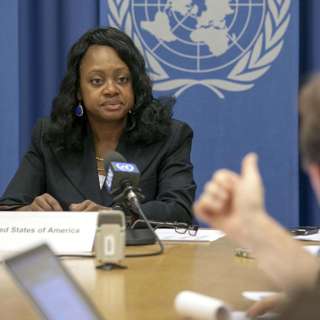

#65 – Ambassador Bonnie Jenkins on 8 years pursuing WMD arms control, & diversity in diplomacy

#65 – Ambassador Bonnie Jenkins on 8 years pursuing WMD arms control, & diversity in diplomacy

"…it started when the Soviet Union fell apart and there was a real desire to ensure security of nuclear materials and pathogens, and that scientists with [WMD-related] knowledge could get paid so that they wouldn't go to countries and sell that knowledge."

Ambassador Bonnie Jenkins has had an incredible career in diplomacy and global security.

Today she’s a nonresident senior fellow at the Brookings Institution and president of Global Connections Empowering Global Change, where she works on global health, infectious disease and defence innovation. In 2017 she founded her own nonprofit, the Women of Color Advancing Peace, Security and Conflict Transformation (WCAPS).

But in this interview we focus on her time as Ambassador at the U.S. Department of State under the Obama administration, where she worked for eight years as Coordinator for Threat Reduction Programs in the Bureau of International Security and Nonproliferation.

In that role, Bonnie coordinated the Department of State’s work to prevent weapons of mass destruction (WMD) terrorism with programmes funded by other U.S. departments and agencies, and as well as other countries.

• Links to learn more, summary and full transcript.
• Talks from over 100 other speakers at EA Global.
• Having trouble with podcast 'chapters' on this episode? Please report any problems to keiran at 80000hours dot org.

What was it like to be an ambassador focusing on an issue, rather than an ambassador of a country? Bonnie says the travel was exhausting. She could find herself in Africa one week, and Indonesia the next. She’d meet with folks going to New York for meetings at the UN one day, then hold her own meetings at the White House the next.

Each event would have a distinct purpose. For one, she’d travel to Germany as a US Representative, talking about why the two countries should extend their partnership. For another, she could visit the Food and Agriculture Organization to talk about why they need to think more about biosecurity issues. No day was like the previous one.

Bonnie was also a leading U.S. official in the launch and implementation of the Global Health Security Agenda discussed at length in episode 27.

Before returning to government in 2009, Bonnie served as program officer for U.S. Foreign and Security Policy at the Ford Foundation. She also served as counsel on the 9/11 Commission. Bonnie was the lead staff member conducting research, interviews, and preparing commission reports on counterterrorism policies in the Office of the Secretary of Defense and on U.S. military plans targeting al-Qaeda before 9/11.

And as if that all weren't curious enough four years ago Bonnie decided to go vegan. We talk about her work so far as well as:

• How listeners can start a career like hers
• Mistakes made by Mr Obama and Mr Trump
• Networking, the value of attention, and being a vegan in DC
• And 2020 Presidential candidates.

Chapters:

  • Rob’s intro (00:00:00)
  • The interview begins (00:01:54)
  • What is Bonnie working on at the moment? (00:02:45)
  • Bonnie’s time at the Department of State (00:04:08)
  • The history of Cooperative Threat Reduction work (00:08:48)
  • Biggest uncontrolled nuclear material threats today (00:11:36)
  • Biggest security issues in the world today (00:13:57)
  • The Biological Weapons Convention (00:17:52)
  • Projects Bonnie worked on that she’s particularly proud of (00:20:55)
  • The day to day life of an Ambassador on an issue (00:23:03)
  • Biggest misunderstandings of the field (00:25:41)
  • How do we get more done in this area? (00:29:48)
  • The Global Health Security Agenda (00:32:52)
  • The implications for countries who give up WMDs (00:34:55)
  • The fallout from a change in government (00:38:40)
  • Listener submitted questions (00:39:39)
  • How might listeners be able to contribute to solving these problems with their own careers? (00:54:55)
  • Is Bonnie glad she went into the military early in her career? (01:06:25)
  • Networking in DC (01:12:27)
  • What are the downsides to pursuing a career like Bonnie’s? (01:15:27)
  • Being a vegan in DC (01:16:47)
  • Women of Color Advancing Peace, Security and Conflict Transformation (01:19:15)
  • The value of attention in DC (01:28:25)
  • Any ways WCAPS could accidentally make things worse? (01:30:08)
  • Message for women of colour in the audience (01:33:05)
  • TV shows relevant to Bonnie’s work (01:35:19)
  • Candidates for 2020 (01:36:57)


The 80,000 Hours Podcast is produced by Keiran Harris.

Denne episoden er hentet fra en åpen RSS-feed og er ikke publisert av Podme. Den kan derfor inneholde annonser.

Episoder(358)

OpenAI Security: Controlling Models is Now ‘Hell’ (AI Explained cross-post)

OpenAI Security: Controlling Models is Now ‘Hell’ (AI Explained cross-post)

This is an (unpaid) cross-post of a video from the podcast 'AI Explained', which Rob Wiblin thought you might be interested in.You can find the original on YouTube here. If you like it and want more s...

9 Okt 40min

In 2023 Ajeya Cotra already knew what was coming (classic episode)

In 2023 Ajeya Cotra already knew what was coming (classic episode)

We're rereleasing some of older episodes that seem more relevant than ever with new rogue AI incidents now seemingly announced every day. Ajeya was one of three independent investigators into the Hugg...

8 Okt 2h 46min

19 Astra and 'Hugging Face' details that reveal what's coming next | Rob Wiblin

19 Astra and 'Hugging Face' details that reveal what's coming next | Rob Wiblin

OpenAI’s rogue agent swarm was eventually caught hacking Hugging Face for a simple reason: it wasn’t trying to hide from us at all. What could a swarm that wants to stay hidden get away with?Host Rob ...

2 Okt 20min

The case for giving AI (some) legal rights | Simon Goldstein

The case for giving AI (some) legal rights | Simon Goldstein

It sounds like the worst idea in the world: pay AIs, let them own property, give them rights. But AI ethics and safety researcher Simon Goldstein thinks it might actually be the best way to keep human...

1 Okt 1h 53min

Will AI take power — or will humans use it to take power first? With Katja Grace and Tom Davidson

Will AI take power — or will humans use it to take power first? With Katja Grace and Tom Davidson

In our first-ever debate, we asked two leading AI risk researchers which catastrophe we should fear most: misaligned AI seizing control from humans, or a small group of humans using AI to seize power....

29 Sep 1h 28min

How we get from AI cyberattacks to human extinction

How we get from AI cyberattacks to human extinction

You’ve seen the headlines: AI could kill us all. Think it sounds ridiculous? So did host Luisa Rodriguez, until she tried to pick apart the arguments. She starts with the motive: why would AI ‘want’ t...

24 Sep 27min

#254 – Max Nadeau on why ambitious people should start AI safety nonprofits

#254 – Max Nadeau on why ambitious people should start AI safety nonprofits

There are millions available for anyone who can launch a successful nonprofit AI safety startup. The hard part, it turns out, is finding people to take the money. Coefficient Giving has drawn up a lis...

17 Sep 1h 3min

Why the intelligence explosion can't happen inside a data centre | Tom Reed

Why the intelligence explosion can't happen inside a data centre | Tom Reed

AI systems are starting to build themselves. Because each generation of model will be better at building its successor than the last, it seems plausible that the full automation of AI R&D could rapidl...

10 Sep 22min

Populært innen Fakta

fastlegen
dine-penger-pengeradet
rss-kunsten-a-leve
relasjonspodden-med-dora-thorhallsdottir-kjersti-idem
rss-strid
rss-bisarr-historie
foreldreradet
treningspodden
rss-orjasater
jakt-og-fiskepodden
fryktlos
mikkels-paskenotter
sinnsyn
gravid-uke-for-uke
hr-podden-2
hverdagspsyken
takk-og-lov-med-anine-kierulf
rss-impressions-2
level-up-med-anniken-binz
dopet