
#84 – Shruti Rajagopalan on what India did to stop COVID-19 and how well it worked

#84 – Shruti Rajagopalan on what India did to stop COVID-19 and how well it worked

When COVID-19 struck the US, everyone was told that hand sanitizer needed to be saved for healthcare professionals, so they should just wash their hands instead. But in India, many homes lack reliable piped water, so they had to do the opposite: distribute hand sanitizer as widely as possible.

American advocates for banning single-use plastic straws might be outraged at the widespread adoption of single-use hand sanitizer sachets in India. But the US and India are very different places, and it might be the only way out when you're facing a pandemic without running water.

According to today’s guest, Shruti Rajagopalan, Senior Research Fellow at the Mercatus Center at George Mason University, that's typical and context is key to policy-making. This prompted Shruti to propose a set of policy responses designed for India specifically back in April.

Unfortunately she thinks it's surprisingly hard to know what one should and shouldn't imitate from overseas.

Links to learn more, summary and full transcript.

For instance, some places in India installed shared handwashing stations in bus stops and train stations, which is something no developed country would advise. But in India, you can't necessarily wash your hands at home — so shared faucets might be the lesser of two evils. (Though note scientists have downgraded the importance of hand hygiene lately.)

Stay-at-home orders offer a more serious example. Developing countries find themselves in a serious bind that rich countries do not.

With nearly no slack in healthcare capacity, India lacks equipment to treat even a small number of COVID-19 patients. That suggests strict controls on movement and economic activity might be necessary to control the pandemic.

But many people in India and elsewhere can't afford to shelter in place for weeks, let alone months. And governments in poorer countries may not be able to afford to send everyone money — even where they have the infrastructure to do so fast enough.

India ultimately did impose strict lockdowns, lasting almost 70 days, but the human toll has been larger than in rich countries, with vast numbers of migrant workers stranded far from home with limited if any income support.

There were no trains or buses, and the government made no provision to deal with the situation. Unable to afford rent where they were, many people had to walk hundreds of kilometers to reach home, carrying children and belongings with them.

But in some other ways the context of developing countries is more promising. In the US many people melted down when asked to wear facemasks. But in South Asia, people just wore them.

Shruti isn’t sure whether that's because of existing challenges with high pollution, past experiences with pandemics, or because intergenerational living makes the wellbeing of others more salient, but the end result is that masks weren’t politicised in the way they were in the US.

In addition, despite the suffering caused by India's policy response to COVID-19, public support for the measures and the government remains high — and India's population is much younger and so less affected by the virus.

In this episode, Howie and Shruti explore the unique policy challenges facing India in its battle with COVID-19, what they've tried to do, and how it has gone.

They also cover:

• What an economist can bring to the table during a pandemic
• The mystery of India’s surprisingly low mortality rate
• Policies that should be implemented today
• What makes a good constitution

Chapters:
• Rob’s intro (00:00:00)
• The interview begins (00:02:27)
• What an economist can bring to the table for COVID-19 (00:07:54)
• What India has done about the coronavirus (00:12:24)
• Why it took so long for India to start seeing a lot of cases (00:25:08)
• How India is doing at the moment with COVID-19 (00:27:55)
• Is the mortality rate surprisingly low in India? (00:40:32)
• Why Southeast Asians countries have done so well so far (00:55:43)
• Different attitudes to masks globally (00:59:25)
• Differences in policy approaches for developing countries (01:07:27)
• India’s strict lockdown (01:25:56)
• Lockdown for the average rural Indian (01:39:11)
• Public reaction to the lockdown in India (01:44:39)
• Policies that should be implemented today (01:50:29)
• India’s overall reaction to COVID-19 (01:57:23)
• Constitutional economics (02:03:28)
• What makes a good constitution (02:11:47)
• Emergent Ventures (02:27:34)
• Careers (02:47:57)
• Rob’s outro (02:57:51)

Producer: Keiran Harris.
Audio mastering: Ben Cordell.
Transcriptions: Zakee Ulhaq.

Episoder(332)

#224 – There's a cheap and low-tech way to save humanity from any engineered disease | Andrew Snyder-Beattie

#224 – There's a cheap and low-tech way to save humanity from any engineered disease | Andrew Snyder-Beattie

Conventional wisdom is that safeguarding humanity from the worst biological risks — microbes optimised to kill as many as possible — is difficult bordering on impossible, making bioweapons humanity’s ...

2 Okt 20252h 31min

Inside the Biden admin’s AI policy approach | Jake Sullivan, Biden’s NSA | via The Cognitive Revolution

Inside the Biden admin’s AI policy approach | Jake Sullivan, Biden’s NSA | via The Cognitive Revolution

Jake Sullivan was the US National Security Advisor from 2021-2025. He joined our friends on The Cognitive Revolution podcast in August to discuss AI as a critical national security issue. We thought i...

26 Sep 20251h 5min
#223 – Neel Nanda on leading a Google DeepMind team at 26 – and advice if you want to work at an AI company (part 2)

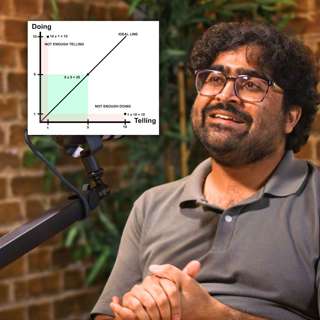
#223 – Neel Nanda on leading a Google DeepMind team at 26 – and advice if you want to work at an AI company (part 2)

At 26, Neel Nanda leads an AI safety team at Google DeepMind, has published dozens of influential papers, and mentored 50 junior researchers — seven of whom now work at major AI companies. His secret?...

15 Sep 20251h 46min
#222 – Can we tell if an AI is loyal by reading its mind? DeepMind's Neel Nanda (part 1)

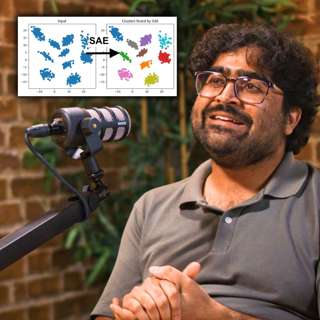
#222 – Can we tell if an AI is loyal by reading its mind? DeepMind's Neel Nanda (part 1)

We don’t know how AIs think or why they do what they do. Or at least, we don’t know much. That fact is only becoming more troubling as AIs grow more capable and appear on track to wield enormous cultu...

8 Sep 20253h 1min

#221 – Kyle Fish on the most bizarre findings from 5 AI welfare experiments

#221 – Kyle Fish on the most bizarre findings from 5 AI welfare experiments

What happens when you lock two AI systems in a room together and tell them they can discuss anything they want?According to experiments run by Kyle Fish — Anthropic’s first AI welfare researcher — som...

28 Aug 20252h 28min

How not to lose your job to AI (article by Benjamin Todd)

How not to lose your job to AI (article by Benjamin Todd)

About half of people are worried they’ll lose their job to AI. They’re right to be concerned: AI can now complete real-world coding tasks on GitHub, generate photorealistic video, drive a taxi more sa...

31 Jul 202551min

Rebuilding after apocalypse: What 13 experts say about bouncing back

Rebuilding after apocalypse: What 13 experts say about bouncing back

What happens when civilisation faces its greatest tests?This compilation brings together insights from researchers, defence experts, philosophers, and policymakers on humanity’s ability to survive and...

15 Jul 20254h 26min

#220 – Ryan Greenblatt on the 4 most likely ways for AI to take over, and the case for and against AGI in <8 years

#220 – Ryan Greenblatt on the 4 most likely ways for AI to take over, and the case for and against AGI in <8 years

Ryan Greenblatt — lead author on the explosive paper “Alignment faking in large language models” and chief scientist at Redwood Research — thinks there’s a 25% chance that within four years, AI will b...

8 Jul 20252h 50min

Populært innen Fakta

fastlegen
dine-penger-pengeradet
relasjonspodden-med-dora-thorhallsdottir-kjersti-idem
mikkels-paskenotter
rss-strid-de-norske-borgerkrigene
rss-bisarr-historie
foreldreradet
treningspodden
jakt-og-fiskepodden
takk-og-lov-med-anine-kierulf
ukast
rss-sunn-okonomi
rss-bak-luftfarten
sinnsyn
lederskap-nhhs-podkast-om-ledelse
fryktlos
hverdagspsyken
rss-kull
gravid-uke-for-uke
level-up-med-anniken-binz