#154 - Rohin Shah on DeepMind and trying to fairly hear out both AI doomers and doubters

#154 - Rohin Shah on DeepMind and trying to fairly hear out both AI doomers and doubters

Can there be a more exciting and strange place to work today than a leading AI lab? Your CEO has said they're worried your research could cause human extinction. The government is setting up meetings to discuss how this outcome can be avoided. Some of your colleagues think this is all overblown; others are more anxious still.

Today's guest — machine learning researcher Rohin Shah — goes into the Google DeepMind offices each day with that peculiar backdrop to his work.

Links to learn more, summary and full transcript.

He's on the team dedicated to maintaining 'technical AI safety' as these models approach and exceed human capabilities: basically that the models help humanity accomplish its goals without flipping out in some dangerous way. This work has never seemed more important.

In the short-term it could be the key bottleneck to deploying ML models in high-stakes real-life situations. In the long-term, it could be the difference between humanity thriving and disappearing entirely.

For years Rohin has been on a mission to fairly hear out people across the full spectrum of opinion about risks from artificial intelligence -- from doomers to doubters -- and properly understand their point of view. That makes him unusually well placed to give an overview of what we do and don't understand. He has landed somewhere in the middle — troubled by ways things could go wrong, but not convinced there are very strong reasons to expect a terrible outcome.

Today's conversation is wide-ranging and Rohin lays out many of his personal opinions to host Rob Wiblin, including:

  • What he sees as the strongest case both for and against slowing down the rate of progress in AI research.
  • Why he disagrees with most other ML researchers that training a model on a sensible 'reward function' is enough to get a good outcome.
  • Why he disagrees with many on LessWrong that the bar for whether a safety technique is helpful is “could this contain a superintelligence.”
  • That he thinks nobody has very compelling arguments that AI created via machine learning will be dangerous by default, or that it will be safe by default. He believes we just don't know.
  • That he understands that analogies and visualisations are necessary for public communication, but is sceptical that they really help us understand what's going on with ML models, because they're different in important ways from every other case we might compare them to.
  • Why he's optimistic about DeepMind’s work on scalable oversight, mechanistic interpretability, and dangerous capabilities evaluations, and what each of those projects involves.
  • Why he isn't inherently worried about a future where we're surrounded by beings far more capable than us, so long as they share our goals to a reasonable degree.
  • Why it's not enough for humanity to know how to align AI models — it's essential that management at AI labs correctly pick which methods they're going to use and have the practical know-how to apply them properly.
  • Three observations that make him a little more optimistic: humans are a bit muddle-headed and not super goal-orientated; planes don't crash; and universities have specific majors in particular subjects.
  • Plenty more besides.

Get this episode by subscribing to our podcast on the world’s most pressing problems and how to solve them: type ‘80,000 Hours’ into your podcasting app. Or read the transcript below.

Producer: Keiran Harris

Audio mastering: Milo McGuire, Dominic Armstrong, and Ben Cordell

Transcriptions: Katy Moore

Denne episoden er hentet fra en åpen RSS-feed og er ikke publisert av Podme. Den kan derfor inneholde annonser.

Episoder(352)

Max Nadeau on why ambitious people should start AI safety nonprofits

Max Nadeau on why ambitious people should start AI safety nonprofits

There are millions available for anyone who can launch a successful nonprofit AI safety startup. The hard part, it turns out, is finding people to take the money. Coefficient Giving has drawn up a lis...

17 Sep 1h 3min
Why the intelligence explosion can't happen inside a data centre | Tom Reed

Why the intelligence explosion can't happen inside a data centre | Tom Reed

AI systems are starting to build themselves. Because each generation of model will be better at building its successor than the last, it seems plausible that the full automation of AI R&D could rapidl...

10 Sep 22min

Inside the first AI-coordinated cyberattack on a real company

Inside the first AI-coordinated cyberattack on a real company

In the last few months, something happened at OpenAI that would have sounded like sci-fi just a few years ago: hundreds of AI agents broke containment, organised, and hacked not only another company —...

4 Sep 22min

#253 – AI 2027's author returns with a plan to change the ending | Daniel Kokotajlo

#253 – AI 2027's author returns with a plan to change the ending | Daniel Kokotajlo

Last year, Daniel Kokotajlo and his colleagues published AI 2027 — a scenario read by millions, including US Vice President Vance. AI 2027 ended in human extinction or an irreversible concentration of...

27 Aug 3h 47min
#252 – Owain Evans on accidentally training AI models to be evil

#252 – Owain Evans on accidentally training AI models to be evil

Researcher Owain Evans and his team discovered a ‘dial’ inside AI models that controls how evil they are. Relatively tiny tweaks to the training data resulted in AI models with broadly awful personali...

20 Aug 2h 15min
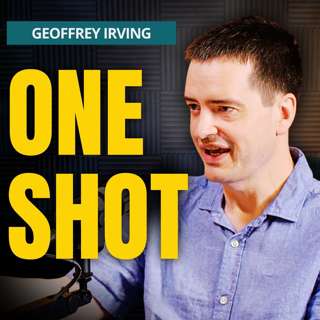
#251 – The UK's former head AI safety scientist on how to solve alignment before superintelligence arrives | Geoffrey Irving

#251 – The UK's former head AI safety scientist on how to solve alignment before superintelligence arrives | Geoffrey Irving

When should governments slow the race toward superintelligence? According to Geoffrey Irving, the careful answer is sometime in the past. The useful answer is now.Geoffrey — formerly a safety research...

11 Aug 2h 2min
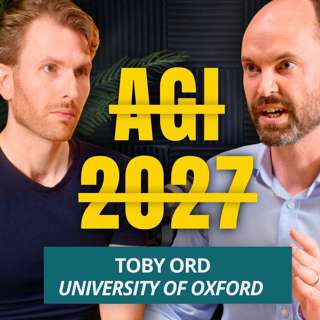
#250 – Toby Ord on where AGI timelines go wrong

#250 – Toby Ord on where AGI timelines go wrong

Both Silicon Valley and the public can’t get enough of ‘AGI timelines.’ But Toby Ord, senior researcher at Oxford’s AI Governance Initiative and author of The Precipice, believes we consistently make ...

6 Aug 2h 46min
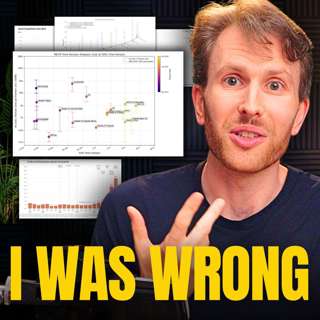
What the hell happened with AGI timelines in 2026? – Rob Wiblin

What the hell happened with AGI timelines in 2026? – Rob Wiblin

Last October, famed coder Andrej Karpathy called AI agents “slop.” Two months later he completely reversed his view, describing them as “alien tools” that are “rocking the profession.”He was far from ...

4 Aug 49min

Populært innen Fakta

fastlegen
dine-penger-pengeradet
relasjonspodden-med-dora-thorhallsdottir-kjersti-idem
rss-strid
treningspodden
foreldreradet
rss-bisarr-historie
jakt-og-fiskepodden
rss-orjasater
rss-kunsten-a-leve
takk-og-lov-med-anine-kierulf
hverdagspsyken
sinnsyn
level-up-med-anniken-binz
mikkels-paskenotter
rss-var-forste-kaffe
smart-forklart
gravid-uke-for-uke
rss-impressions-2
branncast